Lacle Miangela M, Moelans Cathy B, Kornegoor Robert, van der Pol Carmen, Witkamp Arjen J, van der Wall Elsken, Rueschoff Josef, Buerger Horst, van Diest Paul J
Department of Pathology, University Medical Center Utrecht, PO Box 85500, 3508 GA, Utrecht, The Netherlands.
Cell Oncol (Dordr). 2015 Jun;38(3):237-45. doi: 10.1007/s13402-015-0227-7. Epub 2015 Apr 24.
Overall, HER2-amplified female breast cancer (FBC) is associated with a high grade, an aggressive phenotype and a poor prognosis. In male breast cancer (MBC) amplification of HER2, located on chromosome 17, occurs at a lower frequency than in FBC, where it is part of complex rearrangements. So far, only few studies have addressed the occurrence of chromosome 17 alterations in small MBC cohorts.
Multiplex ligation-dependent probe amplification (MLPA) and fluorescence in situ hybridization (FISH) were used to detect and characterize copy number changes on chromosome 17 in a cohort of 139 MBC. The results obtained were compared to those in FBC, and were correlated with clinicopathological features and patient outcome data.
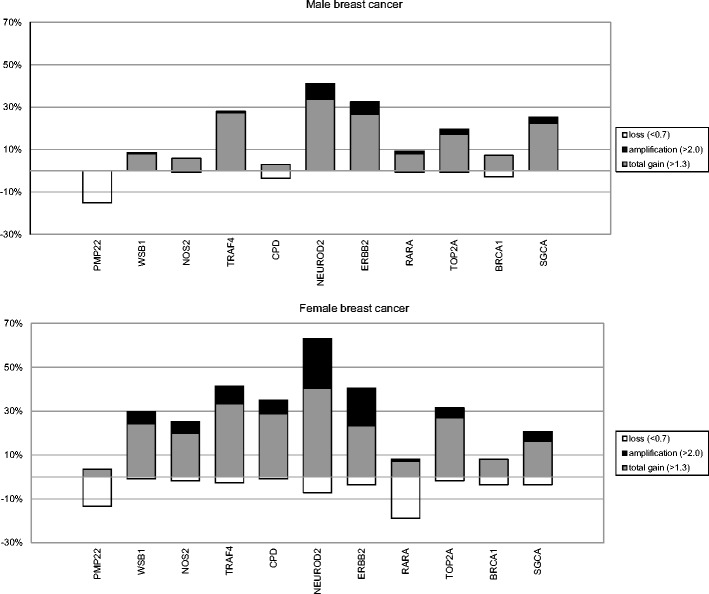
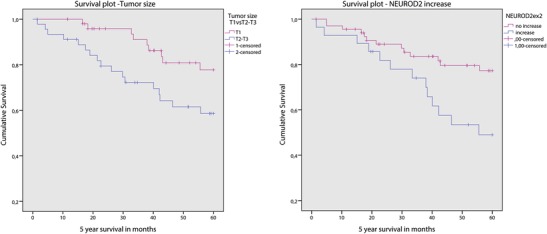
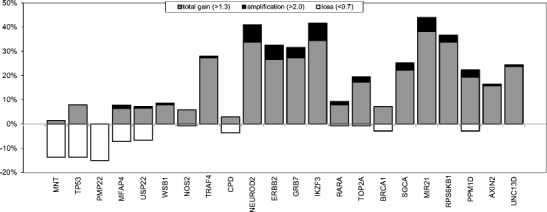
We observed a lower frequency of chromosome 17 copy number changes with less complex rearrangement patterns in MBC compared to FBC. Chromosome 17 changes in MBC included gains of 17q and losses of 17p. Whole chromosome 17 polyploidies were not encountered. Two recurrent chromosome 17 amplicons were detected: on 17q12 (encompassing the NEUROD2, HER2, GRB7 and IKZF3 gens) and on 17q23.1 (encompassing the MIR21 and RPS6KB1 genes). Whole arm copy number gains of 17q were associated with decreased 5 year survival rates (p = 0.010). Amplification of HER2 was associated with a high tumor grade, but did not predict patient survival. Although copy number gains of HER2 and NEUROD2 were associated with a high tumor grade, a high mitotic count and a decreased 5 year survival rate (p = 0.015), only tumor size and NEUROD2 copy number gains emerged as independent prognostic factors.
In MBC chromosome 17 shows less complex rearrangements and fewer copy number changes compared to FBC. Frequent gains of 17q, encompassing two distinct amplicons, and losses of 17p were observed, but no whole chromosome 17 polyploidies. Only NEUROD2 gains seem to have an independent prognostic impact. These results suggest different roles of chromosome 17 aberrations in male versus female breast carcinogenesis.
总体而言,HER2扩增的女性乳腺癌(FBC)具有高级别、侵袭性表型和不良预后。位于17号染色体上的HER2在男性乳腺癌(MBC)中的扩增频率低于FBC,在FBC中它是复杂重排的一部分。到目前为止,只有少数研究探讨了小样本MBC队列中17号染色体改变的发生情况。
采用多重连接依赖探针扩增(MLPA)和荧光原位杂交(FISH)检测并表征139例MBC队列中17号染色体的拷贝数变化。将所得结果与FBC中的结果进行比较,并与临床病理特征和患者预后数据相关联。
我们观察到,与FBC相比,MBC中17号染色体拷贝数变化的频率较低,重排模式较不复杂。MBC中17号染色体的变化包括17q增益和17p缺失。未发现17号染色体全染色体多倍体。检测到两个反复出现的17号染色体扩增子:位于17q12(包含NEUROD2、HER2、GRB7和IKZF3基因)和17q23.1(包含MIR21和RPS6KB1基因)。17q的全臂拷贝数增加与5年生存率降低相关(p = 0.010)。HER2扩增与高肿瘤分级相关,但不能预测患者生存。虽然HER2和NEUROD2的拷贝数增加与高肿瘤分级、高有丝分裂计数和5年生存率降低相关(p = 0.015),但只有肿瘤大小和NEUROD2拷贝数增加是独立的预后因素。
与FBC相比,MBC中17号染色体显示出较不复杂的重排和较少的拷贝数变化。观察到17q频繁增益,包括两个不同的扩增子,以及17p缺失,但没有17号染色体全染色体多倍体。只有NEUROD2增益似乎具有独立的预后影响。这些结果表明17号染色体畸变在男性与女性乳腺癌发生中具有不同作用。