Paddick Stella-Maria, Gray William K, Ogunjimi Luqman, Lwezuala Bingileki, Olakehinde Olaide, Kisoli Aloyce, Kissima John, Mbowe Godfrey, Mkenda Sarah, Dotchin Catherine L, Walker Richard W, Mushi Declare, Collingwood Cecilia, Ogunniyi Adesola
Northumbria Healthcare NHS Foundation Trust, North Tyneside General Hospital, North Shields, UK.
Institute of Neuroscience, Newcastle University, Newcastle upon Tyne, UK.
BMC Geriatr. 2015 Apr 25;15:53. doi: 10.1186/s12877-015-0040-1.
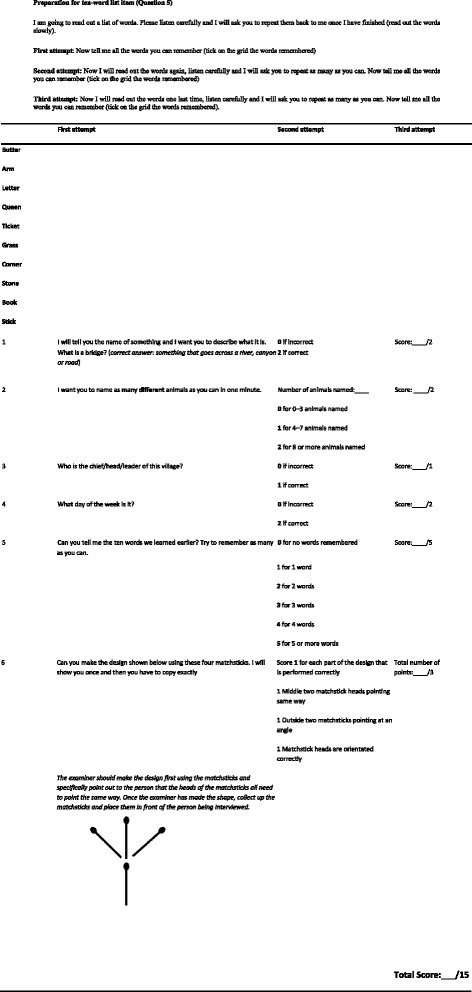
We have previously described the development of the Identification and Intervention for Dementia in Elderly Africans (IDEA) cognitive screen for use in populations with low levels of formal education. The IDEA cognitive screen was developed and field-tested in an elderly, community-based population in rural Tanzania with a relatively high prevalence of cognitive impairment. The aim of this study was to validate the IDEA cognitive screen as an assessment of major cognitive impairment in hospital settings in Nigeria and Tanzania.
In Nigeria, 121 consecutive elderly medical clinic outpatients reviewed at the University College Hospital, Ibadan were screened using the IDEA cognitive screen. In Tanzania, 97 consecutive inpatients admitted to Mawenzi Regional Hospital (MRH), Moshi, and 108 consecutive medical clinic outpatients attending the geriatric medicine clinic at MRH were screened. Inter-rater reliability was assessed in Tanzanian outpatients attending St Joseph's Hospital in Moshi using three raters. A diagnosis of dementia or delirium (DSM-IV criteria) was classified as major cognitive impairment and was provided independently by a physician blinded to the results of the screening assessment.
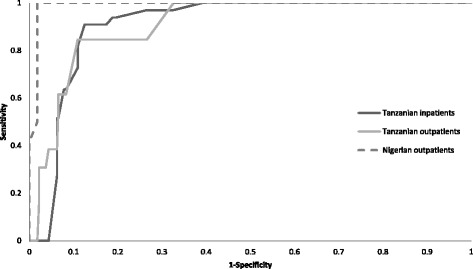
The area under the receiver operating characteristic (AUROC) curve in Nigerian outpatients, Tanzanian outpatients and Tanzanian inpatients was 0.990, 0.919 and 0.917 respectively. Inter-rater reliability was good (intra-class correlation coefficient 0.742 to 0.791). In regression models, the cognitive screen did not appear to be educationally biased.
The IDEA cognitive screen performed well in these populations and should prove useful in screening for dementia and delirium in other areas of sub-Saharan Africa.
我们之前描述了针对非洲老年人群体的痴呆症识别与干预(IDEA)认知筛查工具的开发,该工具适用于受正规教育程度较低的人群。IDEA认知筛查工具是在坦桑尼亚农村地区一个以社区为基础的老年人群体中开发并进行现场测试的,该群体认知障碍患病率相对较高。本研究的目的是验证IDEA认知筛查工具在尼日利亚和坦桑尼亚医院环境中作为主要认知障碍评估工具的有效性。
在尼日利亚,对伊巴丹大学学院医院连续就诊的121名老年门诊患者使用IDEA认知筛查工具进行筛查。在坦桑尼亚,对莫希马温齐地区医院(MRH)连续收治的97名住院患者以及MRH老年医学门诊连续就诊的108名门诊患者进行筛查。在莫希圣约瑟夫医院的坦桑尼亚门诊患者中,由三名评估者评估评分者间信度。由一名对筛查评估结果不知情的医生独立做出痴呆或谵妄(DSM-IV标准)的诊断,并将其归类为主要认知障碍。
尼日利亚门诊患者、坦桑尼亚门诊患者和坦桑尼亚住院患者的受试者工作特征(AUROC)曲线下面积分别为0.990、0.919和0.917。评分者间信度良好(组内相关系数为0.742至0.791)。在回归模型中,认知筛查工具似乎不存在教育偏差。
IDEA认知筛查工具在这些人群中表现良好,在撒哈拉以南非洲其他地区筛查痴呆和谵妄时应会很有用。