Stevelink Sharon A M, Malcolm Estelle M, Gill Pashyca C, Fear Nicola T
Department of Psychological Medicine, King's Centre for Military Health Research (KCMHR), King's College London, London, UK.
King's College School of Medicine, King's College London, London, UK.
Br J Ophthalmol. 2015 Aug;99(8):1103-8. doi: 10.1136/bjophthalmol-2014-305986. Epub 2015 Apr 23.
Since the start of the conflicts in Iraq and Afghanistan, the numbers of young service personnel who have sustained a combat-related visual impairment have increased. This cross-sectional study examined the mental well-being of ex-servicemen (aged 22-55 years) with a visual impairment and determined if the mental health of those with a combat-related visual impairment differed from those whose visual impairment is not combat-related.
Male ex-service personnel with a visual impairment completed a telephone interview assessing the presence of depressive symptomatology, probable anxiety disorder, post-traumatic stress disorder (PTSD) symptomatology and alcohol misuse. Data were analysed using descriptive statistics.
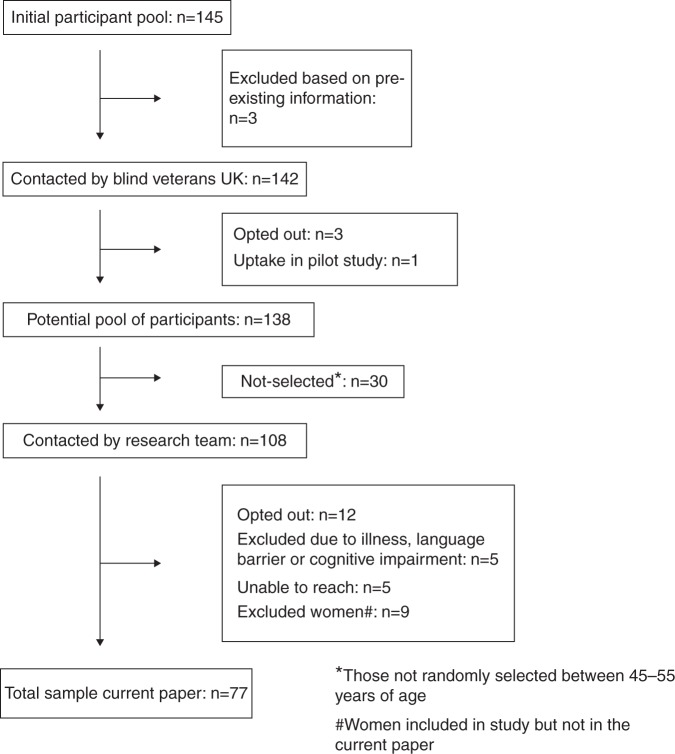
77 participants were included in the study, reflecting a response rate of 76.2%. Of those with complete data (n=74), 20 ex-servicemen had a combat-related visual impairment. Among ex-service personnel with a combat-related visual impairment, 10.0% (95% CI 0 to 23.2) screened positive for a probable depression, 25.0% (95% CI 6.0 to 44.0) for probable anxiety and 10.0% (95% CI 0 to 23.2) for probable PTSD. The prevalence of probable depression and probable PTSD differed among those with a non-combat-related visual impairment, namely 18.5% (95% CI 8.1 to 28.9) and 16.7% (95% CI 6.8 to 26.7), respectively. Probable anxiety was 18.5% (95% CI 8.1 to 28.9) among non-combat-related visually impaired ex-service personnel. 45.0% (95% CI 23.2 to 66.8) of combat-related visually impaired personnel reported hazardous drinking, compared with 20.4% (95% CI 9.7 to 31.2) of those with a non-combat-related visual impairment.
Mental health problems were prevalent among visually impaired younger ex-servicemen. No statistically significant differences were found in the prevalence of mental health problems among ex-servicemen with a combat-related visual impairment compared with those with a non-combat-related visual impairment.
自伊拉克和阿富汗冲突爆发以来,遭受与战斗相关视力损害的年轻军人数量有所增加。这项横断面研究调查了有视力损害的退役军人(年龄在22 - 55岁之间)的心理健康状况,并确定与战斗相关视力损害者的心理健康状况是否与非战斗相关视力损害者不同。
有视力损害的男性退役军人完成了一项电话访谈,评估抑郁症状、可能的焦虑症、创伤后应激障碍(PTSD)症状和酒精滥用情况。数据采用描述性统计进行分析。
77名参与者纳入研究,应答率为76.2%。在有完整数据的参与者(n = 74)中,20名退役军人有与战斗相关的视力损害。在有与战斗相关视力损害的退役军人中,10.0%(95%CI 0至23.2)筛查出可能患有抑郁症,25.0%(95%CI 6.0至44.0)可能患有焦虑症,10.0%(95%CI 0至23.2)可能患有创伤后应激障碍。非战斗相关视力损害者中可能患有抑郁症和可能患有创伤后应激障碍的患病率分别为18.5%(95%CI 8.1至28.9)和16.7%(95%CI 6.8至26.7)。非战斗相关视力损害的退役军人中可能患有焦虑症的比例为18.5%(95%CI 8.1至28.9)。45.0%(95%CI 23.2至66.8)的与战斗相关视力损害人员报告有危险饮酒行为,相比之下,非战斗相关视力损害者的这一比例为20.4%(95%CI 9.7至31.2)。
视力受损的年轻退役军人中普遍存在心理健康问题。与非战斗相关视力损害的退役军人相比,有战斗相关视力损害的退役军人中,心理健康问题的患病率没有统计学上的显著差异。