Department of Medical Bioscience, Dong-A University, Saha-Gu Nakdong-Daero 550 beongil 37, Busan, 604-714 Republic of Korea.
Department of Computer Science, Dong-A University, Saha-Gu Nakdong-Daero 550 beongil 37, Busan, 604-714 Republic of Korea.
Plant Methods. 2015 Apr 18;11:30. doi: 10.1186/s13007-015-0074-6. eCollection 2015.
Genetic markers are tools that can facilitate molecular breeding, even in species lacking genomic resources. An important class of genetic markers is those based on orthologous genes, because they can guide hypotheses about conserved gene function, a situation that is well documented for a number of agronomic traits. For under-studied species a key bottleneck in gene-based marker development is the need to develop molecular tools (e.g., oligonucleotide primers) that reliably access genes with orthology to the genomes of well-characterized reference species.
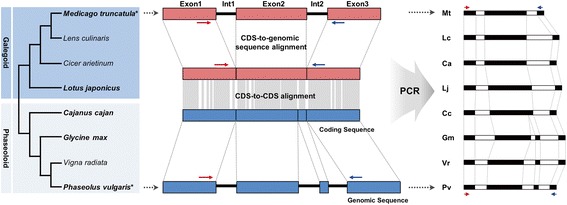
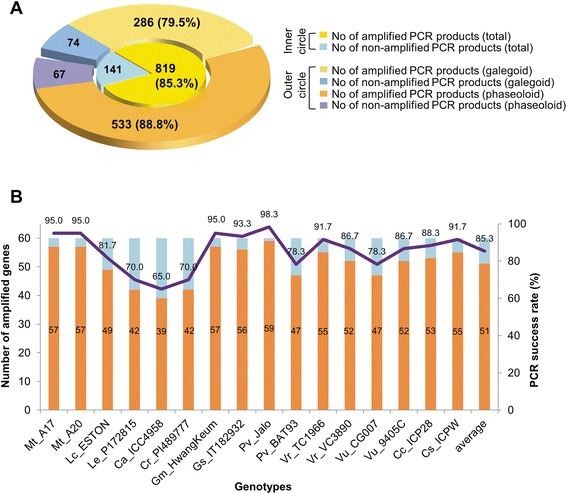
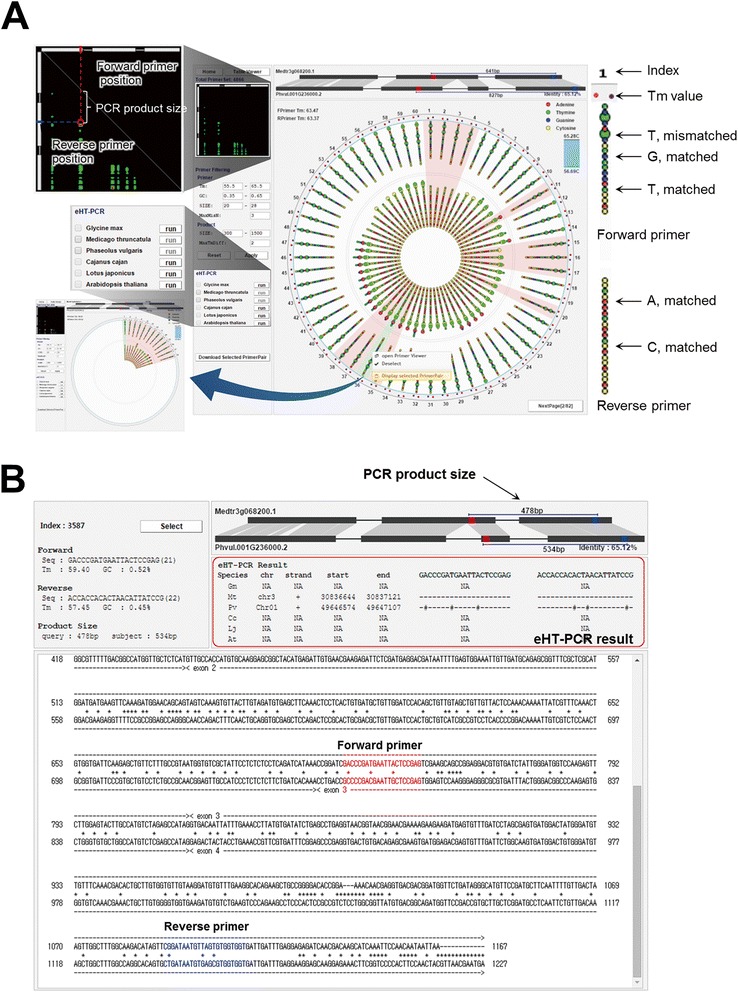
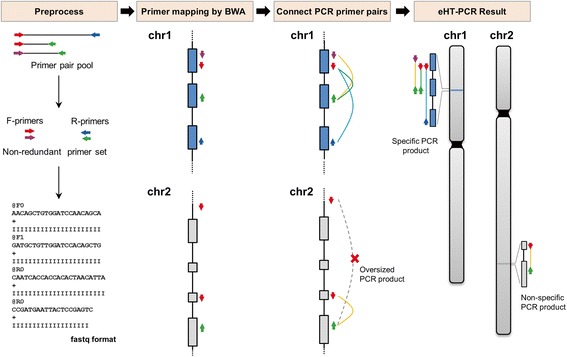
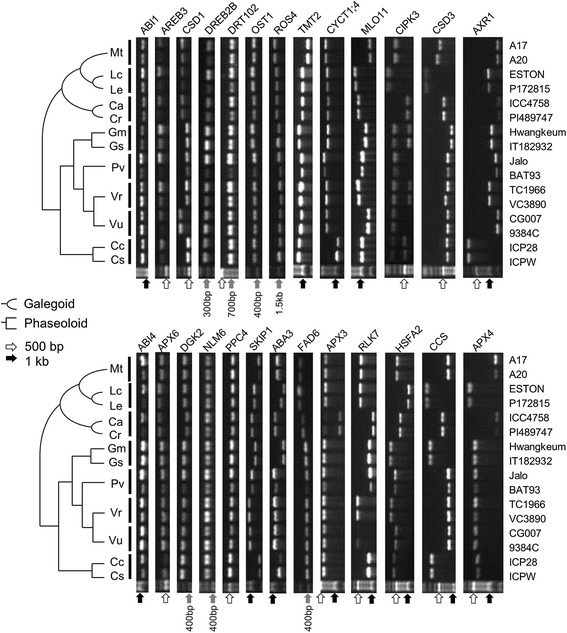
Here we report an efficient platform for the design of cross-species gene-derived markers in legumes. The automated platform, named CSGM Designer (URL: http://tgil.donga.ac.kr/CSGMdesigner), facilitates rapid and systematic design of cross-species genic markers. The underlying database is composed of genome data from five legume species whose genomes are substantially characterized. Use of CSGM is enhanced by graphical displays of query results, which we describe as "circular viewer" and "search-within-results" functions. CSGM provides a virtual PCR representation (eHT-PCR) that predicts the specificity of each primer pair simultaneously in multiple genomes. CSGM Designer output was experimentally validated for the amplification of orthologous genes using 16 genotypes representing 12 crop and model legume species, distributed among the galegoid and phaseoloid clades. Successful cross-species amplification was obtained for 85.3% of PCR primer combinations.
CSGM Designer spans the divide between well-characterized crop and model legume species and their less well-characterized relatives. The outcome is PCR primers that target highly conserved genes for polymorphism discovery, enabling functional inferences and ultimately facilitating trait-associated molecular breeding.
遗传标记是一种可以促进分子育种的工具,即使在缺乏基因组资源的物种中也是如此。一类重要的遗传标记是基于同源基因的标记,因为它们可以指导关于保守基因功能的假设,在许多农艺性状中,这种情况有很好的记录。对于研究较少的物种,基于基因的标记开发的一个关键瓶颈是需要开发分子工具(例如,寡核苷酸引物),这些工具能够可靠地访问与特征明确的参考物种基因组具有同源性的基因。
本文报道了一种在豆科植物中设计跨物种基因衍生标记的有效平台。该自动化平台名为 CSGM Designer(网址:http://tgil.donga.ac.kr/CSGMdesigner),便于快速系统地设计跨物种基因标记。基础数据库由五个豆科物种的基因组数据组成,这些物种的基因组特征明显。CSGM 的使用通过查询结果的图形显示得到增强,我们将其描述为“圆形查看器”和“结果内搜索”功能。CSGM 提供了一种虚拟 PCR 表示形式(eHT-PCR),可以同时在多个基因组中预测每个引物对的特异性。CSGM Designer 的输出通过使用代表 12 个作物和模式豆科植物物种的 16 个基因型进行正交基因扩增的实验验证,这些基因型分布在 galegoid 和 phaseoloid 分支中。85.3%的 PCR 引物组合获得了跨物种扩增。
CSGM Designer 跨越了特征明确的作物和模式豆科植物及其特征不太明确的亲缘物种之间的鸿沟。结果是针对高度保守基因的 PCR 引物,用于发现多态性,从而能够进行功能推断,并最终促进与性状相关的分子育种。