Tumin Makmor, Raja Ariffin Raja Noriza, Mohd Satar NurulHuda, Ng Kok-Peng, Lim Soo-Kun, Chong Chin-Sieng
1. Dept. of Administrative Studies and Politics, Faculty of Economics and Administration, University of Malaya, Kuala Lumpur, Malaysia.
2. Dept. of Economics, Faculty of Economics and Administration, University of Malaya, Kuala Lumpur, Malaysia.
Iran J Public Health. 2014 Jul;43(7):926-35.
Solving the dilemma of the organ shortage in Malaysia requires educating Malaysians about organ donation and transplantation. This paper aims at exploring the average Malaysian households ' preferred channels of campaigns and the preferred campaigners in a family setting, targeting at the dialysis family members.
We analyzed the responses of 350 respondents regarding organ donation campaigns. The respondents are 2 family members of 175 dialysis patients from 3 different institutions. The information on respondents' willingness to donate and preferred method and channel of organ donation campaign were collected through questionnaire.
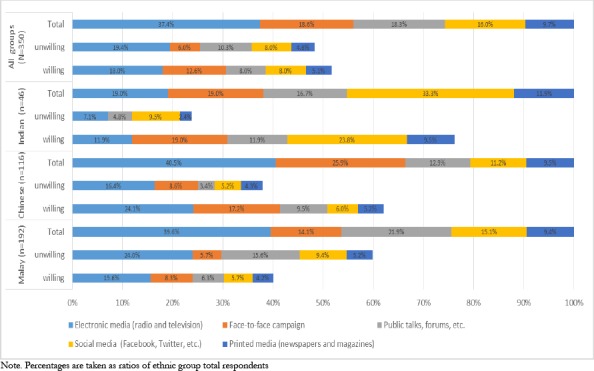
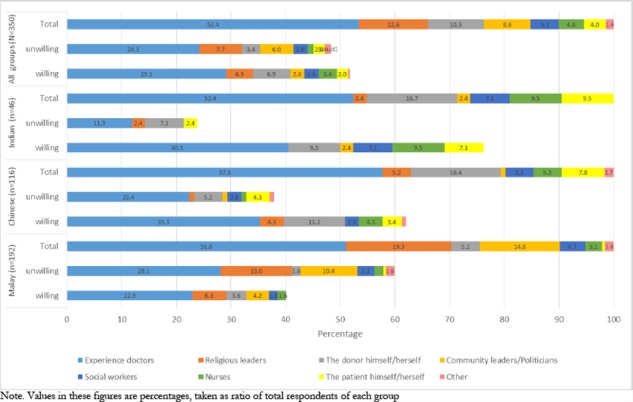
Malaysian families have a good tendency to welcome campaigns in both the public and private (their homes) spheres. We also found that campaigns facilitated by the electronic media (Television and Radio) and executed by experienced doctors are expected to optimize the outcomes of organ donation, in general. Chi-square tests show that there are no significant differences in welcoming campaigns among ethnics. However, ethnics preferences over the campaign methods and campaigners are significantly different (P <0.05).
Ethnic differences imply that necessary modifications on the campaign channels and campaigners should also be taken under consideration. By identifying the preferred channel and campaigners, this study hopes to shed some light on the ways to overcome the problem of organ shortage in Malaysia.
解决马来西亚器官短缺的困境需要让马来西亚人了解器官捐赠和移植。本文旨在探讨马来西亚普通家庭在家庭环境中对宣传活动的首选渠道以及首选的宣传者,目标受众为透析患者的家庭成员。
我们分析了350名受访者对器官捐赠宣传活动的回应。这些受访者是来自3个不同机构的175名透析患者的2名家庭成员。通过问卷调查收集了受访者的捐赠意愿以及器官捐赠宣传活动的首选方式和渠道等信息。
马来西亚家庭普遍倾向于在公共领域和私人领域(他们家中)接受宣传活动。我们还发现,一般来说,由电子媒体(电视和广播)推动并由经验丰富的医生执行的宣传活动有望优化器官捐赠的效果。卡方检验表明,不同种族在接受宣传活动方面没有显著差异。然而,不同种族对宣传方式和宣传者的偏好存在显著差异(P<0.05)。
种族差异意味着在宣传渠道和宣传者方面也应考虑进行必要的调整。通过确定首选渠道和宣传者,本研究希望为解决马来西亚器官短缺问题的方法提供一些启示。