Medizinische Physik, Carl von Ossietzky Universität Oldenburg, Oldenburg, Germany Hearing Systems, Department of Electrical Engineering, Technical University of Denmark, Kgs. Lyngby, Denmark
Medizinische Physik, Carl von Ossietzky Universität Oldenburg, Oldenburg, Germany Cluster of Excellence Hearing4all, Oldenburg, Germany.
Trends Hear. 2015 Apr 24;19:2331216515584149. doi: 10.1177/2331216515584149.
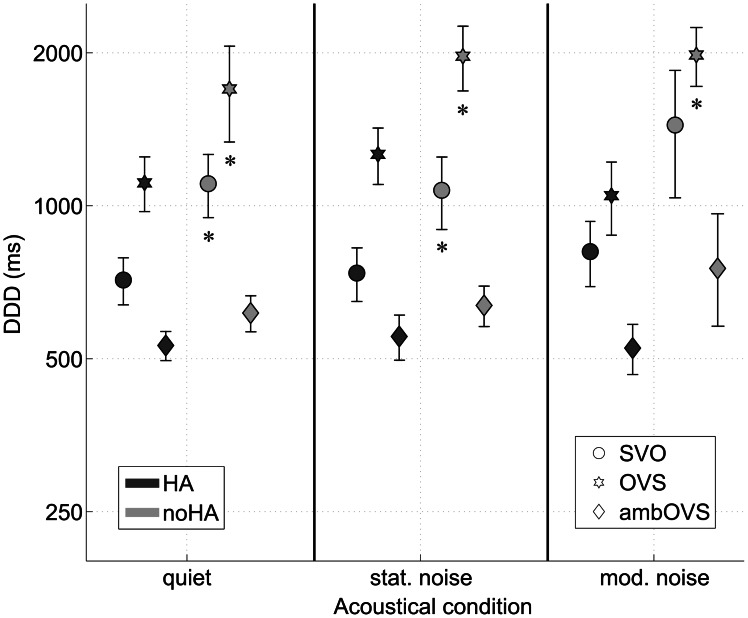
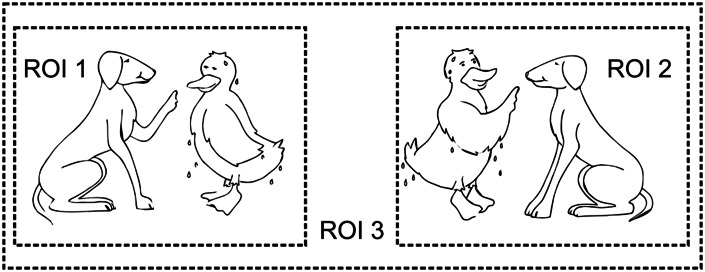
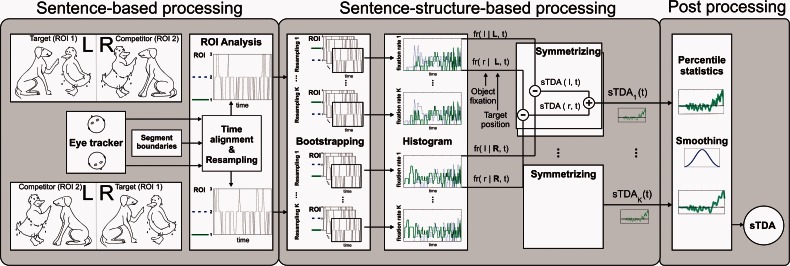
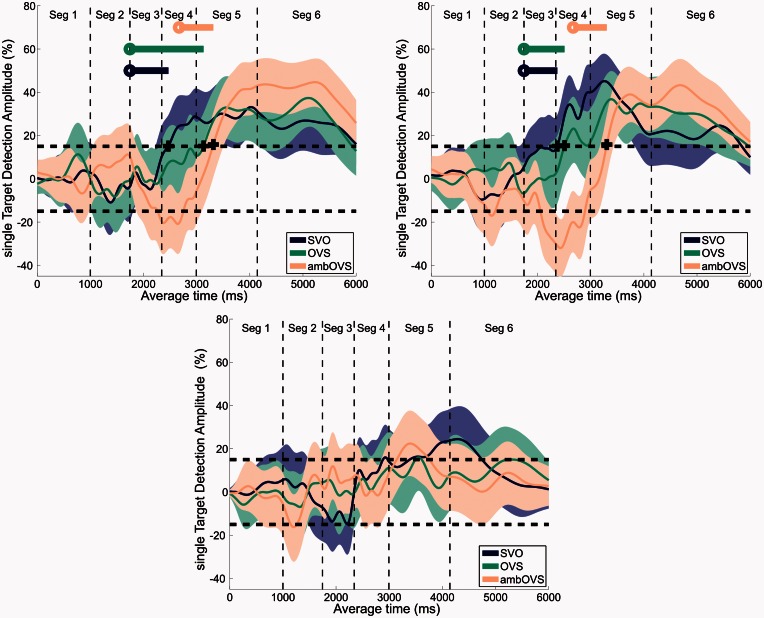
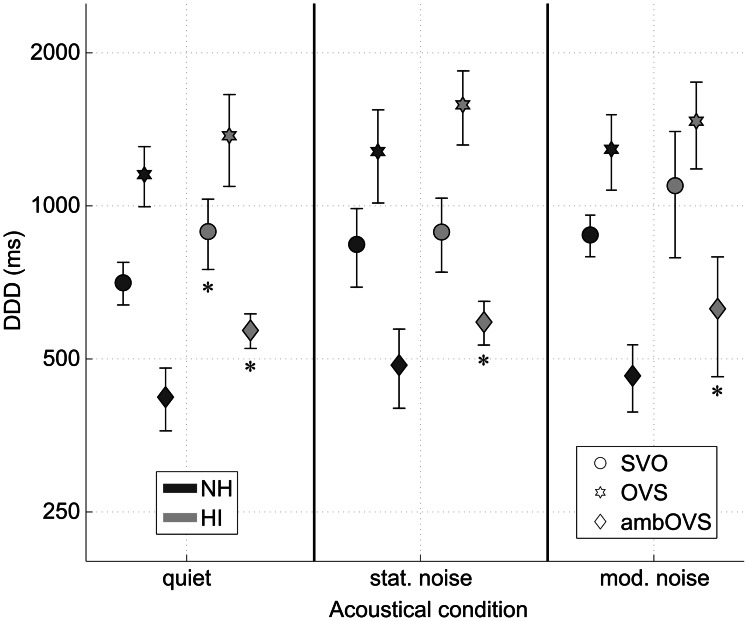
The main objective of this study was to investigate the extent to which hearing impairment influences the duration of sentence processing. An eye-tracking paradigm is introduced that provides an online measure of how hearing impairment prolongs processing of linguistically complex sentences; this measure uses eye fixations recorded while the participant listens to a sentence. Eye fixations toward a target picture (which matches the aurally presented sentence) were measured in the presence of a competitor picture. Based on the recorded eye fixations, the single target detection amplitude, which reflects the tendency of the participant to fixate the target picture, was used as a metric to estimate the duration of sentence processing. The single target detection amplitude was calculated for sentence structures with different levels of linguistic complexity and for different listening conditions: in quiet and in two different noise conditions. Participants with hearing impairment spent more time processing sentences, even at high levels of speech intelligibility. In addition, the relationship between the proposed online measure and listener-specific factors, such as hearing aid use and cognitive abilities, was investigated. Longer processing durations were measured for participants with hearing impairment who were not accustomed to using a hearing aid. Moreover, significant correlations were found between sentence processing duration and individual cognitive abilities (such as working memory capacity or susceptibility to interference). These findings are discussed with respect to audiological applications.
本研究的主要目的是探讨听力障碍对句子处理时间的影响程度。引入了一种眼动追踪范式,该范式提供了一种在线测量听力障碍如何延长语言复杂句子处理时间的方法;该方法使用参与者在听句子时记录的眼动注视来测量。在存在竞争图片的情况下,测量了对目标图片(与听觉呈现的句子匹配)的眼动注视。基于记录的眼动注视,使用单个目标检测幅度作为指标来估计句子处理的持续时间,该幅度反映了参与者注视目标图片的倾向。为不同语言复杂度水平的句子结构和不同的听力条件计算了单个目标检测幅度:在安静环境中和两种不同的噪声环境中。听力障碍患者即使在言语可懂度较高的情况下,处理句子的时间也会更长。此外,还研究了所提出的在线测量方法与听力障碍患者特有的因素(如助听器的使用和认知能力)之间的关系。不习惯使用助听器的听力障碍患者的处理持续时间更长。此外,还发现句子处理持续时间与个体认知能力(如工作记忆能力或易受干扰的程度)之间存在显著相关性。这些发现与听力学应用相关。