Institute of Dutch Studies, University of Oldenburg, Ammerländer Heerstraße 114-116, 26129, Oldenburg, Germany.
Cluster of Excellence "Hearing4all", University of Oldenburg, Ammerländer Heerstraße 114-116, 26129, Oldenburg, Germany.
Sci Rep. 2021 Mar 16;11(1):5994. doi: 10.1038/s41598-021-85349-5.
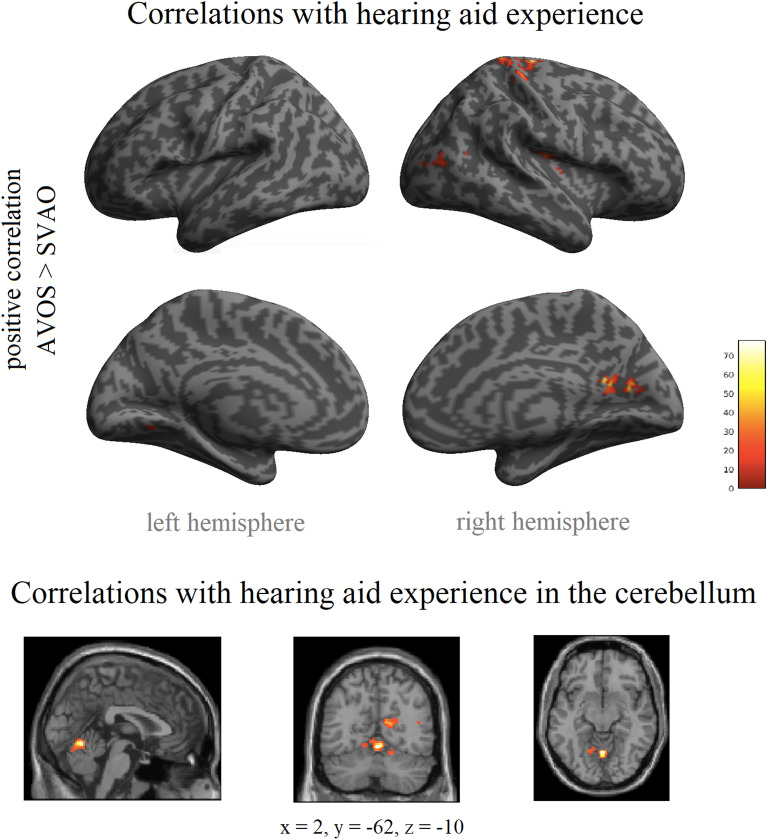
Age-related hearing loss typically affects the hearing of high frequencies in older adults. Such hearing loss influences the processing of spoken language, including higher-level processing such as that of complex sentences. Hearing aids may alleviate some of the speech processing disadvantages associated with hearing loss. However, little is known about the relation between hearing loss, hearing aid use, and their effects on higher-level language processes. This neuroimaging (fMRI) study examined these factors by measuring the comprehension and neural processing of simple and complex spoken sentences in hard-of-hearing older adults (n = 39). Neither hearing loss severity nor hearing aid experience influenced sentence comprehension at the behavioral level. In contrast, hearing loss severity was associated with increased activity in left superior frontal areas and the left anterior insula, but only when processing specific complex sentences (i.e. object-before-subject) compared to simple sentences. Longer hearing aid experience in a sub-set of participants (n = 19) was associated with recruitment of several areas outside of the core speech processing network in the right hemisphere, including the cerebellum, the precentral gyrus, and the cingulate cortex, but only when processing complex sentences. Overall, these results indicate that brain activation for language processing is affected by hearing loss as well as subsequent hearing aid use. Crucially, they show that these effects become apparent through investigation of complex but not simple sentences.
年龄相关性听力损失通常会影响老年人高频听力。这种听力损失会影响口语的处理,包括更高级别的处理,如复杂句子的处理。助听器可能会减轻与听力损失相关的一些言语处理方面的劣势。然而,对于听力损失、助听器使用及其对更高层次语言过程的影响之间的关系,人们知之甚少。这项神经影像学(fMRI)研究通过测量听力受损的老年成年人(n=39)对简单和复杂口语句子的理解和神经处理,来研究这些因素。听力损失的严重程度和助听器使用经验都没有在行为层面上影响句子理解。相比之下,听力损失的严重程度与左额上回和左前岛叶的活动增加有关,但仅在处理特定的复杂句子(即物主在前)时与简单句子相比。在一部分参与者(n=19)中,助听器使用时间较长与右半球几个核心言语处理网络之外的区域的募集有关,包括小脑、中央前回和扣带回皮质,但仅在处理复杂句子时如此。总的来说,这些结果表明,大脑对语言处理的激活受到听力损失以及随后的助听器使用的影响。至关重要的是,它们表明,这些影响只有通过对复杂而非简单句子的研究才能显现出来。