Laboratory of Plant Genetics and Breeding, Faculty of Agriculture, Saga University , Honjyo-machi 1, Saga 840-8502 , Japan ; Laboratory of Plant Genetics and Breeding, Faculty of Agriculture, Yamagata University , Wakaba-machi 1, Tsuruoka, Yamagata 997-8555 , Japan.
Laboratory of Plant Genetics and Breeding, Faculty of Agriculture, Saga University , Honjyo-machi 1, Saga 840-8502 , Japan.
Breed Sci. 2014 Dec;64(4):371-7. doi: 10.1270/jsbbs.64.371. Epub 2014 Dec 1.
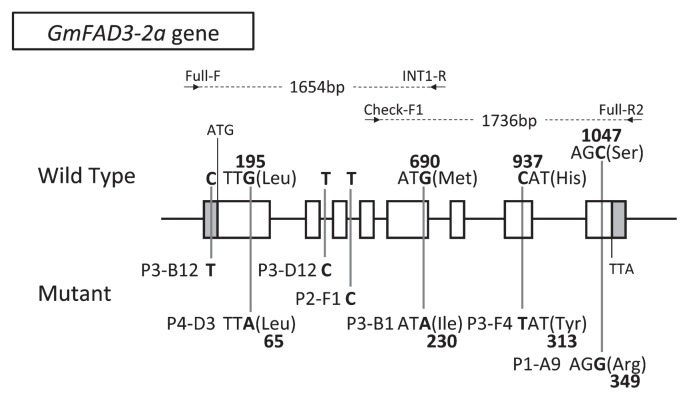
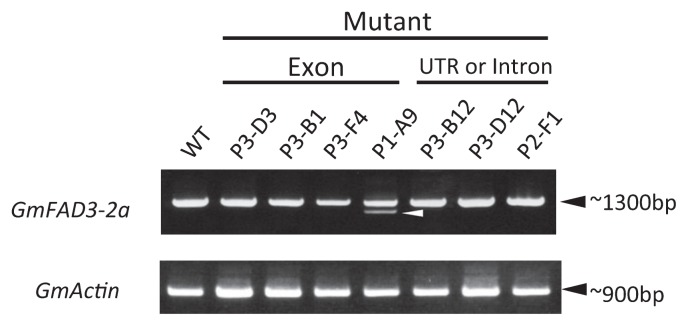
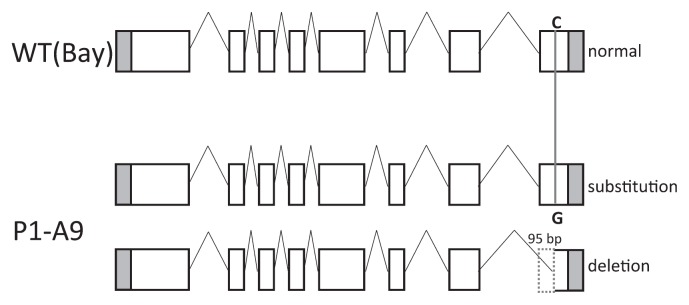
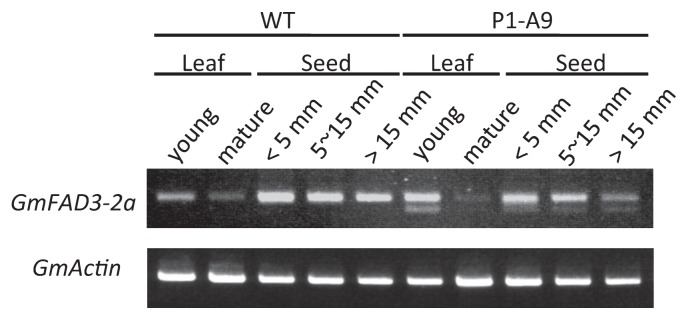
Soybean (Glycine max (L.) Merr.) oil typically contains 8% α-linolenic acid that is highly unstable and easily oxidized. This property is undesirable in many food and industrial applications. Genetic strategies for reducing α-linolenic acid content would enhance the commercial value. However, genetic resources for low α-linolenic acid content are limited among natural soybean variations. Microsomal omega-3-fatty acid desaturase (FAD3) is responsible for the synthesis of α-linolenic acid in the polyunsaturated fatty acid pathway. There are four FAD3 homologs (Glyma02g39230, Glyma11g27190, Glyma14g37350 and Glyma18g06950) in the soybean genome. While non-functional alleles have been reported for Glyma02g39230 (GmFAD3-1a) and Glyma14g37350 (GmFAD3-1b), little variation is seen in Glyma18g06950 (GmFAD3-2a). We isolated seven mutant GmFAD3-2a alleles, each containing a single-nucleotide substitution, from 39,100 independent mutant lines by using targeting induced local lesions in genomes (TILLING). Analysis of GmFAD3-2a transcripts and enzyme activities revealed that one missense mutant, 'P1-A9', contains a non-functional allele of GmFAD3-2a. By combining three non-functional alleles (GmFAD3-1a, GmFAD3-1b, and GmFAD3-2a), we generated soybean lines containing <2% α-linolenic acid in their seeds. The reverse-genetics-based development of novel mutant alleles in the fatty acid metabolic pathway will allow the improvement of soybean with better oil quality through conventional breeding.
大豆(Glycine max (L.) Merr.)油通常含有 8%的α-亚麻酸,该酸极不稳定,容易氧化。在许多食品和工业应用中,这种性质是不理想的。降低α-亚麻酸含量的遗传策略将提高其商业价值。然而,在天然大豆变异中,低α-亚麻酸含量的遗传资源有限。微粒体ω-3 脂肪酸去饱和酶(FAD3)负责多不饱和脂肪酸途径中α-亚麻酸的合成。大豆基因组中有四个 FAD3 同源物(Glyma02g39230、Glyma11g27190、Glyma14g37350 和 Glyma18g06950)。虽然已经报道了 Glyma02g39230(GmFAD3-1a)和 Glyma14g37350(GmFAD3-1b)的非功能等位基因,但在 Glyma18g06950(GmFAD3-2a)中几乎没有发现变异。我们通过使用靶向诱导基因组局部损伤(TILLING)从 39100 个独立的突变株中分离出了 7 个突变的 GmFAD3-2a 等位基因,每个等位基因都含有一个单核苷酸替换。对 GmFAD3-2a 转录物和酶活性的分析表明,一个错义突变体'P1-A9'含有一个无功能的 GmFAD3-2a 等位基因。通过结合三个无功能的等位基因(GmFAD3-1a、GmFAD3-1b 和 GmFAD3-2a),我们生成了种子中α-亚麻酸含量低于 2%的大豆品系。脂肪酸代谢途径中基于反向遗传学的新型突变等位基因的开发将允许通过传统育种来改善具有更好油质的大豆。