Kuźmińska-Bajor Marta, Grzymajło Krzysztof, Ugorski Maciej
Department of Biotechnology and Food Microbiology, Wrocław University of Environmental and Life Sciences, Wrocław Poland.
Department of Biochemistry, Pharmacology and Toxicology, Faculty of Veterinary Medicine, Wrocław University of Environmental and Life Sciences, Wrocław Poland.
Front Microbiol. 2015 Apr 9;6:276. doi: 10.3389/fmicb.2015.00276. eCollection 2015.
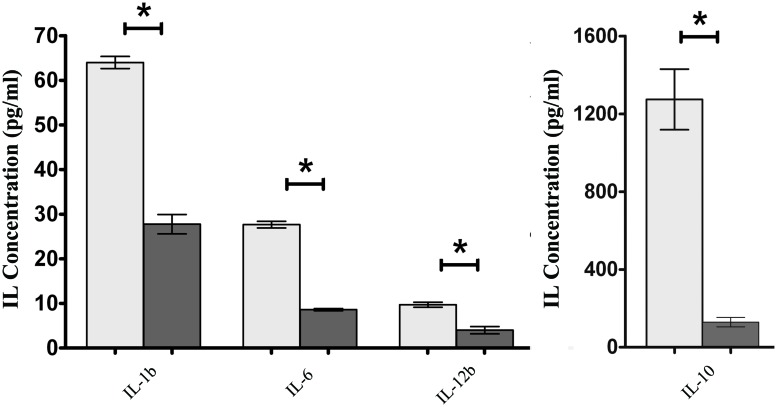
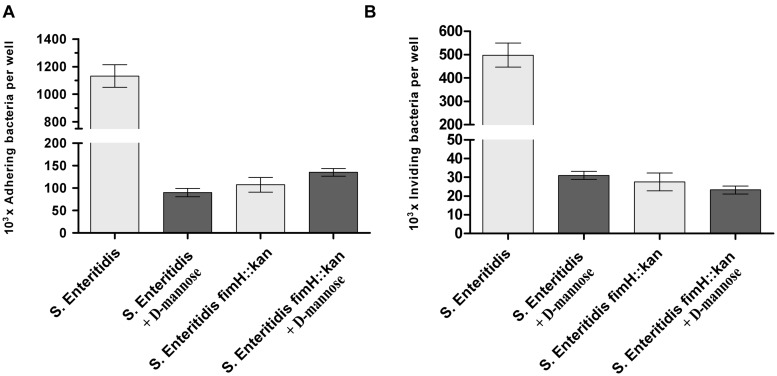
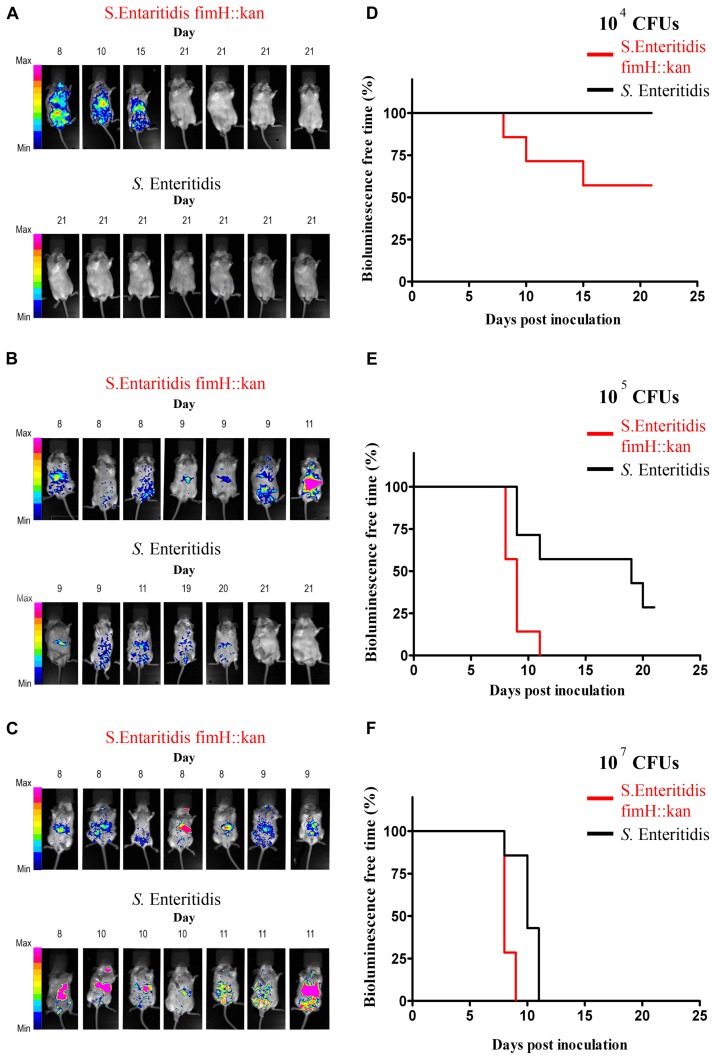
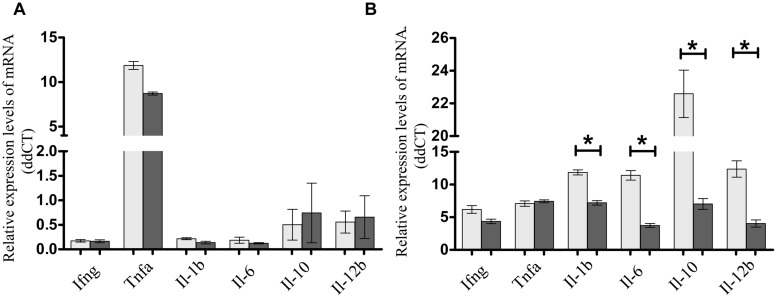
We have recently shown that Salmonella Gallinarum type 1 fimbriae with endogenous mannose-resistant (MR) variant of the FimH protein increase systemic dissemination of S. Gallinarum and colonization of internal organs in comparison to the S. Gallinarum fimH knockout strain or the mutant expressing mannose-sensitive (MS) FimH variant from S. Enteritidis. Elaborating from these studies, we proposed that MS variants of FimH are advantageous in gastrointestinal infections, in contrast to MR FimH variants which decrease intestinal colonization and promote their systemic spreading. To support our hypothesis, we carried out in vivo studies using mice infected with wild-type S. Enteritidis and its fimH knockout strain (S. Enteritidis), which was characterized by significantly lower adhesion and invasiveness of murine ICE-1 intestinal cells. Using bioluminescence imaging, we observed that the loss of MS FimH adhesin correlates well with the highly increased colonization of mice by these bacteria. The appearance of the mutant strain was observed much earlier than wild-type Salmonella, and mice infected with 10(4)-10(7) S. Enteritidis fimH::kan CFUs had significantly (P < 0.05) shorter infection-free time than animals inoculated with wild-type S. Enteritidis. Infections caused by non-typhoid Salmonella, such as S. Enteritidis, are associated with massive inflammation of the lamina propria and lymph nodes in the intestinal tract. Therefore, we evaluated the role of MS type 1 fimbriae in the induction of cytokine expression and secretion, using murine ICE-1 intestinal cells. We showed that the expression, as well as secretion, of Il-1b, Il-6, Il-10, and Il-12b was significantly higher in cells infected with wild-type S. Enteritidis compared to cells infected with the mutant strain. Based on our results, we propose that type 1 fimbriae may play an important role in the pathogenicity of S. Enteritidis and may contribute to an intestinal inflammatory response.
我们最近发现,与鸡伤寒沙门氏菌fimH基因敲除菌株或表达肠炎沙门氏菌中甘露糖敏感(MS)型FimH变体的突变体相比,带有FimH蛋白内源性甘露糖抗性(MR)变体的鸡伤寒沙门氏菌1型菌毛可增加鸡伤寒沙门氏菌的全身扩散及内部器官的定植。基于这些研究,我们提出,与降低肠道定植并促进全身扩散的MR型FimH变体相比,FimH的MS变体在胃肠道感染中具有优势。为支持我们的假设,我们使用感染野生型肠炎沙门氏菌及其fimH基因敲除菌株(肠炎沙门氏菌)的小鼠进行了体内研究,该基因敲除菌株的特征是对小鼠ICE-1肠道细胞的黏附性和侵袭性显著降低。使用生物发光成像技术,我们观察到MS型FimH黏附素的缺失与这些细菌在小鼠体内高度增加的定植密切相关。突变菌株的出现比野生型沙门氏菌早得多,感染10⁴-10⁷CFU肠炎沙门氏菌fimH::kan的小鼠的无感染时间显著(P<0.05)短于接种野生型肠炎沙门氏菌的动物。由非伤寒沙门氏菌引起的感染,如肠炎沙门氏菌,与肠道固有层和淋巴结的大量炎症有关。因此,我们使用小鼠ICE-1肠道细胞评估了MS型1型菌毛在细胞因子表达和分泌诱导中的作用。我们发现,与感染突变菌株的细胞相比,感染野生型肠炎沙门氏菌的细胞中Il-1b、Il-6、Il-10和Il-12b的表达及分泌显著更高。基于我们的结果,我们提出1型菌毛可能在肠炎沙门氏菌致病性中起重要作用,并可能导致肠道炎症反应。