Garfield Alastair S, Li Chia, Madara Joseph C, Shah Bhavik P, Webber Emily, Steger Jennifer S, Campbell John N, Gavrilova Oksana, Lee Charlotte E, Olson David P, Elmquist Joel K, Tannous Bakhos A, Krashes Michael J, Lowell Bradford B
1] Division of Endocrinology, Diabetes and Metabolism, Department of Medicine, Beth Israel Deaconess Medical Center, Harvard Medical School, Boston, Massachusetts, USA. [2] Centre for Integrative Physiology, Hugh Robson Building, University of Edinburgh, Edinburgh, UK.
1] Diabetes, Endocrinology and Obesity Branch, National Institute of Diabetes and Digestive and Kidney Diseases, National Institutes of Health, Bethesda, Maryland, USA. [2] National Institute on Drug Abuse, National Institutes of Health, Baltimore, Maryland, USA.
Nat Neurosci. 2015 Jun;18(6):863-71. doi: 10.1038/nn.4011. Epub 2015 Apr 27.
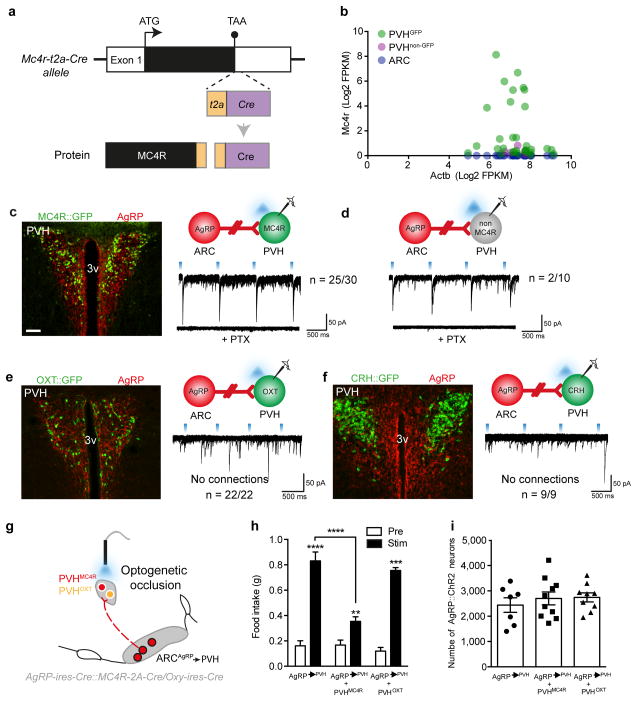
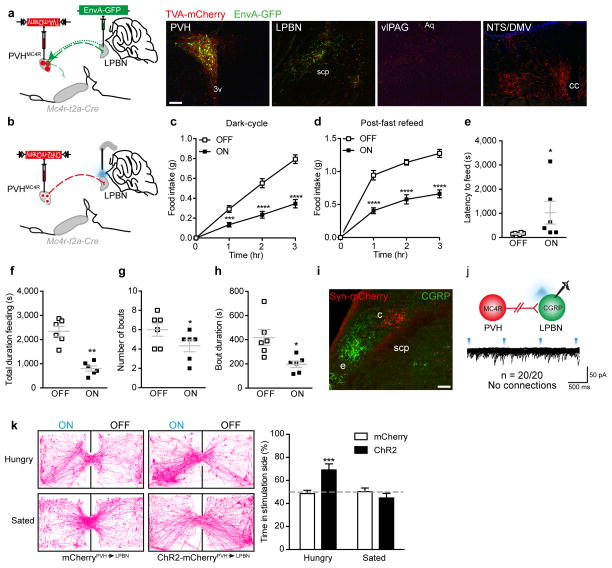
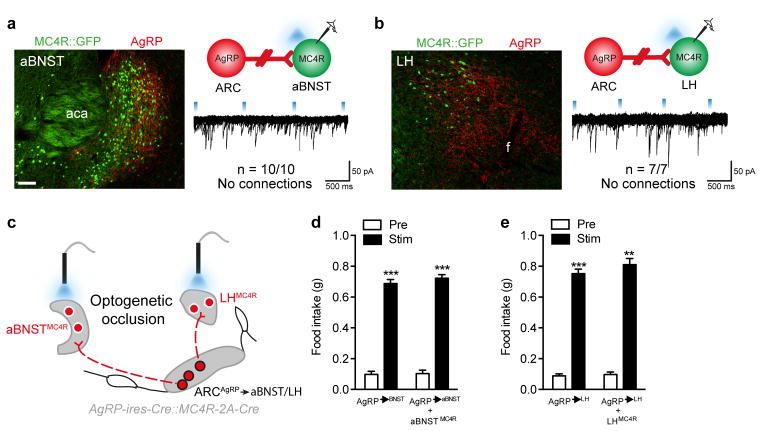
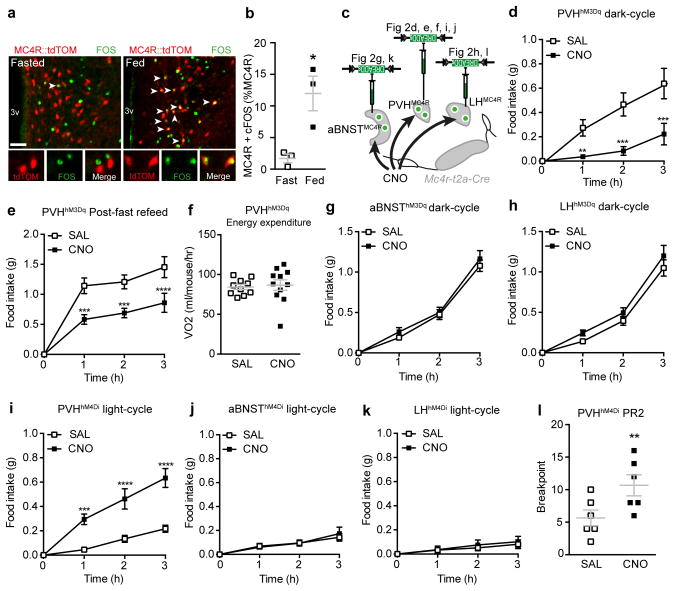
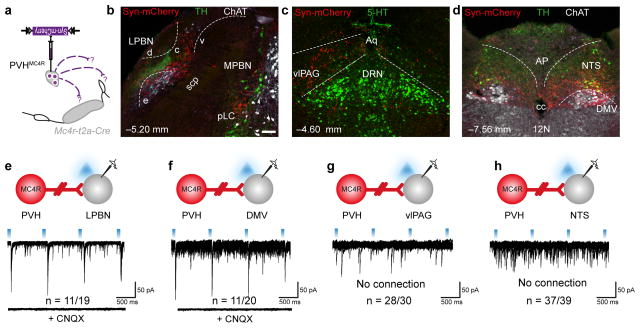
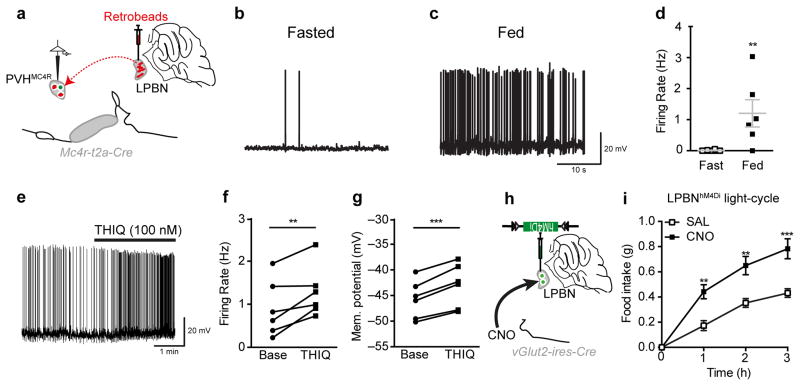
Pro-opiomelanocortin (POMC)- and agouti-related peptide (AgRP)-expressing neurons of the arcuate nucleus of the hypothalamus (ARC) are oppositely regulated by caloric depletion and coordinately stimulate and inhibit homeostatic satiety, respectively. This bimodality is principally underscored by the antagonistic actions of these ligands at downstream melanocortin-4 receptors (MC4R) in the paraventricular nucleus of the hypothalamus (PVH). Although this population is critical to energy balance, the underlying neural circuitry remains unknown. Using mice expressing Cre recombinase in MC4R neurons, we demonstrate bidirectional control of feeding following real-time activation and inhibition of PVH(MC4R) neurons and further identify these cells as a functional exponent of ARC(AgRP) neuron-driven hunger. Moreover, we reveal this function to be mediated by a PVH(MC4R)→lateral parabrachial nucleus (LPBN) pathway. Activation of this circuit encodes positive valence, but only in calorically depleted mice. Thus, the satiating and appetitive nature of PVH(MC4R)→LPBN neurons supports the principles of drive reduction and highlights this circuit as a promising target for antiobesity drug development.
下丘脑弓状核(ARC)中表达阿片-促黑素皮质素原(POMC)和刺鼠相关肽(AgRP)的神经元分别受到热量消耗的相反调节,分别协同刺激和抑制稳态饱腹感。这种双态性主要由这些配体在下丘脑室旁核(PVH)中对下游黑皮质素-4受体(MC4R)的拮抗作用所强调。尽管这群神经元对能量平衡至关重要,但其潜在的神经回路仍不清楚。利用在MC4R神经元中表达Cre重组酶的小鼠,我们证明了实时激活和抑制PVH(MC4R)神经元后对进食的双向控制,并进一步确定这些细胞是ARC(AgRP)神经元驱动饥饿的功能指数。此外,我们揭示了这种功能是由PVH(MC4R)→臂旁外侧核(LPBN)通路介导的。激活该回路编码正价,但仅在热量消耗的小鼠中如此。因此,PVH(MC4R)→LPBN神经元的饱腹感和食欲特性支持驱力降低原则,并突出了该回路作为抗肥胖药物开发的一个有前景的靶点。