Yu Yunguo, Schmid Anita M, Victor Jonathan D
Brain and Mind Research Institute, Weill Cornell Medical College, New York, United States.
Elife. 2015 Apr 27;4:e06604. doi: 10.7554/eLife.06604.
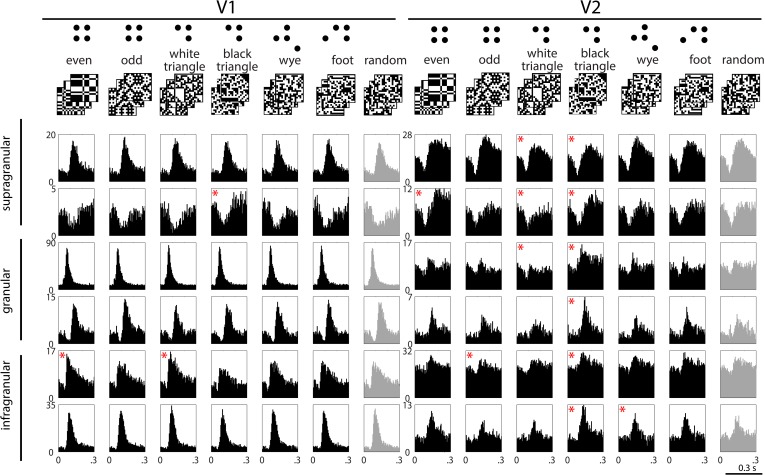
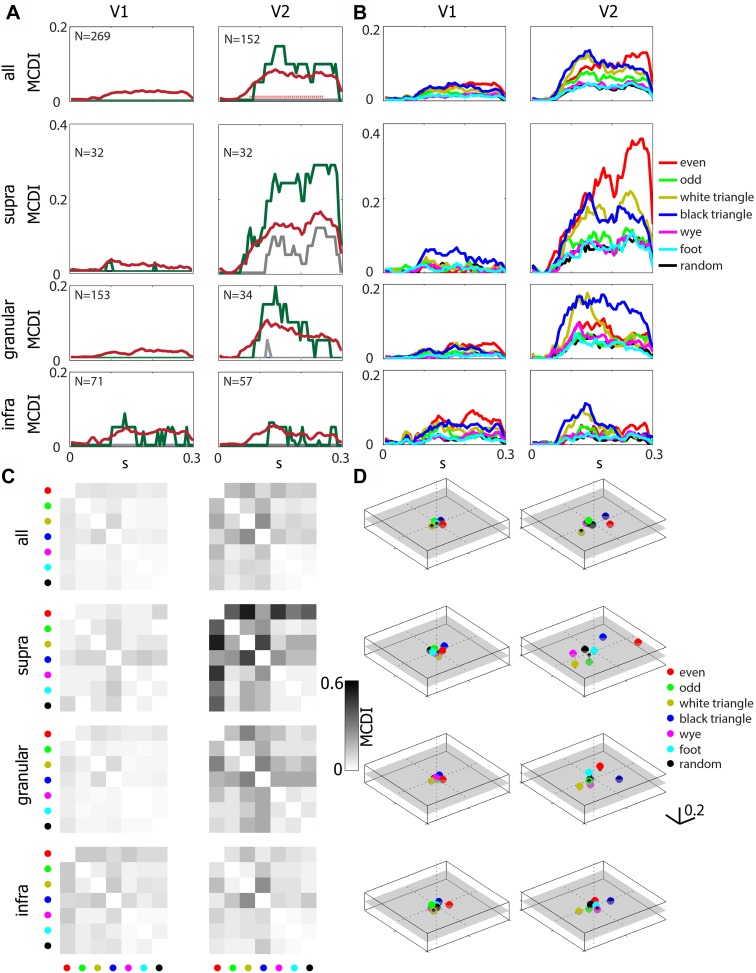
Using the visual system as a model, we recently showed that the efficient coding principle accounted for the allocation of computational resources in central sensory processing: when sampling an image is the main limitation, resources are devoted to compute the statistical features that are the most variable, and therefore the most informative (eLife 2014;3:e03722. DOI: 10.7554/eLife.03722 Hermundstad et al., 2014). Building on these results, we use single-unit recordings in the macaque monkey to determine where these computations--sensitivity to specific multipoint correlations--occur. We find that these computations take place in visual area V2, primarily in its supragranular layers. The demonstration that V2 neurons are sensitive to the multipoint correlations that are informative about natural images provides a common computational underpinning for diverse but well-recognized aspects of neural processing in V2, including its sensitivity to corners, junctions, illusory contours, figure/ground, and 'naturalness.'
以视觉系统为模型,我们最近发现,高效编码原则解释了中枢感觉处理中计算资源的分配情况:当图像采样是主要限制因素时,资源会用于计算变化最大、因此信息量最大的统计特征(《eLife》2014年;3:e03722。DOI:10.7554/eLife.03722 Hermundstad等人,2014年)。基于这些结果,我们利用猕猴的单神经元记录来确定这些计算——对特定多点相关性的敏感性——发生在哪里。我们发现这些计算发生在视觉区域V2,主要在其颗粒上层。V2神经元对有关自然图像的多点相关性敏感这一发现,为V2中神经处理的各种但广为人知的方面提供了一个共同的计算基础,包括其对角落、交点、虚幻轮廓、图形/背景和“自然性”的敏感性。