Fauchier Laurent, Greenlaw Nicola, Ferrari Roberto, Ford Ian, Fox Kim M, Tardif Jean-Claude, Tendera Michal, Steg Ph Gabriel
Service de Cardiologie, Centre Hospitalier Universitaire Trousseau and Université François Rabelais, Tours, France.
Robertson Centre, University of Glasgow, Glasgow, United Kingdom.
PLoS One. 2015 Apr 27;10(4):e0125164. doi: 10.1371/journal.pone.0125164. eCollection 2015.
Few data are available regarding the use of antithrombotic strategies in coronary artery disease patients with atrial fibrillation (AF) in everyday practice. We sought to describe the prevalence of AF and its antithrombotic management in a contemporary population of patients with stable coronary artery disease.
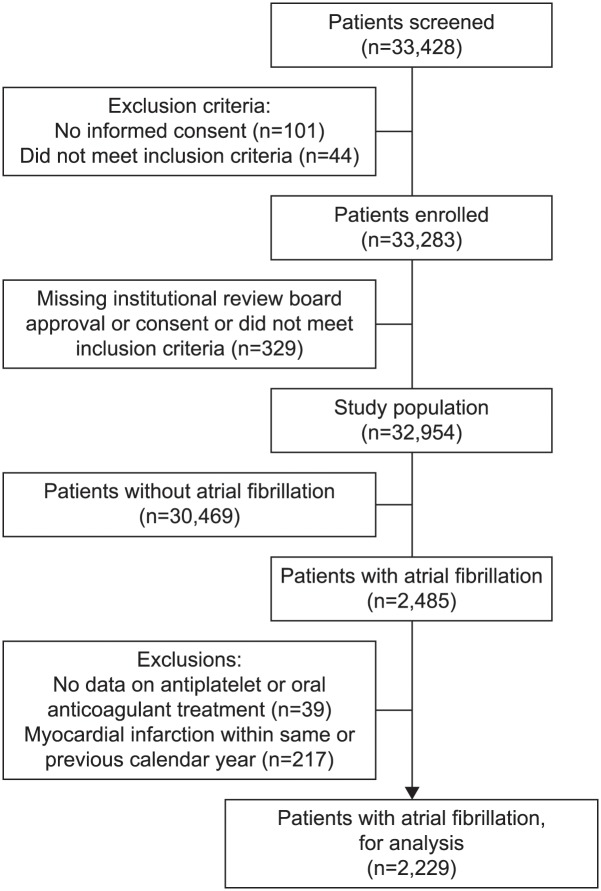
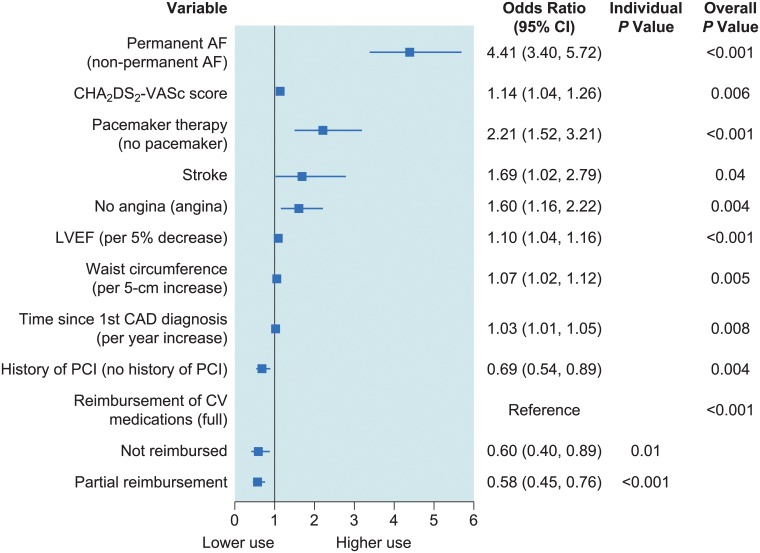
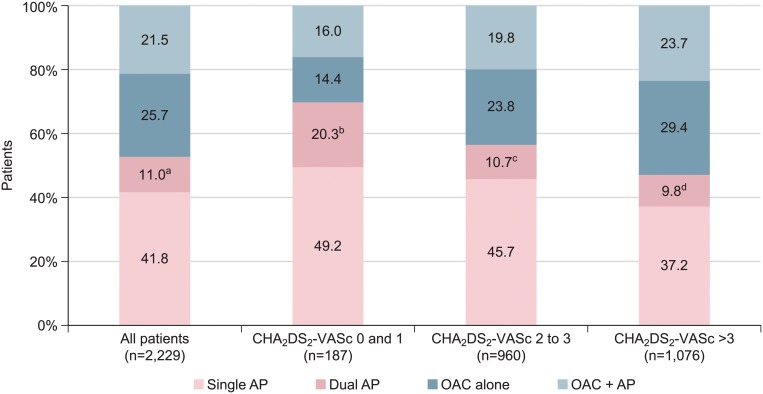
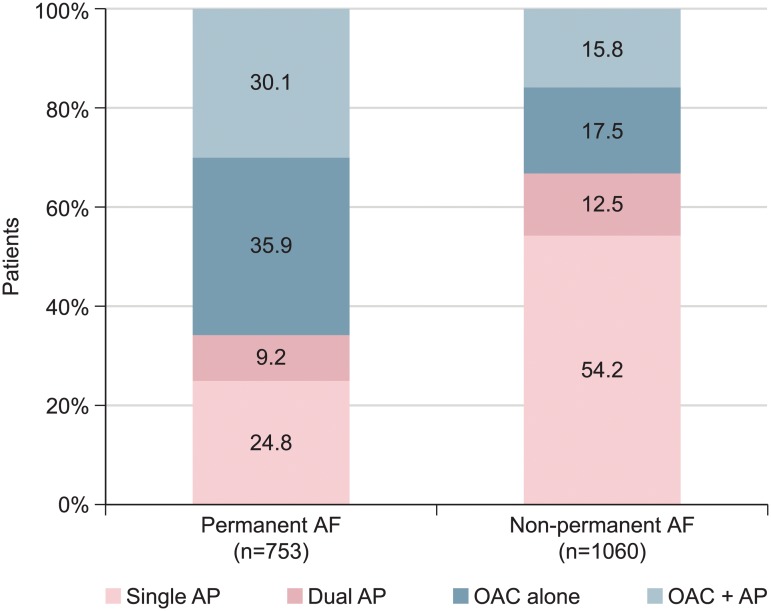
CLARIFY is an international, prospective, longitudinal registry of outpatients with stable coronary artery disease, defined as prior (≥12 months) myocardial infarction, revascularization procedure, coronary stenosis >50%, or chest pain associated with evidence of myocardial ischemia. Overall, 33,428 patients were screened, of whom 32,954 had data available for analysis at baseline; of these 2,229 (6.7%) had a history of AF. Median (interquartile range) CHA2DS2-VASc score was 4 (3, 5). Oral anticoagulation alone was used in 25.7%, antiplatelet therapy alone in 52.8% (single 41.8%, dual 11.0%), and both in 21.5%. OAC use was independently associated with permanent AF (p<0.001), CHA2DS2-VASc score (p=0.006), pacemaker (p<0.001), stroke (p=0.04), absence of angina (p=0.004), decreased left ventricular ejection fraction (p<0.001), increased waist circumference (p=0.005), and longer history of coronary artery disease (p=0.008). History of percutaneous coronary intervention (p=0.004) and no/partial reimbursement for cardiovascular medication (p=0.01, p<0.001, respectively) were associated with reduced oral anticoagulant use.
In this contemporary cohort of patients with stable coronary artery disease and AF, most of whom are theoretical candidates for anticoagulation, oral anticoagulants were used in only 47.2%. Half of the patients received antiplatelet therapy alone and one-fifth received both antiplatelets and oral anticoagulants. Efforts are needed to improve adherence to guidelines in these patients.
ISRCTN registry of clinical trials: ISRCTN43070564.
在日常临床实践中,关于冠心病合并心房颤动(AF)患者抗血栓治疗策略的应用数据较少。我们旨在描述当代稳定型冠心病患者中AF的患病率及其抗血栓治疗情况。
CLARIFY是一项针对稳定型冠心病门诊患者的国际前瞻性纵向注册研究,稳定型冠心病定义为既往(≥12个月)心肌梗死、血运重建术、冠状动脉狭窄>50%或伴有心肌缺血证据的胸痛。总体而言,共筛查了33428例患者,其中32954例患者在基线时有可供分析的数据;其中2229例(6.7%)有AF病史。CHA2DS2-VASc评分的中位数(四分位间距)为4(3,5)。单独使用口服抗凝药的占25.7%,单独使用抗血小板治疗的占52.8%(单一抗血小板治疗占41.8%,双联抗血小板治疗占11.0%),两者都使用的占21.5%。口服抗凝药的使用与永久性AF(p<0.001)、CHA2DS2-VASc评分(p=0.006)、起搏器(p<0.001)、中风(p=0.04)、无心绞痛(p=0.004)、左心室射血分数降低(p<0.001)、腰围增加(p=0.005)以及冠心病病史较长(p=0.008)独立相关。经皮冠状动脉介入治疗史(p=0.004)以及心血管药物无报销/部分报销(分别为p=0.01,p<0.001)与口服抗凝药使用减少相关。
在这个当代稳定型冠心病合并AF患者队列中,大多数从理论上讲是抗凝治疗的候选者,但仅47.2%的患者使用了口服抗凝药。一半的患者仅接受抗血小板治疗,五分之一的患者同时接受抗血小板和口服抗凝药治疗。需要努力提高这些患者对指南的依从性。
ISRCTN临床试验注册:ISRCTN43070564。