Sorbets Emmanuel, Greenlaw Nicola, Ferrari Roberto, Ford Ian, Fox Kim M, Tardif Jean-Claude, Tendera Michal, Steg Philippe Gabriel
FACT (French Alliance for Cardiovascular Clinical Trials, an F-CRIN Network), Département Hospitalo-Universitaire FIRE (Fibrosis, Inflammation, Remodelling), Université Paris-Diderot, Sorbonne Paris-Cité, Paris, France; Hôpital Bichat, Assistance Publique-Hôpitaux de Paris, France; INSERM U-1148, Paris, France.
Université Paris 13, Hôpital Avicenne, Assistance Publique-Hôpitaux de Paris, Bobigny, France.
Clin Cardiol. 2017 Oct;40(10):797-806. doi: 10.1002/clc.22730. Epub 2017 May 31.
Despite major advances in prevention and treatment, coronary artery disease (CAD) remains the leading cause of death worldwide. Whereas many sources of data are available on the epidemiology of acute coronary syndromes, fewer datasets reflect the contemporary management and outcomes of stable CAD patients.
A worldwide contemporary registry would improve our knowledge about stable CAD. The main objectives are to describe the demographics, clinical profile, contemporary management and outcomes of outpatients with stable CAD; to identify gaps between evidence and treatment; and to investigate long-term prognostic determinants.
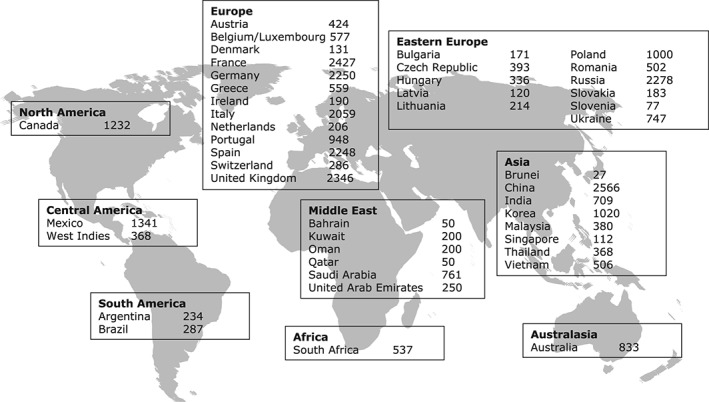
CLARIFY (ProspeCtive observational LongitudinAl RegIstry oF patients with stable coronary arterY disease) is an ongoing international observational longitudinal registry. Stable CAD patients from 45 countries in Europe, Asia, America, Middle East, Australia and Africa were enrolled between November 2009 and June 2010. The inclusion criteria were previous myocardial infarction, evidence of coronary stenosis >50%, proven symptomatic myocardial ischemia or prior revascularization procedure. The main exclusion criteria were serious non-cardiovascular disease, conditions interfering with life expectancy or severe other cardiovascular disease (including advanced heart failure). Follow-up visits were planned annually for up to 5 years, interspersed with 6-month telephone calls.
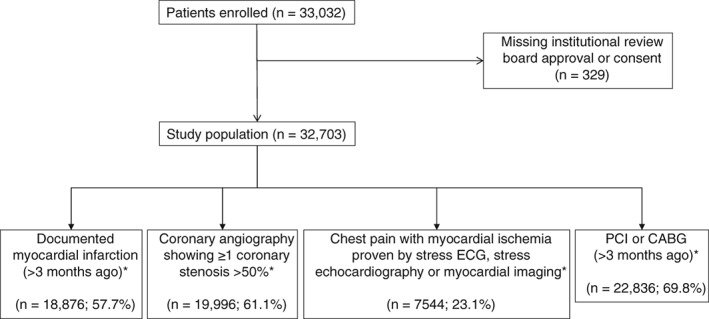
Of the 32,703 patients enrolled, most (77.6%) were male, age (mean ± SD) was 64.2 ± 10.5 years, and 71.0% were receiving treatment for hypertension; mean ± SD resting heart rate was 68.2 ± 10.6 bpm. Patients were enrolled based on a history of myocardial infarction >3 months earlier (57.7%), having at least one stenosis >50% on coronary angiography (61.1%), proven symptomatic myocardial ischemia on non-invasive testing (23.1%), or history of percutaneous coronary intervention or coronary artery bypass graft (69.8%). Baseline characteristics were similar across the four subgroups identified by the four inclusion criteria.
CLARIFY will provide a useful resource for understanding the current epidemiology of stable CAD.
尽管在预防和治疗方面取得了重大进展,但冠状动脉疾病(CAD)仍然是全球主要的死亡原因。虽然有许多关于急性冠状动脉综合征流行病学的数据来源,但较少有数据集反映稳定型CAD患者的当代管理和结局。
一个全球性的当代注册研究将增进我们对稳定型CAD的了解。主要目标是描述稳定型CAD门诊患者的人口统计学特征、临床概况、当代管理和结局;识别证据与治疗之间的差距;并调查长期预后决定因素。
CLARIFY(稳定冠状动脉疾病患者前瞻性观察纵向注册研究)是一项正在进行的国际观察性纵向注册研究。2009年11月至2010年6月期间,纳入了来自欧洲、亚洲、美洲、中东、澳大利亚和非洲45个国家的稳定型CAD患者。纳入标准为既往心肌梗死、冠状动脉狭窄>50%的证据、经证实的有症状心肌缺血或既往血运重建手术。主要排除标准为严重非心血管疾病、影响预期寿命的疾病或严重的其他心血管疾病(包括晚期心力衰竭)。计划每年进行随访,最长5年,期间穿插6个月的电话随访。
在纳入的32703例患者中,大多数(77.6%)为男性,年龄(均值±标准差)为64.2±10.5岁,71.0%的患者正在接受高血压治疗;静息心率均值±标准差为68.2±10.6次/分钟。患者根据3个月前的心肌梗死病史(57.7%)、冠状动脉造影显示至少一处狭窄>50%(61.1%)、无创检查证实有症状心肌缺血(23.1%)或经皮冠状动脉介入治疗或冠状动脉旁路移植术病史(69.8%)入组。根据四个纳入标准确定的四个亚组的基线特征相似。
CLARIFY将为了解稳定型CAD的当前流行病学提供有用的资源。