Cristóbal-García Magdalena, García-Arroyo Fernando E, Tapia Edilia, Osorio Horacio, Arellano-Buendía Abraham S, Madero Magdalena, Rodríguez-Iturbe Bernardo, Pedraza-Chaverrí José, Correa Francisco, Zazueta Cecilia, Johnson Richard J, Lozada Laura-Gabriela Sánchez
Department of Nephrology, INC Ignacio Chávez, 14080 Mexico City, DF, Mexico.
Department of Nephrology, INC Ignacio Chávez, 14080 Mexico City, DF, Mexico ; Laboratory of Renal Physiopathology, INC Ignacio Chávez, 14080 Mexico City, DF, Mexico.
Oxid Med Cell Longev. 2015;2015:535686. doi: 10.1155/2015/535686. Epub 2015 Mar 31.
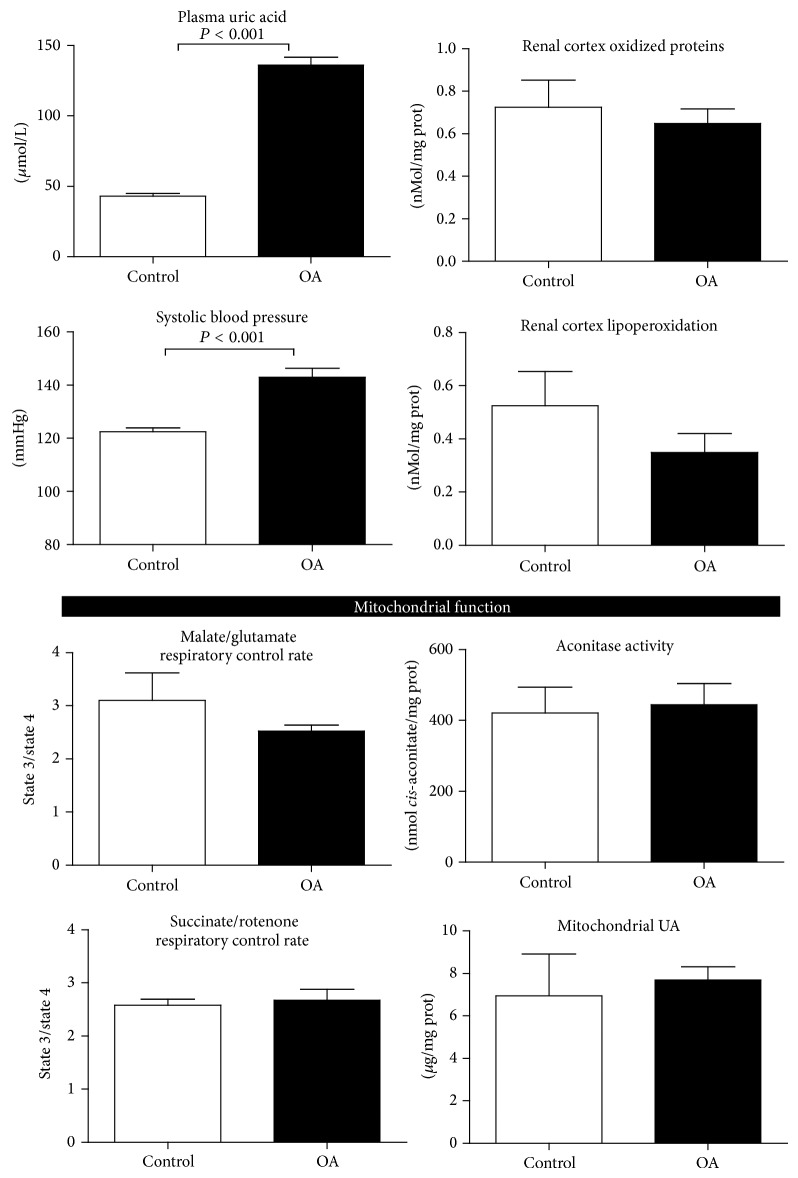
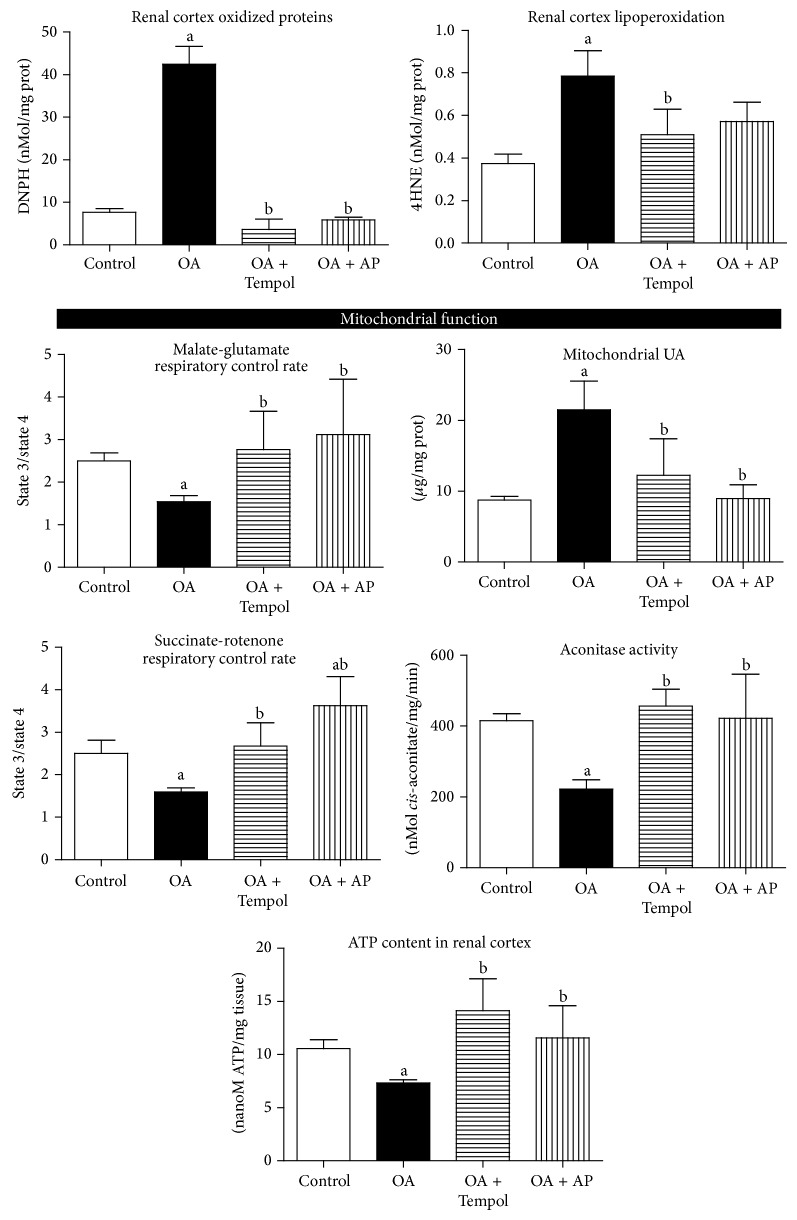
We addressed if oxidative stress in the renal cortex plays a role in the induction of hypertension and mitochondrial alterations in hyperuricemia. A second objective was to evaluate whether the long-term treatment with the antioxidant Tempol prevents renal oxidative stress, mitochondrial alterations, and systemic hypertension in this model. Long-term (11-12 weeks) and short-term (3 weeks) effects of oxonic acid induced hyperuricemia were studied in rats (OA, 750 mg/kg BW), OA+Allopurinol (AP, 150 mg/L drinking water), OA+Tempol (T, 15 mg/kg BW), or vehicle. Systolic blood pressure, renal blood flow, and vascular resistance were measured. Tubular damage (urine N-acetyl-β-D-glucosaminidase) and oxidative stress markers (lipid and protein oxidation) along with ATP levels were determined in kidney tissue. Oxygen consumption, aconitase activity, and uric acid were evaluated in isolated mitochondria from renal cortex. Short-term hyperuricemia resulted in hypertension without demonstrable renal oxidative stress or mitochondrial dysfunction. Long-term hyperuricemia induced hypertension, renal vasoconstriction, tubular damage, renal cortex oxidative stress, and mitochondrial dysfunction and decreased ATP levels. Treatments with Tempol and allopurinol prevented these alterations. Renal oxidative stress induced by hyperuricemia promoted mitochondrial functional disturbances and decreased ATP content, which represent an additional pathogenic mechanism induced by chronic hyperuricemia. Hyperuricemia-related hypertension occurs before these changes are evident.
我们探讨了肾皮质中的氧化应激是否在高尿酸血症诱导的高血压和线粒体改变中起作用。第二个目标是评估抗氧化剂Tempol的长期治疗是否能预防该模型中的肾氧化应激、线粒体改变和全身性高血压。研究了氧嗪酸诱导的高尿酸血症对大鼠的长期(11 - 12周)和短期(3周)影响(氧嗪酸,750 mg/kg体重),分为氧嗪酸 + 别嘌醇(别嘌醇,150 mg/L饮用水)、氧嗪酸 + Tempol(Tempol,15 mg/kg体重)或溶剂对照组。测量了收缩压、肾血流量和血管阻力。测定了肾组织中的肾小管损伤(尿N - 乙酰 - β - D - 氨基葡萄糖苷酶)和氧化应激标志物(脂质和蛋白质氧化)以及ATP水平。评估了肾皮质分离线粒体中的氧消耗、乌头酸酶活性和尿酸。短期高尿酸血症导致高血压,但未出现明显的肾氧化应激或线粒体功能障碍。长期高尿酸血症诱导高血压、肾血管收缩、肾小管损伤、肾皮质氧化应激和线粒体功能障碍,并降低ATP水平。Tempol和别嘌醇治疗可预防这些改变。高尿酸血症诱导的肾氧化应激促进了线粒体功能紊乱并降低了ATP含量,这代表了慢性高尿酸血症诱导的另一种致病机制。高尿酸血症相关的高血压在这些变化明显之前就已发生。