Tobian Aaron A R, Kigozi Godfrey, Manucci Jordyn, Grabowski Mary K, Serwadda David, Musoke Richard, Redd Andrew D, Nalugoda Fred, Reynolds Steven J, Kighoma Nehemiah, Laeyendecker Oliver, Lessler Justin, Gray Ronald H, Quinn Thomas C, Wawer Maria J
Department of Pathology, School of Medicine, Johns Hopkins University, Baltimore, Maryland, United States of America; Rakai Health Sciences Program, Entebbe, Uganda.
Rakai Health Sciences Program, Entebbe, Uganda.
PLoS Med. 2015 Apr 28;12(4):e1001820. doi: 10.1371/journal.pmed.1001820. eCollection 2015 Apr.
A randomized trial of voluntary medical male circumcision (MC) of HIV-infected men reported increased HIV transmission to female partners among men who resumed sexual intercourse prior to wound healing. We conducted a prospective observational study to assess penile HIV shedding after MC.
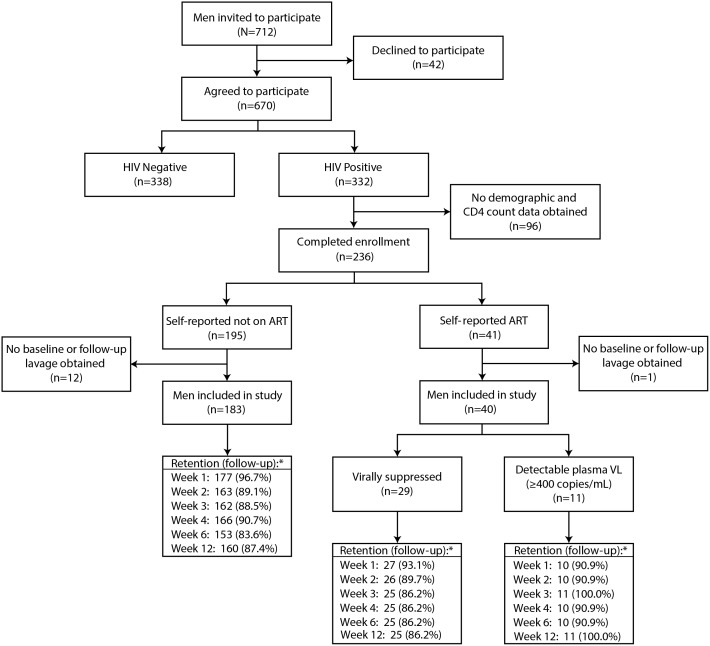
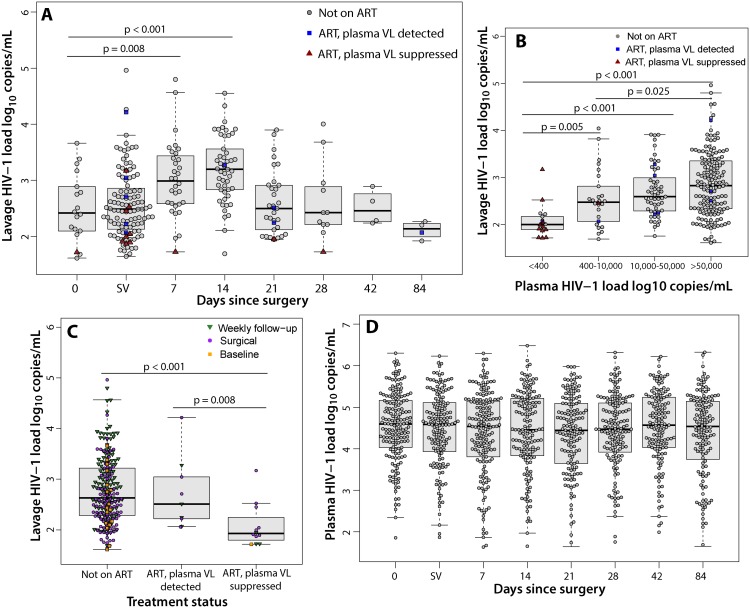
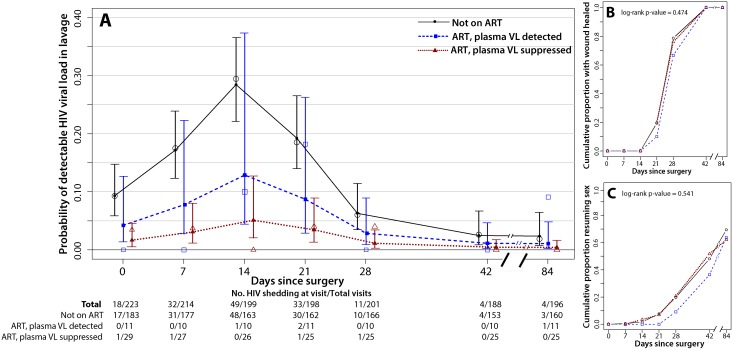
HIV shedding was evaluated among 223 HIV-infected men (183 self-reported not receiving antiretroviral therapy [ART], 11 self-reported receiving ART and had a detectable plasma viral load [VL], and 29 self-reported receiving ART and had an undetectable plasma VL [<400 copies/ml]) in Rakai, Uganda, between June 2009 and April 2012. Preoperative and weekly penile lavages collected for 6 wk and then at 12 wk were tested for HIV shedding and VL using a real-time quantitative PCR assay. Unadjusted prevalence risk ratios (PRRs) and adjusted PRRs (adjPRRs) of HIV shedding were estimated using modified Poisson regression with robust variance. HIV shedding was detected in 9.3% (17/183) of men not on ART prior to surgery and 39.3% (72/183) of these men during the entire study. Relative to baseline, the proportion shedding was significantly increased after MC at 1 wk (PRR = 1.87, 95% CI = 1.12-3.14, p = 0.012), 2 wk (PRR = 3.16, 95% CI = 1.94-5.13, p < 0.001), and 3 wk (PRR = 1.98, 95% CI = 1.19-3.28, p = 0.008) after MC. However, compared to baseline, HIV shedding was decreased by 6 wk after MC (PRR = 0.27, 95% CI = 0.09-0.83, p = 0.023) and remained suppressed at 12 wk after MC (PRR = 0.19, 95% CI = 0.06-0.64, p = 0.008). Detectable HIV shedding from MC wounds occurred in more study visits among men with an HIV plasma VL > 50,000 copies/ml than among those with an HIV plasma VL < 400 copies/ml (adjPRR = 10.3, 95% CI = 4.25-24.90, p < 0.001). Detectable HIV shedding was less common in visits from men with healed MC wounds compared to visits from men without healed wounds (adjPRR = 0.12, 95% CI = 0.07-0.23, p < 0.001) and in visits from men on ART with undetectable plasma VL compared to men not on ART (PRR = 0.15, 95% CI = 0.05-0.43, p = 0.001). Among men with detectable penile HIV shedding, the median log10 HIV copies/milliliter of lavage fluid was significantly lower in men with ART-induced undetectable plasma VL (1.93, interquartile range [IQR] = 1.83-2.14) than in men not on ART (2.63, IQR = 2.28-3.22, p < 0.001). Limitations of this observational study include significant differences in baseline covariates, lack of confirmed receipt of ART for individuals who reported ART use, and lack of information on potential ART initiation during follow-up for those who were not on ART at enrollment.
Penile HIV shedding is significantly reduced after healing of MC wounds. Lower plasma VL is associated with decreased frequency and quantity of HIV shedding from MC wounds. Starting ART prior to MC should be considered to reduce male-to-female HIV transmission risk. Research is needed to assess the time on ART required to decrease shedding, and the acceptability and feasibility of initiating ART at the time of MC.
一项针对感染艾滋病毒男性的自愿男性包皮环切术(MC)随机试验报告称,在伤口愈合前恢复性交的男性中,艾滋病毒向女性伴侣的传播有所增加。我们进行了一项前瞻性观察研究,以评估包皮环切术后阴茎艾滋病毒的脱落情况。
2009年6月至2012年4月期间,在乌干达拉凯对223名感染艾滋病毒的男性(183名自我报告未接受抗逆转录病毒治疗[ART],11名自我报告接受ART且血浆病毒载量[VL]可检测到,29名自我报告接受ART且血浆VL不可检测[<400拷贝/毫升])的艾滋病毒脱落情况进行了评估。术前及术后每周收集阴茎灌洗液,持续6周,然后在12周时进行检测,使用实时定量PCR检测艾滋病毒脱落和VL情况。使用具有稳健方差的修正泊松回归估计艾滋病毒脱落的未调整患病率风险比(PRR)和调整后PRR(adjPRR)。手术前未接受ART的男性中,9.3%(17/183)在整个研究期间检测到艾滋病毒脱落,这些男性中有39.3%(72/183)检测到艾滋病毒脱落。与基线相比,包皮环切术后1周(PRR = 1.87,95%CI = 1.12 - 3.14,p = 0.012)、2周(PRR = 3.16,95%CI = 1.94 - 5.13,p < 0.001)和3周(PRR = 1.98,95%CI = 1.19 - 3.28,p = 0.008)时,脱落比例显著增加。然而,与基线相比,包皮环切术后6周艾滋病毒脱落减少(PRR = 0.27,95%CI = 0.09 - 0.83,p = 0.023),在包皮环切术后12周仍受到抑制(PRR = 0.19,95%CI = 0.06 - 0.64,p = 0.008)。艾滋病毒血浆VL>50,000拷贝/毫升的男性在更多研究访视中检测到来自包皮环切伤口的可检测艾滋病毒脱落,而艾滋病毒血浆VL<400拷贝/毫升的男性则较少(adjPRR = 10.3,95%CI = 4.25 - 24.90,p < 0.001)。与未愈合伤口的男性相比,愈合包皮环切伤口的男性在访视中可检测到的艾滋病毒脱落较少见(adjPRR = 0.12,95%CI = 0.07 - 0.23,p < 0.001),与未接受ART的男性相比,接受ART且血浆VL不可检测的男性在访视中可检测到的艾滋病毒脱落较少(PRR = 0.15,95%CI = 0.05 - 0.43,p = 0.001)。在可检测到阴茎艾滋病毒脱落的男性中,接受ART导致血浆VL不可检测的男性灌洗液中艾滋病毒拷贝数/毫升的中位数对数(1.93,四分位间距[IQR]=1.83 - 2.14)显著低于未接受ART的男性(2.63,IQR = 2.28 - 3.22,p < 0.001)。这项观察性研究的局限性包括基线协变量存在显著差异、报告使用ART的个体缺乏确认的ART接受情况,以及对于入组时未接受ART的个体在随访期间缺乏潜在ART启动信息。
包皮环切伤口愈合后,阴茎艾滋病毒脱落显著减少。较低的血浆VL与包皮环切伤口艾滋病毒脱落的频率和数量减少相关。应考虑在包皮环切术前开始ART,以降低男性向女性传播艾滋病毒的风险。需要开展研究来评估降低脱落所需的ART治疗时间,以及在包皮环切时启动ART的可接受性和可行性。