Wu Yu-Tzu, Prina A Matthew, Barnes Linda E, Matthews Fiona E, Brayne Carol
Department of Public Health and Primary Care, Institute of Public Health, Forvie Site, University of Cambridge, School of Clinical Medicine, Cambridge Biomedical Campus, Cambridge CB2 0SR, UK.
Department of Public Health and Primary Care, Institute of Public Health, Forvie Site, University of Cambridge, School of Clinical Medicine, Cambridge Biomedical Campus, Cambridge CB2 0SR, UK Centre for Global Mental Health, Institute of Psychiatry, King's College London, De Crespigny Park, Denmark Hill, London SE5 8AF, UK.
J Public Health (Oxf). 2015 Sep;37(3):480-7. doi: 10.1093/pubmed/fdv050. Epub 2015 Apr 28.
Community environment might play an important role in supporting ageing in place. This paper aims to explore relocation at older age and its associations with individual and community level factors.
The postcodes of the 2424 people in the year-10 interview of the Cognitive Function and Ageing Study (CFAS) in England were mapped onto Enumeration Districts and linked to their corresponding Townsend deprivation score and the 2011 rural/urban categories. Multilevel logistic regression was conducted to examine the influence of the baseline individual (age, gender, education and social class) and community (rural/urban categories and area deprivation) level factors on relocation over 10 years.
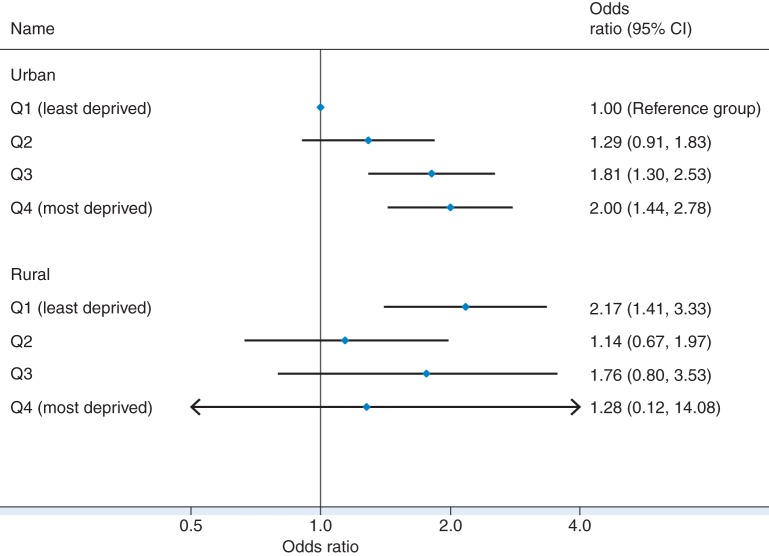
One-third of people moved residence after the age of 65 years and over. Older age, low education, low social class and living in rural areas at baseline were associated with higher probability of moving later in life. The likelihood of relocation in later life increased from least to most deprived areas (odds ratio: 2.0, 95% confidence interval: 1.4, 2.8).
Urban/rural contexts and area deprivation are associated with relocation at older age and indicate that community environment may be relevant to ageing in place.
社区环境可能在支持老年人就地养老方面发挥重要作用。本文旨在探讨老年人的搬迁情况及其与个人和社区层面因素的关联。
将英格兰认知功能与老龄化研究(CFAS)第10年访谈中2424人的邮政编码映射到枚举区,并与相应的汤森贫困得分及2011年农村/城市类别相关联。进行多水平逻辑回归分析,以检验基线时个人(年龄、性别、教育程度和社会阶层)和社区(农村/城市类别及地区贫困程度)层面因素对10年间搬迁情况的影响。
三分之一的人在65岁及以上时搬了家。年龄较大、教育程度低、社会阶层低以及基线时居住在农村地区与晚年搬家的可能性较高相关。晚年搬迁的可能性从最不贫困地区到最贫困地区逐渐增加(优势比:2.0,95%置信区间:1.4,2.8)。
城乡背景和地区贫困程度与老年人搬迁有关,表明社区环境可能与就地养老相关。