Jinnouchi Hideaki, Sugiyama Seigo, Yoshida Akira, Hieshima Kunio, Kurinami Noboru, Suzuki Tomoko, Miyamoto Fumio, Kajiwara Keizo, Matsui Kunihiko, Jinnouchi Tomio
Diabetes Care Center, Jinnouchi Hospital, 6-2-3 Kuhonji, Chuo-ku, Kumamoto 862-0976, Japan ; Division of Preventive Cardiology, Department of Cardiovascular Medicine, Kumamoto University Hospital, 1-1-1, Honjo, Chuo-ku, Kumamoto 860-8556, Japan ; Diabetes Care Center, Cardiovascular Division, Jinnouchi Hospital, 6-2-3 Kuhonji, Chuo-ku, Kumamoto 862-0976, Japan.
Diabetes Care Center, Jinnouchi Hospital, 6-2-3 Kuhonji, Chuo-ku, Kumamoto 862-0976, Japan ; Diabetes Care Center, Cardiovascular Division, Jinnouchi Hospital, 6-2-3 Kuhonji, Chuo-ku, Kumamoto 862-0976, Japan ; Department of Cardiovascular Medicine, Faculty of Life Sciences, Graduate School of Medical Science, Kumamoto University, 1-1-1, Honjo, Chuo-ku, Kumamoto 860-8556, Japan.
J Diabetes Res. 2015;2015:706416. doi: 10.1155/2015/706416. Epub 2015 Apr 2.
Glucagon-like peptide-1 (GLP-1) analog promotes insulin secretion by acting on pancreatic β-cells. This antihyperglycemic treatment for type 2 diabetes mellitus (DM) has attracted increased clinical attention not only for its antihyperglycemic action but also for its potential extrapancreatic effects. We investigated whether liraglutide, a GLP-1 analog, could enhance insulin sensitivity as assessed by the hyperinsulinemic-euglycemic clamp in type 2 DM patients.
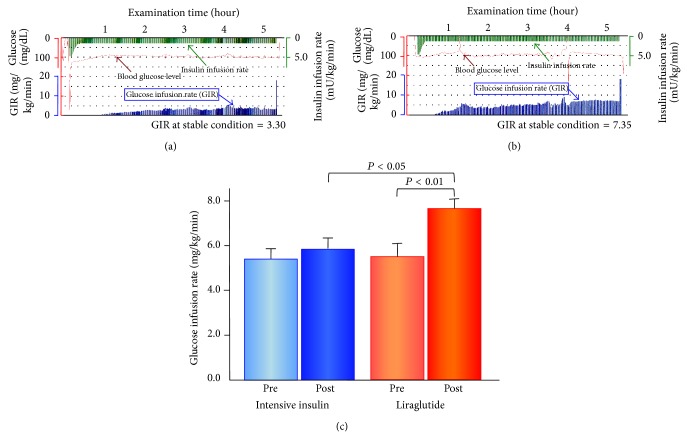
We prospectively enrolled 31 uncontrolled type 2 DM patients who were hospitalized and equally managed by guided diet- and exercise-therapies and then introduced to either liraglutide- or intensive insulin-therapy for 4 weeks. Insulin sensitivity was assessed by the glucose infusion rate (GIR) using hyperinsulinemic-euglycemic clamp before and after the therapies.
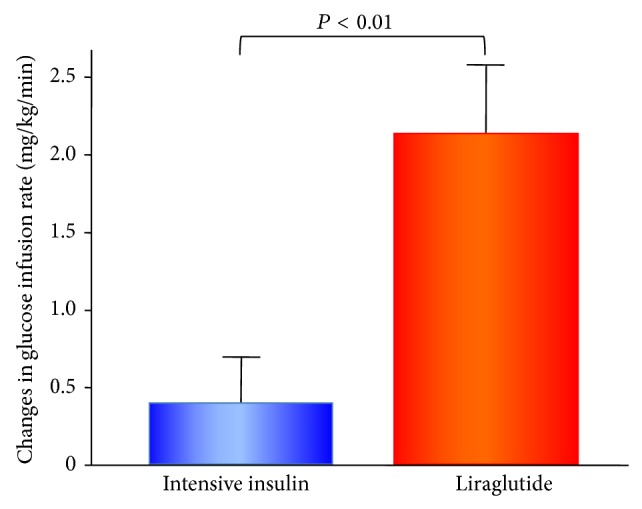
Values of HbA1c, postprandial plasma glucose, and body mass index (BMI) were significantly decreased by hospitalized intensive insulin-therapy or liraglutide-therapy. GIR was significantly increased by liraglutide-therapy but not by insulin-therapy, indicating that liraglutide-therapy significantly enhanced insulin sensitivity. BMI decreased during liraglutide-therapy but was not significantly correlated with changes in GIR. Multivariate logistic regression analysis demonstrated that liraglutide-therapy significantly correlated with increased insulin sensitivity in uncontrolled DM patients.
Liraglutide may exhibit favorable effects on diabetes control for type 2 DM patients by increasing insulin sensitivity as an extrapancreatic action. Clinical trial registration Unique Identifier is UMIN000015201.
胰高血糖素样肽-1(GLP-1)类似物通过作用于胰腺β细胞促进胰岛素分泌。这种用于2型糖尿病(DM)的抗高血糖治疗不仅因其抗高血糖作用,还因其潜在的胰腺外效应而受到越来越多的临床关注。我们研究了GLP-1类似物利拉鲁肽是否能增强2型DM患者的胰岛素敏感性,通过高胰岛素正常血糖钳夹试验进行评估。
我们前瞻性纳入了31例未得到控制的2型DM住院患者,他们接受了相同的饮食和运动疗法指导,然后分别接受利拉鲁肽或强化胰岛素治疗4周。在治疗前后,通过高胰岛素正常血糖钳夹试验使用葡萄糖输注率(GIR)评估胰岛素敏感性。
住院强化胰岛素治疗或利拉鲁肽治疗后,糖化血红蛋白(HbA1c)、餐后血糖和体重指数(BMI)值均显著降低。利拉鲁肽治疗使GIR显著增加,而胰岛素治疗则未使其增加,这表明利拉鲁肽治疗显著增强了胰岛素敏感性。利拉鲁肽治疗期间BMI下降,但与GIR的变化无显著相关性。多因素逻辑回归分析表明,利拉鲁肽治疗与未得到控制的DM患者胰岛素敏感性增加显著相关。
利拉鲁肽可能通过增加胰岛素敏感性这一胰腺外作用,对2型DM患者的糖尿病控制产生有益影响。临床试验注册号唯一标识符为UMIN000015201。