Watson Amanda H A, Sabumei Gaius, Mola Glen, Iedema Rick
PNG Economic and Public Sector Program, PO Box 776, Port Moresby, NCD 111, Papua New Guinea.
Visiting Fellow, School of International, Political and Strategic Studies, Australian National University, Canberra, ACT 0200, Australia.
J Pers Med. 2015 Apr 27;5(2):120-39. doi: 10.3390/jpm5020120.
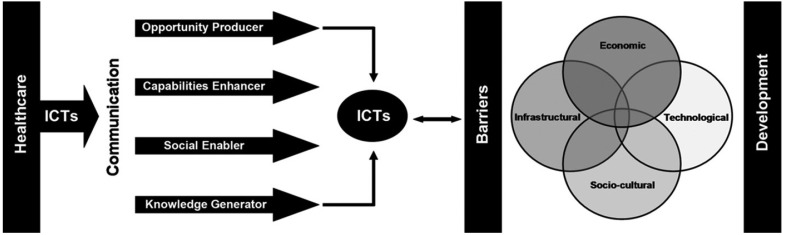
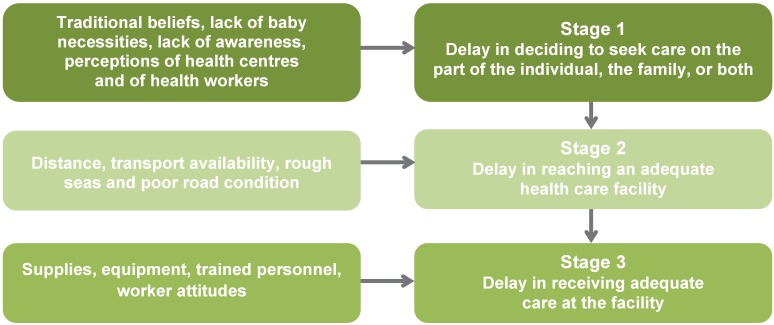
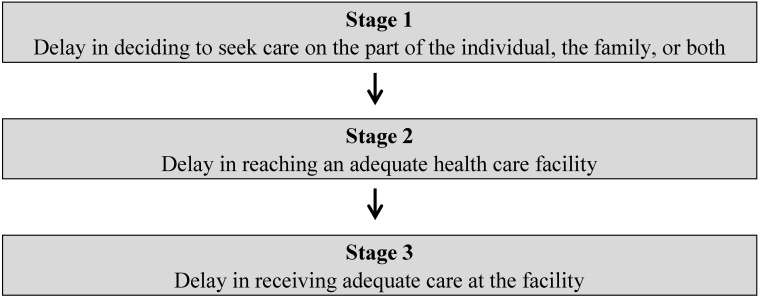
This paper presents the findings of a research project which has involved the establishment of a maternal health phone line in Milne Bay Province of Papua New Guinea (PNG). Mobile phones and landline phones are key information and communication technologies (ICTs). This research study uses the "ICTs for healthcare development" model to ascertain benefits and barriers to the successful implementation of the Childbirth Emergency Phone. PNG has a very high maternal mortality rate. The "three stages of delay" typology was developed by Thaddeus and Maine to determine factors that might delay provision of appropriate medical treatment and hence increase risk of maternal death. The "three stages of delay" typology has been utilised in various developing countries and also in the present study. Research undertaken has involved semi-structured interviews with health workers, both in rural settings and in the labour ward in Alotau. Additional data has been gathered through focus groups with health workers, analysis of notes made during phone calls, interviews with women and community leaders, observations and field visits. One hundred percent of interviewees (n = 42) said the project helped to solve communication barriers between rural health workers and Alotau Provincial Hospital. Specific examples in which the phone line has helped to create positive health outcomes will be outlined in the paper, drawn from research interviews. The Childbirth Emergency Phone project has shown itself to play a critical role in enabling healthcare workers to address life-threatening childbirth complications. The project shows potential for rollout across PNG; potentially reducing maternal morbidity and maternal mortality rates by overcoming communication challenges.
本文介绍了一个研究项目的成果,该项目涉及在巴布亚新几内亚(PNG)的米尔恩湾省建立一条孕产妇健康热线。移动电话和固定电话是关键的信息通信技术(ICT)。本研究采用“信息通信技术促进医疗保健发展”模型,以确定成功实施分娩应急电话的益处和障碍。巴布亚新几内亚的孕产妇死亡率非常高。萨迪厄斯和缅因州提出了“延误的三个阶段”类型学,以确定可能延误提供适当医疗治疗从而增加孕产妇死亡风险的因素。“延误的三个阶段”类型学已在各个发展中国家以及本研究中得到应用。所开展的研究包括对农村地区和阿洛陶产科病房的卫生工作者进行半结构化访谈。通过与卫生工作者进行焦点小组讨论、分析电话记录、采访妇女和社区领袖、观察和实地考察收集了更多数据。100%的受访者(n = 42)表示,该项目有助于解决农村卫生工作者与阿洛陶省医院之间的沟通障碍。本文将从研究访谈中概述热线电话有助于产生积极健康结果的具体实例。分娩应急电话项目已表明其在使医护人员能够应对危及生命的分娩并发症方面发挥着关键作用。该项目显示出在巴布亚新几内亚全国推广的潜力;通过克服沟通挑战,有可能降低孕产妇发病率和孕产妇死亡率。