School of Midwifery, Health Sciences Building, Laurentian University, 935 Ramsey Lake Road, Sudbury, ON, P3E 2C6, Canada.
Dalla Lana School of Public Health, Health Sciences Building, University of Toronto, 155 College Street, Suite 526, Toronto, ON, M5T 3M7, Canada.
BMC Pregnancy Childbirth. 2018 Jun 20;18(1):254. doi: 10.1186/s12884-018-1881-3.
In Haiti, the number of women dying in pregnancy, during childbirth and the weeks after giving birth remains unacceptably high. The objective of this research was to explore determinants of maternal mortality in rural Haiti through Community-Based Action Research (CBAR), guided by the delays that lead to maternal death. This paper focuses on socioecological determinants of maternal mortality from the perspectives of women of near-miss maternal experiences and community members, and their solutions to reduce maternal mortality in their community.
The study draws on five semi-structured Individual Interviews with women survivors of near-misses, and on four Focus Group Discussions with Community Leaders and with Traditional Birth Attendants. Data collection took place in July 2013. A Community Research Team within a resource-limited rural community in Haiti undertook the research. The methods and analysis process were guided by participatory research and CBAR.
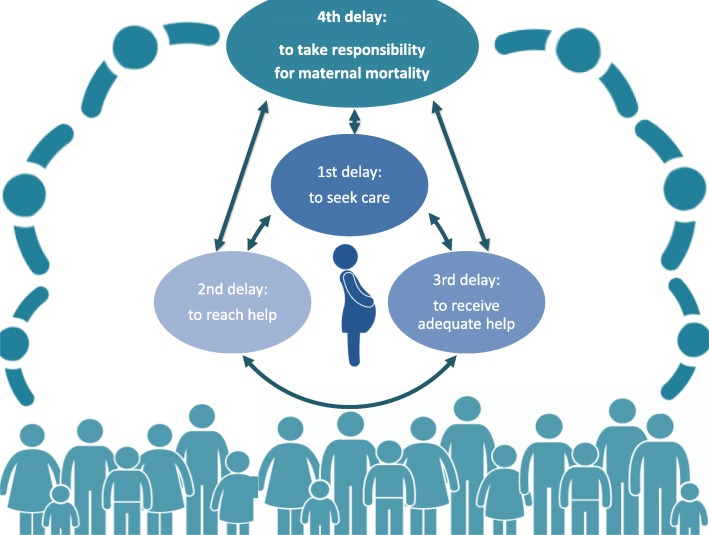
Participants identified three delays that lead to maternal death but also described a fourth delay with respect to community responsibility for maternal mortality. They included women being carried from the community to a healthcare facility as a special example of the fourth delay. Women survivors of near-miss maternal experiences and community leaders suggested solutions to reduce maternal death that centered on prevention and community infrastructure. Most of the strategies for action were related to the fourth delay and include: community mobilization by way of the formation of Neighbourhood Maternal Health/Well-being Committees, and community support through the provision/sharing of food for undernourished women, offering monetary support and establishment of a communication relay/transport system in times of crisis.
Finding sustainable ways to reduce maternal mortality requires a community-based/centred and community-driven comprehensive approach to maternal health/well-being. This includes engagement of community members that is dependent upon community knowledge, political will, mobilization, accountability and empowerment. An engaged/empowered community is one that is well placed to find ways that work in their community to reduce the fourth delay and in turn, maternal death. Potentially, community ownership of challenges and solutions can lead to more sustainable improvements in maternal health/well-being in Haiti.
在海地,孕产妇死亡人数居高不下,令人无法接受。本研究旨在通过以导致孕产妇死亡的延误为指导的基于社区的行动研究(CBAR),探讨海地农村地区孕产妇死亡的决定因素。本文重点从接近孕产妇死亡经历的妇女和社区成员的角度,以及他们在社区中降低孕产妇死亡率的解决方案,探讨孕产妇死亡的社会生态决定因素。
本研究借鉴了 5 名接近孕产妇死亡经历的妇女幸存者的 5 次半结构式个人访谈,以及 4 次社区领导人和传统助产士的焦点小组讨论。数据收集于 2013 年 7 月进行。一个资源有限的海地农村社区内的社区研究团队开展了这项研究。该方法和分析过程以参与式研究和 CBAR 为指导。
参与者确定了导致孕产妇死亡的三个延误,但也描述了第四个延误,即社区对孕产妇死亡的责任。其中包括将妇女从社区送往医疗机构,这是第四个延误的一个特殊例子。接近孕产妇死亡经历的妇女幸存者和社区领导提出了减少孕产妇死亡的解决方案,这些方案以预防和社区基础设施为中心。大多数行动策略都与第四个延误有关,包括:通过组建邻里孕产妇健康/福祉委员会实现社区动员,以及通过为营养不良的妇女提供/分享食物、提供经济支持和在危机时期建立沟通接力/运输系统来提供社区支持。
找到可持续的方法来降低孕产妇死亡率需要采取以社区为基础/中心和以社区为驱动的全面孕产妇健康/福祉方法。这包括社区成员的参与,这取决于社区知识、政治意愿、动员、问责制和赋权。一个参与/赋权的社区更有能力找到适合其社区的方法,以减少第四个延误,从而降低孕产妇死亡率。社区对挑战和解决方案的所有权可能会导致海地孕产妇健康/福祉的可持续改善。