Chum Antony, O'Campo Patricia
Department of Social and Environmental Health Research, London School of Hygiene and Tropical Medicine, 15-17 Tavistock Place, London, WC1H 9SH, UK.
Centre for Research on Inner City Health, St. Michael's Hospital, 209 Victoria, 3rd floor, Toronto, ON, M5B 1C6, Canada.
BMC Public Health. 2015 Apr 30;15:438. doi: 10.1186/s12889-015-1788-0.
Prior research examining neighbourhood effects on cardiovascular diseases (CVDs) has focused on the impact of neighbourhood socio-economic status or a few selected environmental variables. No studies of cardiovascular disease outcomes have investigated a broad range of urban planning related environmental factors. This is the first study to combine multiple neighbourhood influences in an integrated approach to understanding the association between the built and social environment and CVDs. By modeling multiple neighbourhood level social and environmental variables simultaneously, the study improved the estimation of effects by accounting for potential contextual confounders.
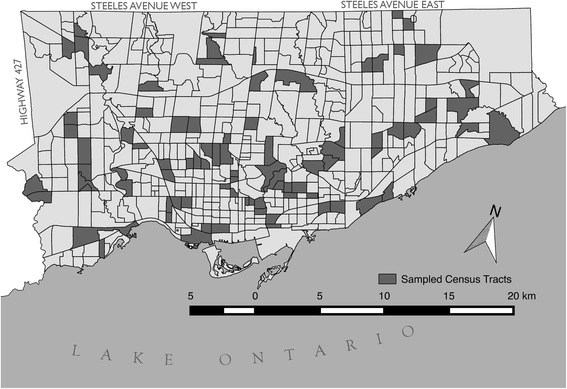
Data were collected using a cross-sectional survey (n = 2411) across 87 census tracts (CT) in Toronto, Canada, and commercial and census data were accessed to characterize the residential environment. Multilevel regressions were used to estimate the associations of neighbourhood factors on the risk of CVD.
Exposure to violent crimes, environmental noise, and proximity to a major road were independently associated with increased odds of CVDs (p < 0.05) in the fully adjusted model. While reduced access to food stores, parks/recreation, and increased access to fast food restaurants were associated with increased odds of CVDs in partially adjusted models (p < 0.05), these associations were fully attenuated after adjusting for BMI and physical activity. Housing disrepair was not associated with CVD risk.
These findings illustrate the importance of measuring and modeling a broad range of neighborhood factors--exposure to violent crimes, environmental noise, and traffic, and access to food stores, fast food, parks/recreation areas--to identify specific stressors in relation to adverse health outcomes. Further research to investigate the temporal order of events is needed to better understand the direction of causation for the observed associations.
先前关于邻里环境对心血管疾病(CVD)影响的研究主要集中在邻里社会经济地位或少数选定环境变量的影响上。尚无关于心血管疾病结局的研究调查过与城市规划相关的广泛环境因素。这是第一项采用综合方法将多种邻里影响因素结合起来,以了解建成环境和社会环境与心血管疾病之间关联的研究。通过同时对多个邻里层面的社会和环境变量进行建模,该研究通过考虑潜在的背景混杂因素改进了效应估计。
通过对加拿大多伦多87个人口普查区(CT)进行横断面调查(n = 2411)收集数据,并获取商业和人口普查数据以描述居住环境。使用多水平回归来估计邻里因素与心血管疾病风险之间的关联。
在完全调整模型中,遭受暴力犯罪、环境噪音以及靠近主要道路与心血管疾病风险增加独立相关(p < 0.05)。虽然在部分调整模型中,食品店、公园/娱乐设施的可达性降低以及快餐店的可达性增加与心血管疾病风险增加相关(p < 0.05),但在调整体重指数(BMI)和身体活动后,这些关联完全减弱。房屋失修与心血管疾病风险无关。
这些发现表明,测量和建模广泛的邻里因素——遭受暴力犯罪、环境噪音和交通影响,以及食品店、快餐店、公园/娱乐区的可达性——对于识别与不良健康结局相关的特定压力源非常重要。需要进一步研究调查事件的时间顺序,以更好地理解所观察到的关联的因果方向。