Center for Clinical and Epidemiologic Research, Beijing Anzhen Hospital, Capital Medical University, 100029, Beijing, China.
Beijing Institute of Heart, Lung and Blood Vessel Diseases, Beijing, 100029, China.
Int J Health Geogr. 2023 Jul 29;22(1):16. doi: 10.1186/s12942-023-00340-9.
The availability of physical activity (PA) facilities in neighborhoods is hypothesized to influence cardiovascular disease (CVD), but evidence from individual-level long-term cohort studies is limited. We aimed to assess the association between neighborhood exposure to PA facilities and CVD incidence.
A total of 4658 participants from the Chinese Multi-provincial Cohort Study without CVD at baseline (2007-2008) were followed for the incidence of CVD, coronary heart disease (CHD), and stroke. Availability of PA facilities was defined as both the presence and the density of PA facilities within a 500-m buffer zone around the participants' residential addresses. Time-dependent Cox regression models were performed to estimate the associations between the availability of PA facilities and risks of incident CVD, CHD, and stroke.
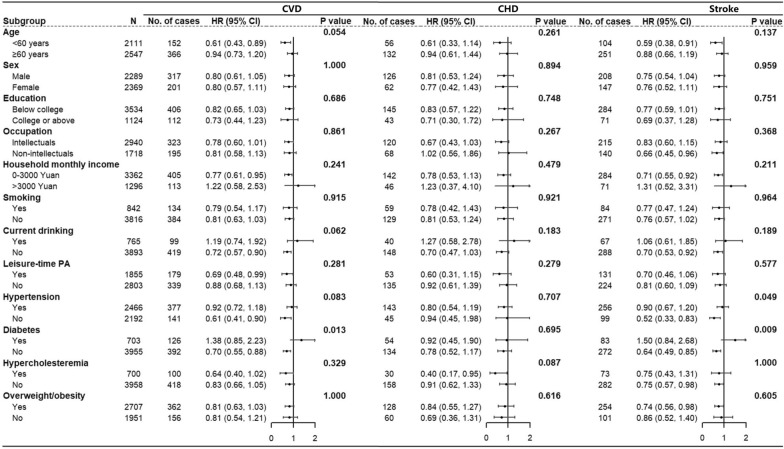
During a median follow-up of 12.1 years, there were 518 CVD events, 188 CHD events, and 355 stroke events. Analyses with the presence indicator revealed significantly lower risks of CVD (hazard ratio [HR] 0.80, 95% confidence interval ([CI] 0.65-0.99) and stroke (HR 0.76, 95% CI 0.60-0.97) in participants with PA facilities in the 500-m buffer zone compared with participants with no nearby facilities in fully adjusted models. In analyses with the density indicator, exposure to 2 and ≥ 3 PA facilities was associated with 35% (HR 0.65, 95% CI 0.47-0.91) and 28% (HR 0.72, 95% CI 0.56-0.92) lower risks of CVD and 40% (HR 0.60, 95% CI 0.40-0.90) and 38% (HR 0.62, 95% CI 0.46-0.84) lower risks of stroke compared with those without any PA facilities in 500-m buffer, respectively. Effect modifications between presence of PA facilities and a history of hypertension for incident stroke (P = 0.049), and a history of diabetes for incident CVD (P = 0.013) and stroke (P = 0.009) were noted.
Residing in neighborhoods with better availability of PA facilities was associated with a lower risk of incident CVD. Urban planning intervention policies that increase the availability of PA facilities could contribute to CVD prevention.
人们假设社区内体育锻炼设施的可用性会影响心血管疾病(CVD),但来自个体水平的长期队列研究的证据有限。我们旨在评估社区内体育锻炼设施的暴露与 CVD 发病之间的关联。
共有 4658 名来自中国多省份队列研究的参与者,在基线时(2007-2008 年)没有 CVD,随访 CVD、冠心病(CHD)和中风的发病情况。体育锻炼设施的可用性定义为参与者居住地址周围 500 米缓冲区中体育锻炼设施的存在和密度。使用时间依赖性 Cox 回归模型估计体育锻炼设施的可用性与 CVD 发病、CHD 和中风风险之间的关系。
在中位随访 12.1 年期间,发生了 518 例 CVD 事件、188 例 CHD 事件和 355 例中风事件。在使用存在指标的分析中,与没有附近设施的参与者相比,在 500 米缓冲区中拥有体育锻炼设施的参与者 CVD(风险比 [HR] 0.80,95%置信区间 [CI] 0.65-0.99)和中风(HR 0.76,95% CI 0.60-0.97)的发病风险显著降低。在使用密度指标的分析中,暴露于 2 个和≥3 个 PA 设施与 CVD 的发病风险降低 35%(HR 0.65,95% CI 0.47-0.91)和 28%(HR 0.72,95% CI 0.56-0.92),与中风的发病风险降低 40%(HR 0.60,95% CI 0.40-0.90)和 38%(HR 0.62,95% CI 0.46-0.84),与在 500 米缓冲区内没有任何 PA 设施的参与者相比。对于中风发病,PA 设施存在和高血压病史之间存在效应修饰(P=0.049),对于 CVD 发病和中风发病,糖尿病病史之间存在效应修饰(P=0.013 和 P=0.009)。
居住在体育锻炼设施可用性较好的社区与 CVD 发病风险降低有关。增加体育锻炼设施可用性的城市规划干预政策可能有助于预防 CVD。