Sun Lijuan, Liu Bodu, Lin Zhaoyu, Yao Yandan, Chen Yanyang, Li Yang, Chen Jianing, Yu Dongsheng, Tang Zhangui, Wang Bosheng, Zeng Shuguang, Fan Song, Wang Youyuan, Li Yilin, Song Erwei, Li Jinsong
Guangdong Provincial Key Laboratory of Malignant Tumor Epigenetics and Gene Regulation, Sun Yat-Sen Memorial Hospital, Sun Yat-Sen University, Guangzhou, 510120, China.
Department of Oral & Maxillofacial Surgery, Sun Yat-sen Memorial Hospital, Sun Yat-sen University, Guangzhou, 510120, China.
Mol Cancer. 2015 Apr 29;14:96. doi: 10.1186/s12943-015-0344-y.
Salivary Adenoid cystic carcinoma (SACC) patients with local invasion and lung metastasis are often resistant to conventional therapy such as operation, chemotherapy and radiotherapy. To explore the underling mechanisms, we studied the roles of miRNA in regulating invasiveness of SACC cells.
MicroRNA profiling was done in SACC cells with microarray. MiRNA mimics or antisense oligonucleotide was transfected and invasiveness of SACC cells was evaluated by adhesion assay and transwell assay. The target gene of miRNA was identified by luciferase reporter assay and "rescue" experiment. Tumor metastasis was evaluated by BALB/c-nu mice xenografts. MiRNA and its target gene expression were identified by in-situ hybridization and immunohistochemistry respectively, in 302 patients from affiliated hospitals of Sun Yat-sen University and in 148 patients from affiliated hospitals of Central South University, and correlated to the clinicopathological status of the patients.
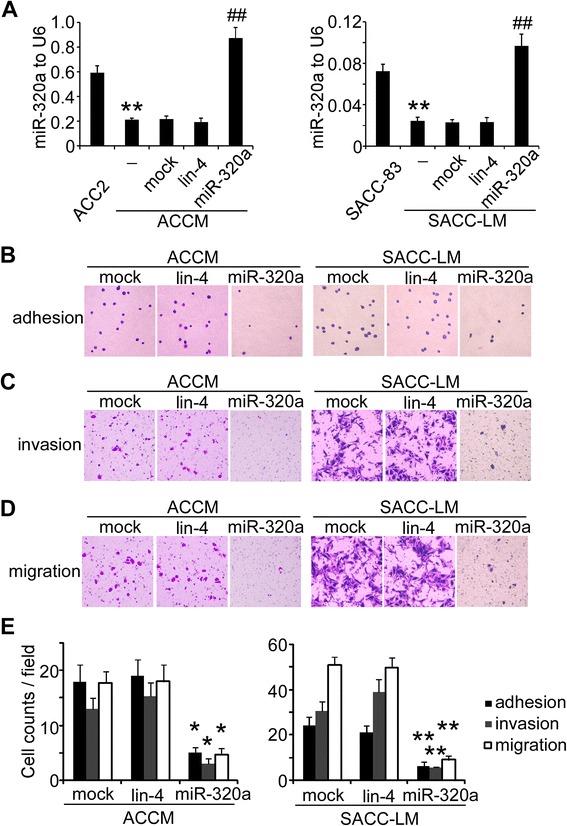
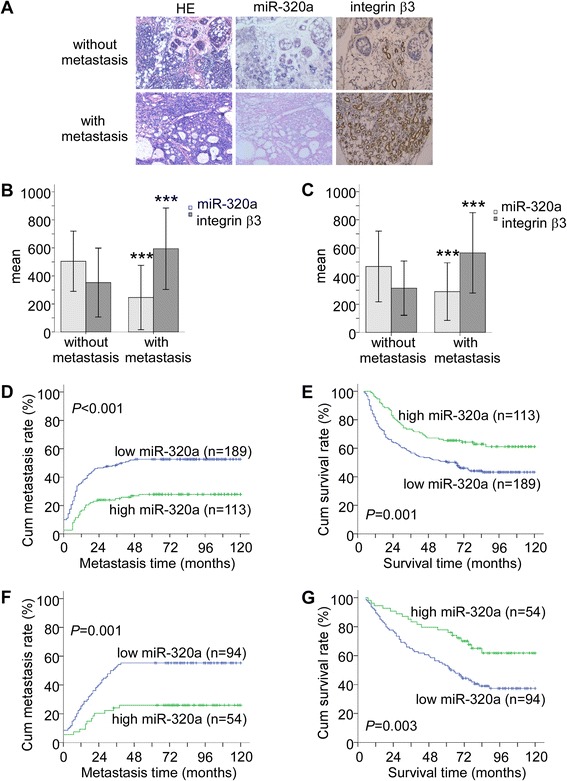
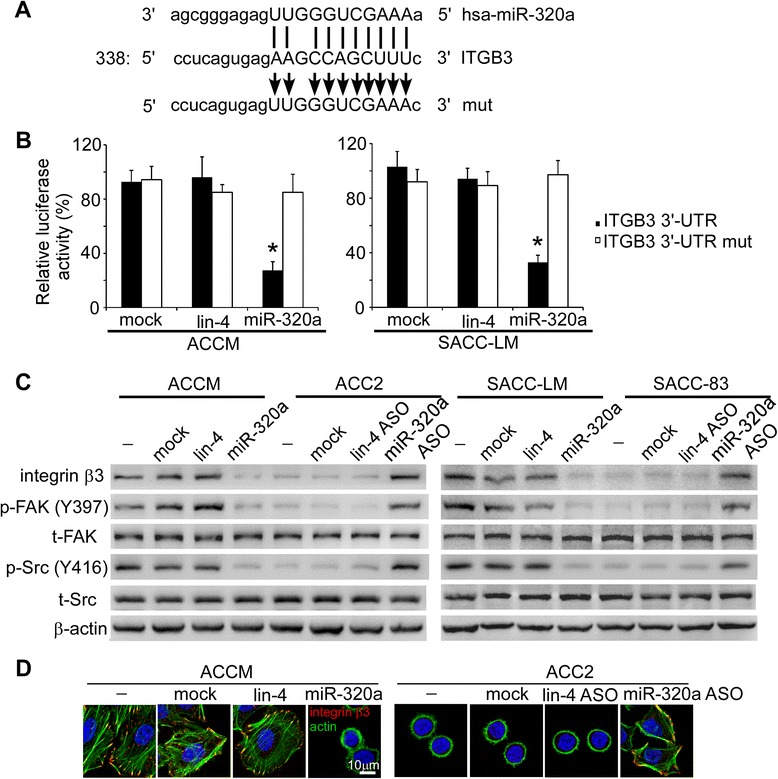
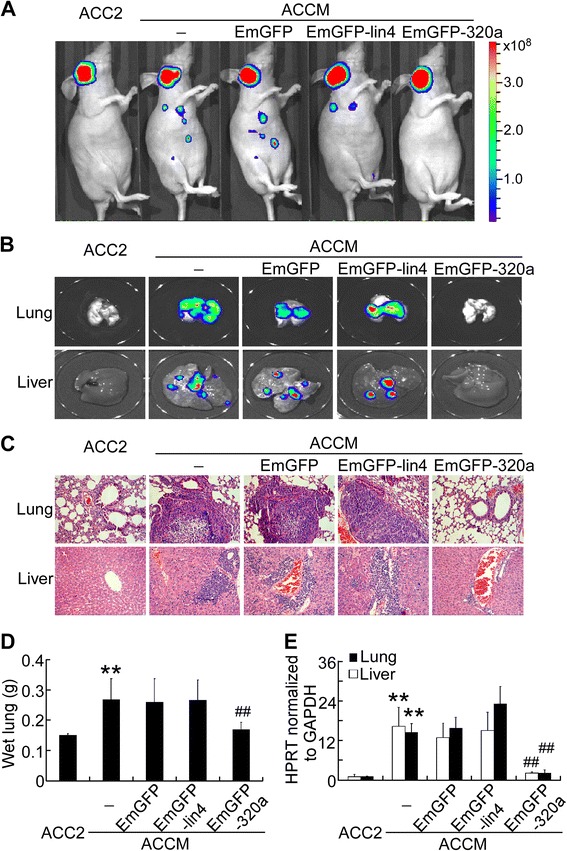
MiR-320a was down-regulated in high lung metastatic ACCM and SACC-LM cells compared with the corresponding low metastatic ACC2 and SACC-83 cells, and inhibited adhesion, invasion and migration of SACC cells by targeting integrin beta 3 (ITGB3). In vivo, enforced miR-320a expression suppressed metastasis of SACC xenografts. In the two independent sets, miR-320a was downregulated in primary SACCs with metastasis compared to those without metastasis, and low expression of this miRNA predicts poor patient survival and rapid metastasis. Multivariate analysis showed that miR-320a expression was an independent indicator of lung metastasis.
MiR-320a inhibits metastasis in SACCs by targeting ITGB3 and may serve as a therapeutic target and prognostic marker in salivary cancers.
局部侵袭和肺转移的涎腺腺样囊性癌(SACC)患者通常对手术、化疗和放疗等传统治疗有抗性。为探究潜在机制,我们研究了微小RNA(miRNA)在调节SACC细胞侵袭性中的作用。
用微阵列对SACC细胞进行微小RNA谱分析。转染miRNA模拟物或反义寡核苷酸,通过黏附试验和Transwell试验评估SACC细胞的侵袭性。通过荧光素酶报告基因试验和“挽救”实验鉴定miRNA的靶基因。通过BALB/c-nu小鼠异种移植评估肿瘤转移。分别用原位杂交和免疫组化鉴定中山大学附属医院302例患者及中南大学附属医院148例患者的miRNA及其靶基因表达,并与患者的临床病理状态相关联。
与相应的低转移ACC2和SACC-83细胞相比,高肺转移ACCM和SACC-LM细胞中miR-320a表达下调,其通过靶向整合素β3(ITGB3)抑制SACC细胞的黏附、侵袭和迁移。在体内,增强miR-320a表达可抑制SACC异种移植瘤的转移。在两个独立队列中,与无转移的原发性SACC相比,有转移的原发性SACC中miR-320a表达下调,该miRNA低表达预示患者生存率低且转移迅速。多因素分析表明,miR-320a表达是肺转移的独立指标。
miR-320a通过靶向ITGB3抑制SACC转移,可能作为涎腺癌的治疗靶点和预后标志物。