Owino Eunice A, Sang Rosemary, Sole Catherine L, Pirk Christian, Mbogo Charles, Torto Baldwyn
International Centre of Insect Physiology and Ecology, P.O BOX 30772-00100, Nairobi, Kenya, Africa.
Department of Zoology and Entomology, University of Pretoria, Pretoria, South Africa.
Parasit Vectors. 2015 Apr 29;8:253. doi: 10.1186/s13071-015-0866-6.
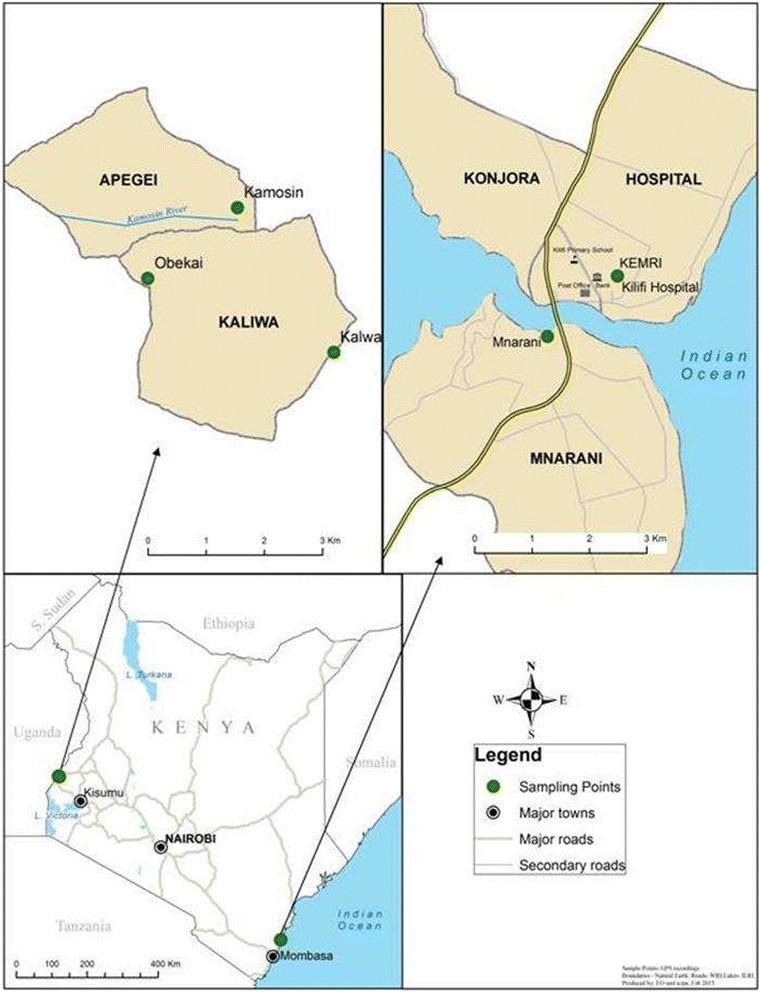
Effective surveillance and estimation of the biting fraction of Aedes aegypti is critical for accurate determination of the extent of virus transmission during outbreaks and inter-epidemic periods of dengue and chikungunya fever. Here, we describe the development and use of synthetic human odor baits for improved sampling of adult Ae. aegypti, in two dengue and chikungunya fevers endemic areas in Kenya; Kilifi and Busia counties.
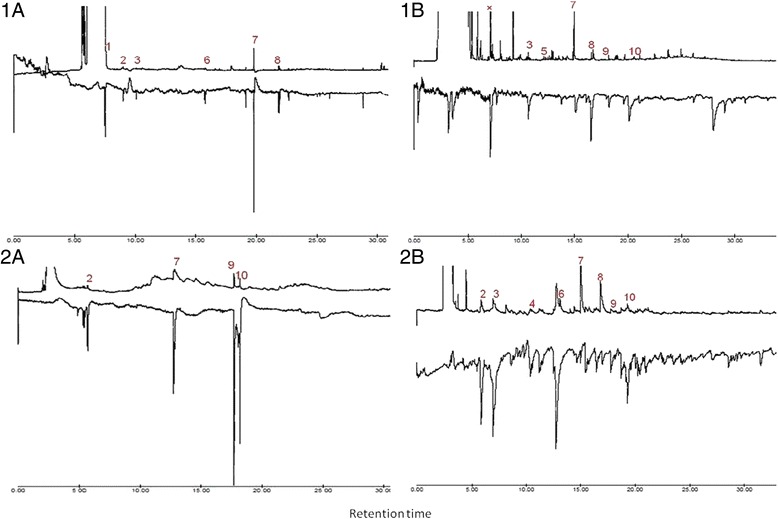
We collected volatiles from the feet and trunks of two female and two male volunteers aged between 25 and 45 years. We used coupled gas chromatography- electroantennographic detection (GC/EAD) analysis to screen for antennally-active components from the volatiles and coupled GC-mass spectrometry (GC/MS) to identify the EAD-active components. Using randomized replicated designs, we compared the efficacies of Biogents (BG) sentinel traps baited with carbon dioxide plus either single or blends of the identified compounds against the BG sentinel trap baited with carbon dioxide plus the BG commercial lure in trapping Ae. aegypti. The daily mosquito counts in the different traps were subjected to negative binomial regression following the generalized linear models procedures.
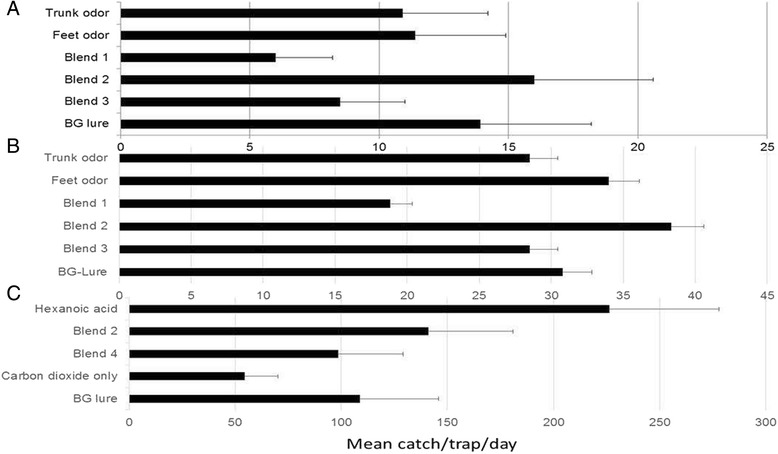
A total of ten major EAD-active components identified by GC/MS as mainly aldehydes and carboxylic acids, were consistently isolated from the human feet and trunk volatiles from at least two volunteers. Field assays with synthetic chemicals of the shared EAD-active components identified from the feet and trunk gave varying results. Ae. aegypti were more attracted to carbon dioxide baited BG sentinel traps combined with blends of aldehydes than to similar traps combined with blends of carboxylic acids. When we assessed the efficacy of hexanoic acid detected in odors of the BG commercial lure and volunteers plus carbon dioxide, trap captures of Ae. aegypti doubled over the trap baited with the commercial BG lure. However, dispensing aldehydes and carboxylic acids together in blends, reduced trap captures of Ae. aegypti by ~45%-50%.
Our results provide evidence for roles of carboxylic acids and aldehydes in Ae. aegypti host attraction and also show that of the carboxylic acids, hexanoic acid is a more effective lure for the vector than the BG commercial lure.
对埃及伊蚊叮咬率进行有效的监测和评估,对于准确确定登革热和基孔肯雅热疫情暴发期间及流行间期病毒传播的程度至关重要。在此,我们描述了合成人类气味诱饵的开发及应用,以改进在肯尼亚两个登革热和基孔肯雅热流行地区(基利菲县和布西亚县)对成年埃及伊蚊的采样。
我们收集了两名年龄在25至45岁之间的女性和两名男性志愿者足部和躯干的挥发物。我们使用气相色谱 - 触角电位检测联用(GC/EAD)分析来筛选挥发物中具有触角活性的成分,并使用气相色谱 - 质谱联用(GC/MS)来鉴定EAD活性成分。采用随机重复设计,我们比较了用二氧化碳加已鉴定化合物的单一成分或混合物诱饵的Biogents(BG)诱蚊灯诱捕埃及伊蚊的效果,与用二氧化碳加BG商业诱饵的BG诱蚊灯进行对比。按照广义线性模型程序,对不同诱蚊灯中每日捕获的蚊子数量进行负二项式回归分析。
通过GC/MS共鉴定出10种主要的EAD活性成分,主要为醛类和羧酸类,这些成分至少从两名志愿者的足部和躯干挥发物中持续分离得到。对从足部和躯干中鉴定出的共享EAD活性成分的合成化学品进行的现场试验得出了不同的结果。与羧酸混合物组合的类似诱蚊灯相比,埃及伊蚊更倾向于被二氧化碳诱饵的BG诱蚊灯与醛混合物组合所吸引。当我们评估在BG商业诱饵和志愿者气味中检测到的己酸加二氧化碳的诱捕效果时,捕获的埃及伊蚊数量比用商业BG诱饵的诱蚊灯增加了一倍。然而,将醛类和羧酸类混合在一起投放时,捕获的埃及伊蚊数量减少了约45% - 50%。
我们的结果为羧酸类和醛类在埃及伊蚊宿主吸引中的作用提供了证据,并且还表明,在羧酸类中,己酸对该媒介的引诱作用比BG商业诱饵更有效。