Department of Chemistry, University of Pretoria, Hatfield, Pretoria, South Africa.
Forestry and Agricultural Biotechnology Institute, University of Pretoria, Hatfield, Pretoria, South Africa.
Parasit Vectors. 2020 Feb 17;13(1):80. doi: 10.1186/s13071-020-3960-3.
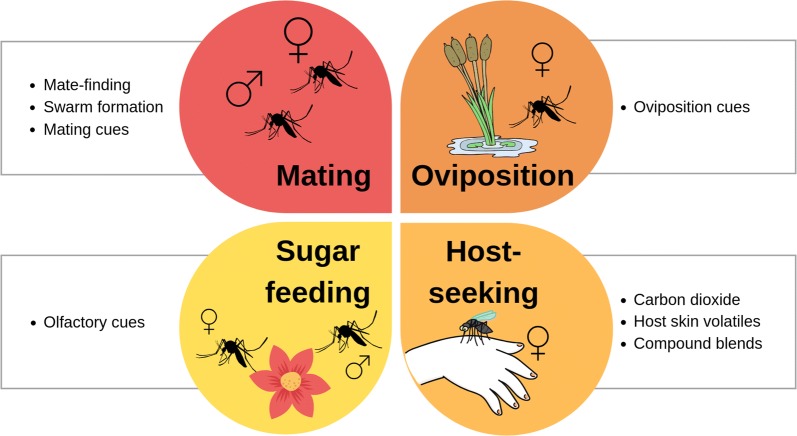
The use of semiochemicals in odour-based traps for surveillance and control of vector mosquitoes is deemed a new and viable component for integrated vector management programmes. Over 114 semiochemicals have been identified, yet implementation of these for management of infectious diseases such as malaria, dengue, chikungunya and Rift Valley fever is still a major challenge. The difficulties arise due to variation in how different mosquito species respond to not only single chemical compounds but also complex chemical blends. Additionally, mosquitoes respond to different volatile blends when they are looking for a mating partner, oviposition sites or a meal. Analytically the challenge lies not only in correctly identifying these semiochemical signals and cues but also in developing formulations that effectively mimic blend ratios that different mosquito species respond to. Only then can the formulations be used to enhance the selectivity and efficacy of odour-based traps. Understanding how mosquitoes use semiochemical cues and signals to survive may be key to unravelling these complex interactions. An overview of the current studies of these chemical messages and the chemical ecology involved in complex behavioural patterns is given. This includes an updated list of the semiochemicals which can be used for integrated vector control management programmes. A thorough understanding of these semiochemical cues is of importance for the development of new vector control methods that can be integrated into established control strategies.
在基于气味的诱捕器中使用信息素来监测和控制病媒蚊子,被认为是综合病媒管理计划的一个新的可行组成部分。已经确定了超过 114 种信息素,但这些信息素在管理疟疾、登革热、基孔肯雅热和裂谷热等传染病方面的实施仍然是一个主要挑战。出现这些困难的原因是,不同的蚊子物种不仅对单一的化学化合物,而且对复杂的化学混合物的反应方式存在差异。此外,蚊子在寻找交配伴侣、产卵地点或食物时,会对不同的挥发性混合物做出反应。在分析方面,挑战不仅在于正确识别这些信息素信号和线索,还在于开发出能够有效模拟不同蚊子物种所响应的混合物比例的配方。只有这样,才能利用这些配方来提高基于气味的诱捕器的选择性和效果。了解蚊子如何利用信息素线索和信号来生存,可能是揭示这些复杂相互作用的关键。本文概述了当前对这些化学信息和复杂行为模式所涉及的化学生态学的研究。这包括可用于综合病媒控制管理计划的信息素的更新清单。彻底了解这些信息素线索对于开发可整合到既定控制策略中的新的病媒控制方法非常重要。