Swarts Daan C, Hegge Jorrit W, Hinojo Ismael, Shiimori Masami, Ellis Michael A, Dumrongkulraksa Justin, Terns Rebecca M, Terns Michael P, van der Oost John
Laboratory of Microbiology, Department of Agrotechnology and Food Sciences, Wageningen University, 6703 HB Wageningen, The Netherlands.
Department of Biochemistry and Molecular Biology, University of Georgia, Athens, Georgia 30602, USA.
Nucleic Acids Res. 2015 May 26;43(10):5120-9. doi: 10.1093/nar/gkv415. Epub 2015 Apr 29.
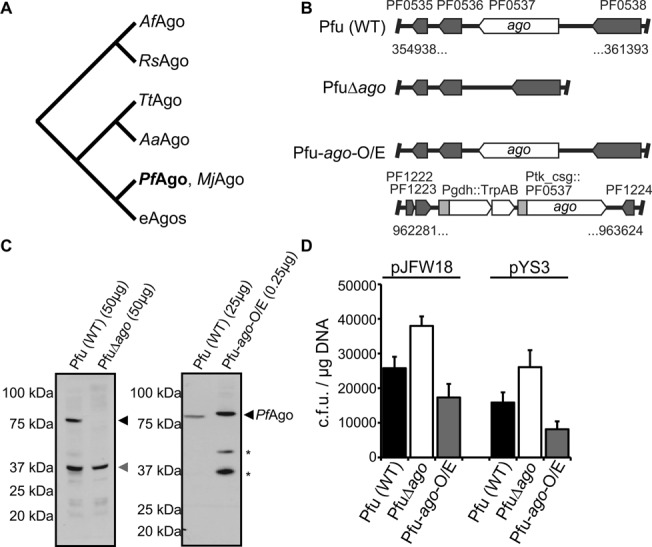
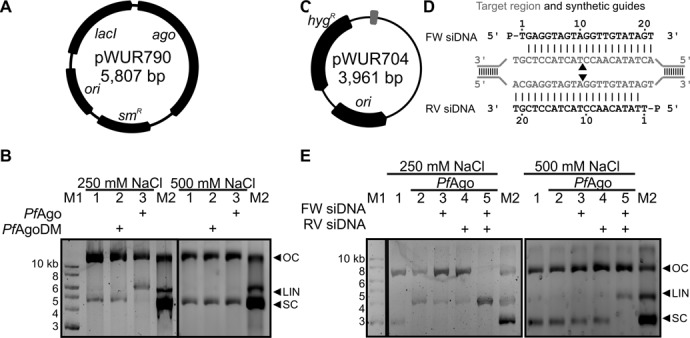
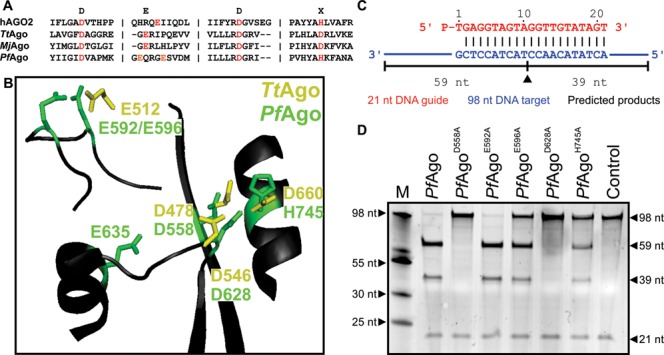
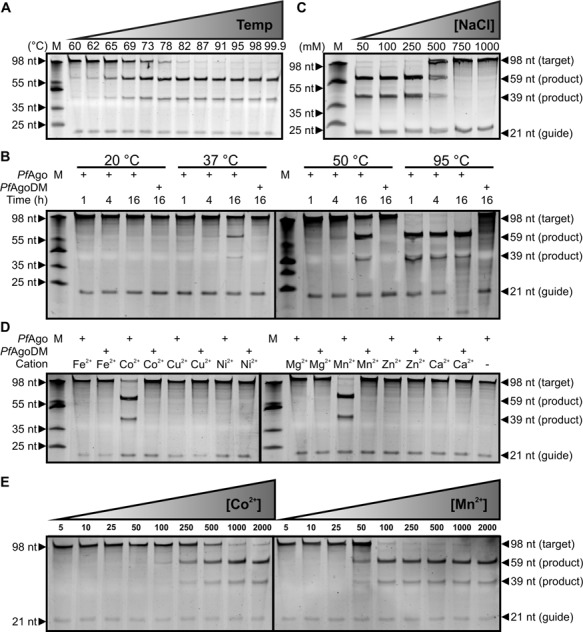
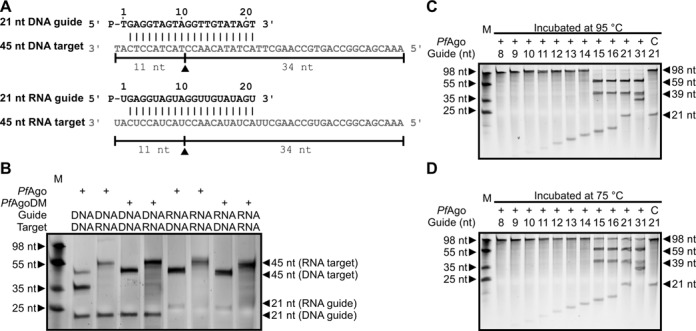
Functions of prokaryotic Argonautes (pAgo) have long remained elusive. Recently, Argonautes of the bacteria Rhodobacter sphaeroides and Thermus thermophilus were demonstrated to be involved in host defense. The Argonaute of the archaeon Pyrococcus furiosus (PfAgo) belongs to a different branch in the phylogenetic tree, which is most closely related to that of RNA interference-mediating eukaryotic Argonautes. Here we describe a functional and mechanistic characterization of PfAgo. Like the bacterial counterparts, archaeal PfAgo contributes to host defense by interfering with the uptake of plasmid DNA. PfAgo utilizes small 5'-phosphorylated DNA guides to cleave both single stranded and double stranded DNA targets, and does not utilize RNA as guide or target. Thus, with respect to function and specificity, the archaeal PfAgo resembles bacterial Argonautes much more than eukaryotic Argonautes. These findings demonstrate that the role of Argonautes is conserved through the bacterial and archaeal domains of life and suggests that eukaryotic Argonautes are derived from DNA-guided DNA-interfering host defense systems.
原核生物中Argonaute蛋白(pAgo)的功能长期以来一直不为人知。最近,已证明球形红杆菌和嗜热栖热菌中的Argonaute蛋白参与宿主防御。嗜热栖热菌(PfAgo)的Argonaute蛋白属于系统发育树中的一个不同分支,与介导RNA干扰的真核生物Argonaute蛋白的分支关系最为密切。在此,我们描述了PfAgo的功能和作用机制。与细菌中的对应蛋白一样,古菌PfAgo通过干扰质粒DNA的摄取来促进宿主防御。PfAgo利用小的5'-磷酸化DNA向导来切割单链和双链DNA靶标,并且不利用RNA作为向导或靶标。因此,就功能和特异性而言,古菌PfAgo与细菌中的Argonaute蛋白更为相似,而与真核生物的Argonaute蛋白差异较大。这些发现表明,Argonaute蛋白的作用在细菌和古菌生命域中是保守的,这表明真核生物的Argonaute蛋白源自DNA引导的DNA干扰宿主防御系统。