Ghawi Husam, Crowson Cynthia S, Rand-Weaver Jennifer, Krusemark Elizabeth, Gabriel Sherine E, Juhn Young J
Department of Pediatric and Adolescent Medicine, Mayo Clinic, Rochester, Minnesota, USA.
Division of Rheumatology, Department of Health Sciences Research and Internal Medicine, Mayo Clinic, Rochester, Minnesota, USA.
BMJ Open. 2015 Apr 29;5(4):e006469. doi: 10.1136/bmjopen-2014-006469.
To assess whether HOUSES (HOUsing-based index of socioeconomic status (SES)) is associated with risk of and mortality after rheumatoid arthritis (RA).
We conducted a population-based case-control study which enrolled population-based RA cases and their controls without RA.
The study was performed in Olmsted County, Minnesota.
Study participants were all residents of Olmsted County, Minnesota, with RA identified using the 1987 American College of Rheumatology criteria for RA from 1 January 1988, to 31 December 2007, using the auspices of the Rochester Epidemiology Project. For each patient with RA, one control was randomly selected from Olmsted County residents of similar age and gender without RA.
The disease status was RA cases and their matched controls in relation to HOUSES as an exposure. As a secondary aim, post-RA mortality among only RA cases was an outcome event. The associations of SES measured by HOUSES with the study outcomes were assessed using logistic regression and Cox models. HOUSES, as a composite index, was formulated based on a summed z-score for housing value, square footage and number of bedrooms and bathrooms.
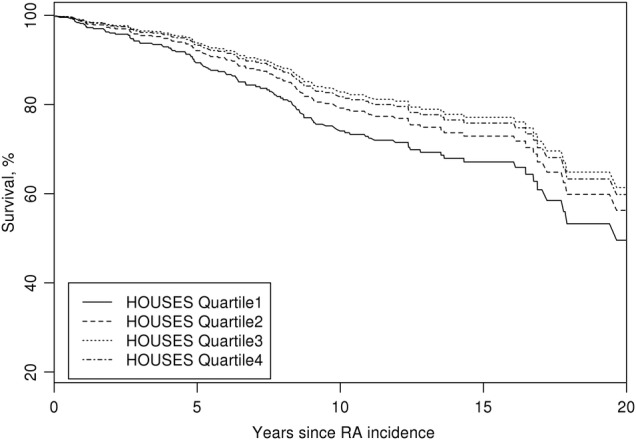
Of the eligible 604 participants, 418 (69%) were female; the mean age was 56±15.6 years. Lower SES, as measured by HOUSES, was associated with the risk of developing RA (0.5±3.8 for controls vs -0.2±3.1 for RA cases, p=0.003), adjusting for age, gender, calendar year of RA index date, smoking status and BMI. The lowest quartile of HOUSES was significantly associated with increased post-RA mortality compared to higher quartiles of HOUSES (HR 1.74; 95% CI 1.10 to 2.74; p=0.017) in multivariate analysis.
Lower SES, as measured by HOUSES, is associated with increased risk of RA and mortality after RA. HOUSES may be a useful tool for health disparities research concerning rheumatological outcomes when conventional SES measures are unavailable.
评估基于住房的社会经济地位指数(HOUSES)是否与类风湿关节炎(RA)的发病风险及死亡率相关。
我们开展了一项基于人群的病例对照研究,纳入了基于人群的RA病例及其无RA的对照。
研究在明尼苏达州奥尔姆斯特德县进行。
研究参与者为明尼苏达州奥尔姆斯特德县的所有居民,使用罗切斯特流行病学项目的资源,依据1987年美国风湿病学会RA标准,确定1988年1月1日至2007年12月31日期间的RA患者。对于每例RA患者,从年龄和性别相似的无RA的奥尔姆斯特德县居民中随机选取一名对照。
疾病状态为RA病例及其匹配的对照与作为暴露因素的HOUSES的关系。作为次要目标,仅RA病例中的RA后死亡率为结局事件。使用逻辑回归和Cox模型评估由HOUSES衡量的社会经济地位与研究结局的关联。HOUSES作为一个综合指数,是基于房屋价值、平方英尺数以及卧室和浴室数量的总和z分数制定的。
在符合条件的604名参与者中,418名(69%)为女性;平均年龄为56±15.6岁。经HOUSES衡量,较低的社会经济地位与患RA的风险相关(对照为0.5±3.8,RA病例为-0.2±3.1,p = 0.003),对年龄、性别、RA索引日期的日历年份、吸烟状况和体重指数进行了调整。在多变量分析中,与HOUSES较高四分位数相比,HOUSES最低四分位数与RA后死亡率增加显著相关(风险比1.74;95%置信区间1.10至2.74;p = 0.017)。
经HOUSES衡量,较低的社会经济地位与RA风险增加及RA后死亡率相关。当无法获得传统社会经济地位衡量指标时,HOUSES可能是用于类风湿病结局健康差异研究的有用工具。