Feng Yang-Chun, Yang Jia, Liu Cheng-Ming, Cheng Zhen-Zhen, Huang Yan-Chun
Clinical Laboratory Center, Tumor Hospital Affiliated to Xinjiang Medical University, Urumqi, People's Republic of China.
Department of Second Internal Medicine, Tumor Hospital Affiliated to Xinjiang Medical University, Urumqi, People's Republic of China.
Onco Targets Ther. 2015 Apr 13;8:827-33. doi: 10.2147/OTT.S80769. eCollection 2015.
The Uygur women have the highest incidence of cervical cancer in all Chinese ethnic groups. The research was conducted to explore whether DNA ploidy could be the prognostic indicator of human papillomavirus (HPV) infection in Xinjiang Uygur women.
Case data and cervical exfoliated cell samples from 326 Uygur women. The DNA ploidy was analyzed by flow cytometry. The flow-through hybridization and gene chip (FHGC) for HPV type test then divided the cases into negative HPV group, non high-risk HPV infection group, single high-risk HPV infection group, and multiple high-risk HPV infection group. Lastly, 113 cases from 273 HPV infection cases were followed up.
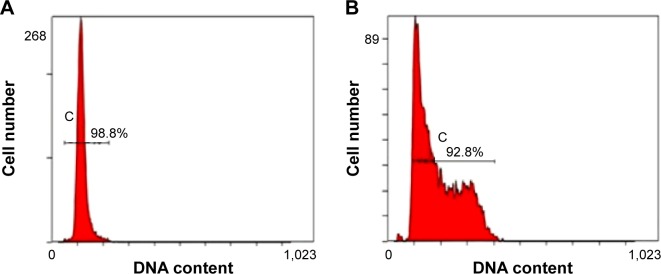
The 16-type HPV had the highest rate in all genotypes infection; 16/18-type HPV mixed infection was the most common type in multiple high-risk HPV infection group. Abnormal DNA ploidy happened along with the seriousness of HPV infection. Compared with the HPV negative group, DNA heteroploid appeared 12.750 times and 22.705 times, respectively, in single high-risk HPV and multiple high-risk HPV infection groups. Followed up 1 year later, the DNA index, S-phase cells' peak percentage and heteroploid of cervical exfoliated cells significantly reduced in single and multiple high-risk HPV infection patients, but in nine patients negative HPV infection and DNA heteroploid still existed.
The finally cure criterion of high-risk HPV infection should include the negative HPV test and normal DNA ploidy analysis. It was useful to prevent and cure cervical lesions in Xinjiang Uygur women through high-risk HPV test and DNA ploidy analysis. The transient infection and persistent infection in Xinjiang Uygur women should be taken as further research.
维吾尔族女性宫颈癌发病率在中国各民族中最高。本研究旨在探讨DNA倍体是否可作为新疆维吾尔族女性人乳头瘤病毒(HPV)感染的预后指标。
收集326例维吾尔族女性的病例资料及宫颈脱落细胞样本。采用流式细胞术分析DNA倍体。采用导流杂交基因芯片技术检测HPV分型,将病例分为HPV阴性组、非高危HPV感染组、单一高危HPV感染组和多重高危HPV感染组。最后,对273例HPV感染病例中的113例进行随访。
16型HPV在所有基因型感染中率最高;16/18型HPV混合感染是多重高危HPV感染组中最常见的类型。DNA倍体异常随HPV感染严重程度增加而出现。与HPV阴性组相比,单一高危HPV感染组和多重高危HPV感染组DNA异倍体出现的风险分别为12.750倍和22.705倍。1年后随访,单一和多重高危HPV感染患者宫颈脱落细胞的DNA指数、S期细胞峰值百分比和异倍体均显著降低,但9例HPV阴性感染患者仍存在DNA异倍体。
高危HPV感染的最终治愈标准应包括HPV检测阴性和DNA倍体分析正常。通过高危HPV检测和DNA倍体分析对新疆维吾尔族女性宫颈病变的防治具有重要意义。新疆维吾尔族女性的短暂感染和持续感染有待进一步研究。