Zagotta Ivana, Dimova Elitsa Y, Debatin Klaus-Michael, Wabitsch Martin, Kietzmann Thomas, Fischer-Posovszky Pamela
Division of Pediatric Endocrinology and Diabetes, Department of Pediatrics and Adolescent Medicine, Ulm University Medical Center Ulm, Germany.
Faculty of Biochemistry and Molecular Medicine, Biocenter Oulu, University of Oulu Oulu, Finland.
Front Pharmacol. 2015 Apr 14;6:79. doi: 10.3389/fphar.2015.00079. eCollection 2015.
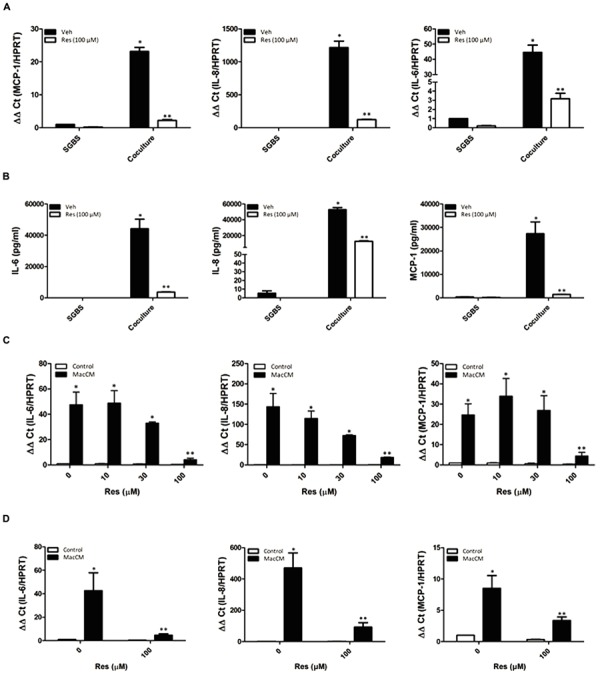
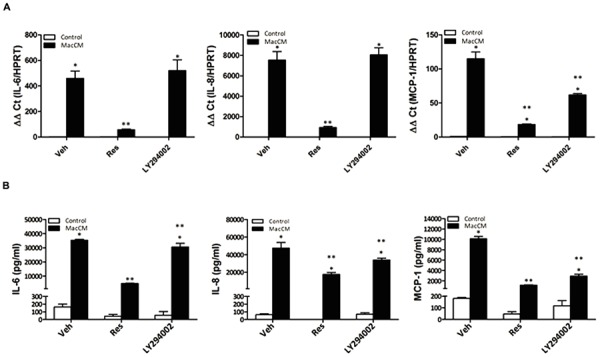
Obesity is associated with an inflammatory status and linked with a number of pathophysiological complications among them cardiovascular disease, type 2 diabetes mellitus, or the metabolic syndrome. Resveratrol was proposed to improve obesity-related inflammatory problems, but the effect of resveratrol on cytokine expression in obesity is not completely understood. In this study, we used an in vitro model of human adipose tissue inflammation to examine the effects of resveratrol on the production of the inflammatory cytokines interleukin 6 (IL-6), IL-8, and monocyte chemoattractant protein 1 (MCP-1). We found that resveratrol reduced IL-6, IL-8, and MCP-1 levels in a concentration-dependent manner in adipocytes under inflammatory conditions. Further experiments showed that the action of resveratrol was mainly due to its NFκB inhibitory potential. Thus, our data support the concept that resveratrol can alleviate obesity-induced up-regulation of inflammatory cytokines providing a new insight toward novel treatment options in obesity.
肥胖与炎症状态相关,并与许多病理生理并发症有关,其中包括心血管疾病、2型糖尿病或代谢综合征。白藜芦醇被认为可以改善与肥胖相关的炎症问题,但白藜芦醇对肥胖中细胞因子表达的影响尚未完全了解。在本研究中,我们使用人脂肪组织炎症的体外模型来研究白藜芦醇对炎性细胞因子白细胞介素6(IL-6)、IL-8和单核细胞趋化蛋白1(MCP-1)产生的影响。我们发现,在炎症条件下,白藜芦醇以浓度依赖的方式降低脂肪细胞中IL-6、IL-8和MCP-1的水平。进一步的实验表明,白藜芦醇的作用主要归因于其抑制NFκB的潜力。因此,我们的数据支持了白藜芦醇可以减轻肥胖诱导的炎性细胞因子上调这一概念,为肥胖的新治疗选择提供了新的见解。