Papaïx Julien, Burdon Jeremy J, Zhan Jiasui, Thrall Peter H
UMR 1290 BIOGER, INRA Thiverval-Grignon, France ; UR 341 MIA, INRA Jouy-en-Josas, France ; UR 546 BioSP, INRA Avignon, France ; CSIRO Agriculture Flagship Canberra, ACT, Australia.
CSIRO Agriculture Flagship Canberra, ACT, Australia.
Evol Appl. 2015 Apr;8(4):385-402. doi: 10.1111/eva.12251. Epub 2015 Mar 5.
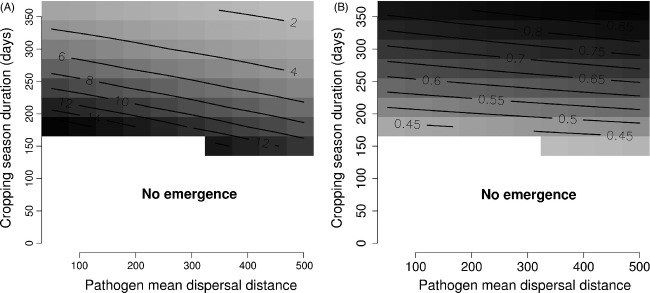
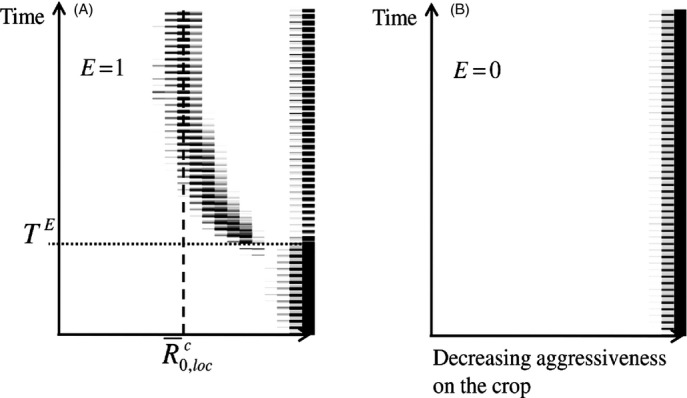
Remnant areas hosting natural vegetation in agricultural landscapes can impact the disease epidemiology and evolutionary dynamics of crop pathogens. However, the potential consequences for crop diseases of the composition, the spatial configuration and the persistence time of the agro-ecological interface - the area where crops and remnant vegetation are in contact - have been poorly studied. Here, we develop a demographic-genetic simulation model to study how the spatial and temporal distribution of remnant wild vegetation patches embedded in an agricultural landscape can drive the emergence of a crop pathogen and its subsequent specialization on the crop host. We found that landscape structures that promoted larger pathogen populations on the wild host facilitated the emergence of a crop pathogen, but such landscape structures also reduced the potential for the pathogen population to adapt to the crop. In addition, the evolutionary trajectory of the pathogen population was determined by interactions between the factors describing the landscape structure and those describing the pathogen life histories. Our study contributes to a better understanding of how the shift of land-use patterns in agricultural landscapes might influence crop diseases to provide predictive tools to evaluate management practices.
农业景观中留存天然植被的区域会影响作物病原体的疾病流行病学和进化动态。然而,农业生态界面(即作物与留存植被接触的区域)的组成、空间配置和持续时间对作物病害的潜在影响却鲜有研究。在此,我们开发了一个种群遗传学模拟模型,以研究嵌入农业景观中的留存野生植被斑块的时空分布如何驱动作物病原体的出现及其随后对作物宿主的适应性分化。我们发现,促进野生宿主上病原体种群数量增加的景观结构有利于作物病原体的出现,但这种景观结构也会降低病原体种群适应作物的潜力。此外,病原体种群的进化轨迹由描述景观结构的因素与描述病原体生活史的因素之间的相互作用决定。我们的研究有助于更好地理解农业景观中土地利用模式的转变如何影响作物病害,从而提供预测工具来评估管理措施。