Henikoff Jorja G, Thakur Jitendra, Kasinathan Sivakanthan, Henikoff Steven
Basic Sciences Division, Fred Hutchinson Cancer Research Center, Seattle, WA 98109, USA.
Basic Sciences Division, Fred Hutchinson Cancer Research Center, Seattle, WA 98109, USA ; Howard Hughes Medical Institute, Seattle, WA 98109, USA.
Sci Adv. 2015 Feb 12;1(1). doi: 10.1126/sciadv.1400234.
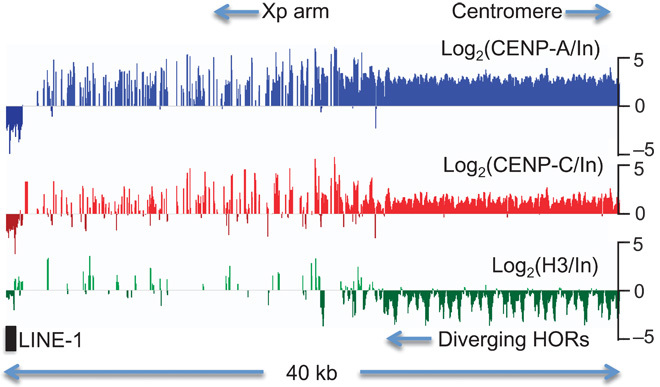
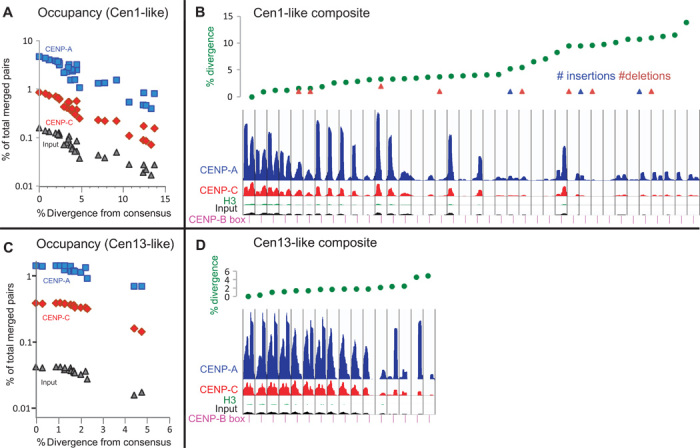
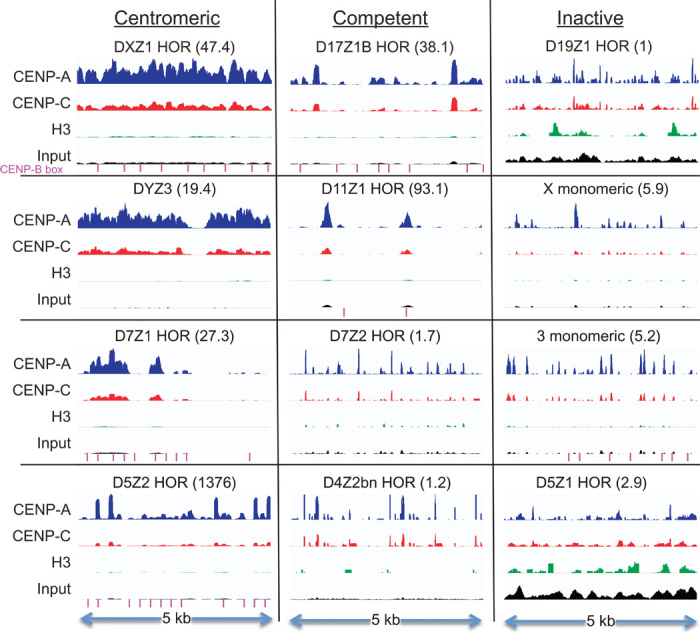
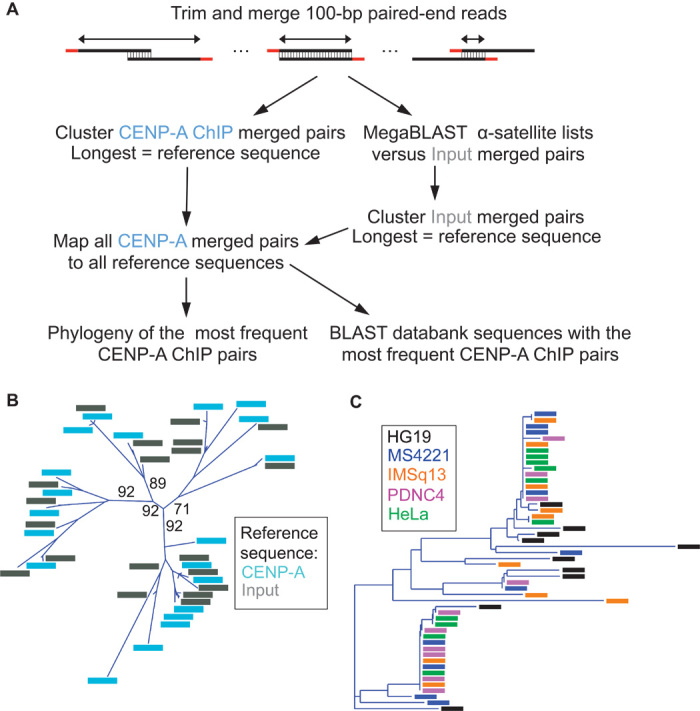
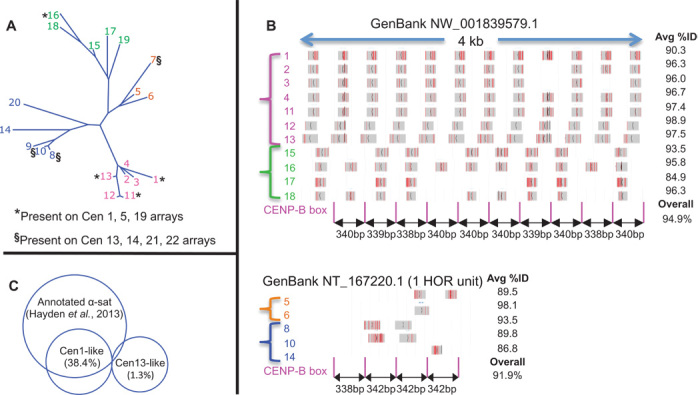
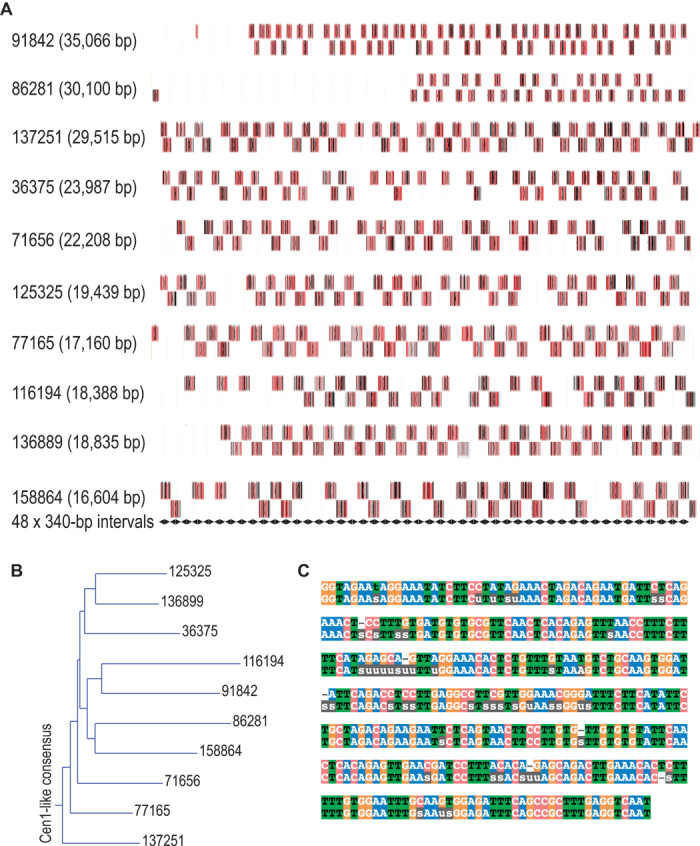
The intractability of homogeneous α-satellite arrays has impeded understanding of human centromeres. Artificial centromeres are produced from higher-order repeats (HORs) present at centromere edges, although the exact sequences and chromatin conformations of centromere cores remain unknown. We use high-resolution chromatin immunoprecipitation (ChIP) of centromere components followed by clustering of sequence data as an unbiased approach to identify functional centromere sequences. We find that specific dimeric α-satellite units shared by multiple individuals dominate functional human centromeres. We identify two recently homogenized α-satellite dimers that are occupied by precisely positioned CENP-A (cenH3) nucleosomes with two ~100-base pair (bp) DNA wraps in tandem separated by a CENP-B/CENP-C-containing linker, whereas pericentromeric HORs show diffuse positioning. Precise positioning is largely maintained, whereas abundance decreases exponentially with divergence, which suggests that young α-satellite dimers with paired ~100-bp particles mediate evolution of functional human centromeres. Our unbiased strategy for identifying functional centromeric sequences should be generally applicable to tandem repeat arrays that dominate the centromeres of most eukaryotes.
均匀α-卫星阵列的难处理性阻碍了对人类着丝粒的理解。人工着丝粒由着丝粒边缘存在的高阶重复序列(HORs)产生,尽管着丝粒核心的确切序列和染色质构象仍然未知。我们使用着丝粒组件的高分辨率染色质免疫沉淀(ChIP),随后对序列数据进行聚类,作为一种无偏倚的方法来识别功能性着丝粒序列。我们发现多个个体共有的特定二聚体α-卫星单元主导着功能性人类着丝粒。我们鉴定出两个最近均质化的α-卫星二聚体,它们被精确定位的CENP-A(cenH3)核小体占据,有两个串联的约100个碱基对(bp)的DNA缠绕,中间由一个含CENP-B/CENP-C的连接子隔开,而着丝粒周围的HORs显示出分散的定位。精确的定位在很大程度上得以维持,而丰度随着分歧呈指数下降,这表明具有配对的约100-bp颗粒的年轻α-卫星二聚体介导了功能性人类着丝粒的进化。我们识别功能性着丝粒序列的无偏倚策略应普遍适用于大多数真核生物着丝粒中占主导地位的串联重复阵列。