Silal Sheetal Prakash, Penn-Kekana Loveday, Bärnighausen Till, Schneider Helen
Department of Statistical Sciences, University of Cape Town, Cape Town, South Africa.
Centre for Health Policy, School of Public Health, University of the Witwatersrand, Johannesburg, South Africa.
Global Health. 2014 Jul 15;10:60. doi: 10.1186/s12992-014-0060-1.
There is global concern with geographical and socio-economic inequalities in access to and use of maternal delivery services. Little is known, however, on how local-level socio-economic inequalities are related to the uptake of needed maternal health care. We conducted a study of relative socio-economic inequalities in use of hospital-based maternal delivery services within two rural sub-districts of South Africa.
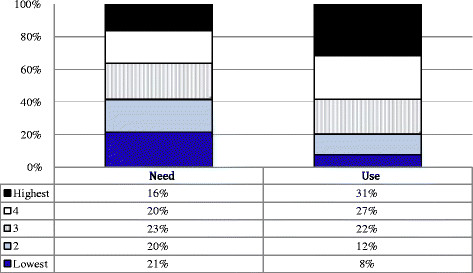
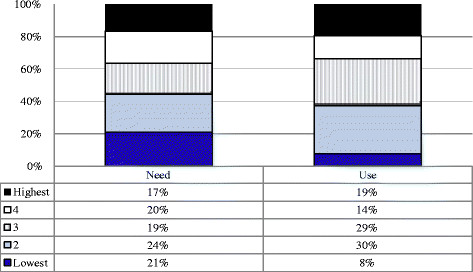
We used both population-based surveillance and facility-based clinical record data to examine differences in the relative distribution of socio-economic status (SES), using a household assets index to measure wealth, among those needing maternal delivery services and those using them in the Bushbuckridge sub-district, Mpumalanga, and Hlabisa sub-district, Kwa-Zulu Natal. We compared the SES distributions in households with a birth in the previous year with the household SES distributions of representative samples of women who had delivered in hospitals in these two sub-districts.
In both sub-districts, women in the lowest SES quintile were significantly under-represented in the hospital user population, relative to need for delivery services (8% in user population vs 21% in population in need; p < 0.001 in each sub-district). Exit interviews provided additional evidence on potential barriers to access, in particular the affordability constraints associated with hospital delivery.
The findings highlight the need for alternative strategies to make maternal delivery services accessible to the poorest women within overall poor communities and, in doing so, decrease socioeconomic inequalities in utilisation of maternal delivery services.
全球都在关注孕产妇分娩服务的获取和使用方面存在的地域及社会经济不平等问题。然而,关于地方层面的社会经济不平等如何与所需孕产妇保健服务的利用相关,却知之甚少。我们对南非两个农村地区基于医院的孕产妇分娩服务使用中的相对社会经济不平等进行了一项研究。
我们利用基于人群的监测和基于机构的临床记录数据,通过家庭资产指数衡量财富,来研究姆普马兰加省布什巴克里奇地区和夸祖鲁 - 纳塔尔省赫拉比萨地区中需要孕产妇分娩服务的人群与实际使用这些服务的人群在社会经济地位(SES)相对分布上的差异。我们将上一年有新生儿出生的家庭的SES分布与这两个地区在医院分娩的妇女代表性样本的家庭SES分布进行了比较。
在这两个地区,相对于分娩服务需求而言,SES最低五分位数组的妇女在医院使用人群中的占比均显著偏低(使用人群中占8%,而有需求人群中占21%;每个地区p < 0.001)。出院访谈为获取服务的潜在障碍提供了更多证据,尤其是与医院分娩相关的可负担性限制。
研究结果凸显了需要采取替代策略,以使最贫困社区中的最贫困妇女能够获得孕产妇分娩服务,从而减少孕产妇分娩服务利用方面的社会经济不平等。