Brindle Nicola R, Joyce Johanna A, Rostker Fanya, Lawlor Elizabeth R, Swigart-Brown Lamorna, Evan Gerard, Hanahan Douglas, Shchors Ksenya
Swiss Institute for Experimental Cancer Research (ISREC), Swiss Federal Institute of Technology Lausanne (EPFL), Lausanne, Switzerland.
Departments of Pathology and Department of Biochemistry and Biophysics, University of California San Francisco (UCSF), San Francisco, United States of America; Cancer Biology and Genetics Program, Memorial Sloan-Kettering Cancer Center, New York, New York, United States of America.
PLoS One. 2015 Apr 30;10(4):e0120348. doi: 10.1371/journal.pone.0120348. eCollection 2015.
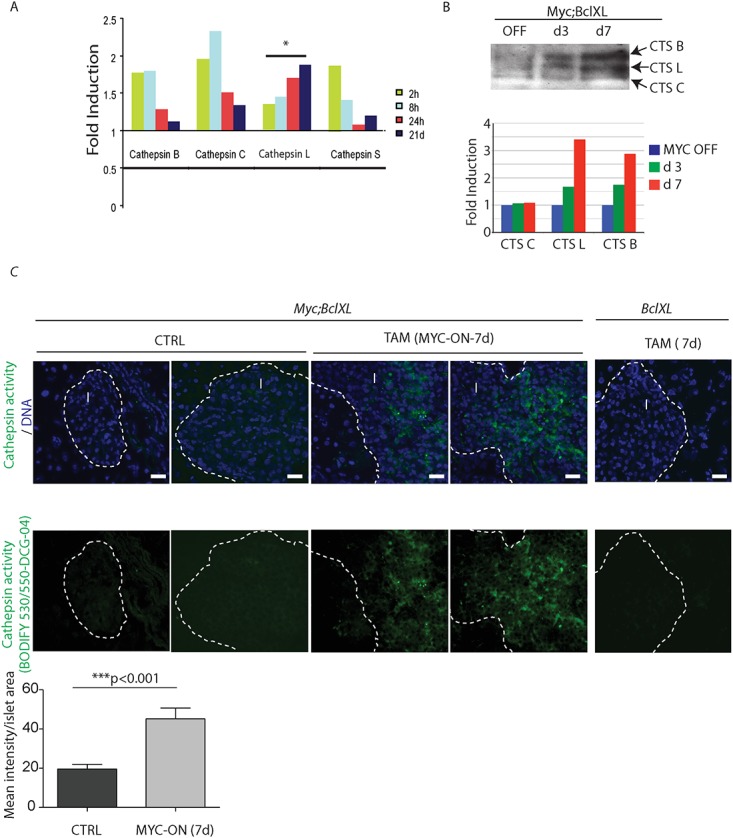
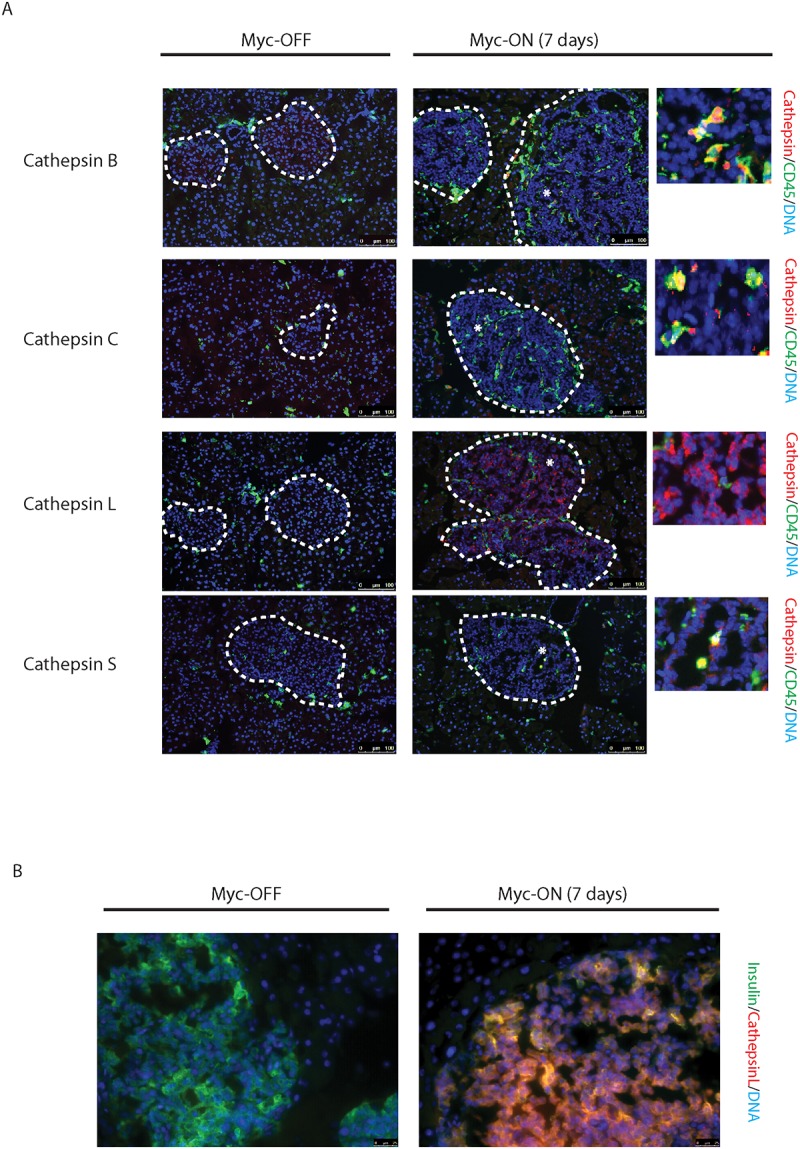
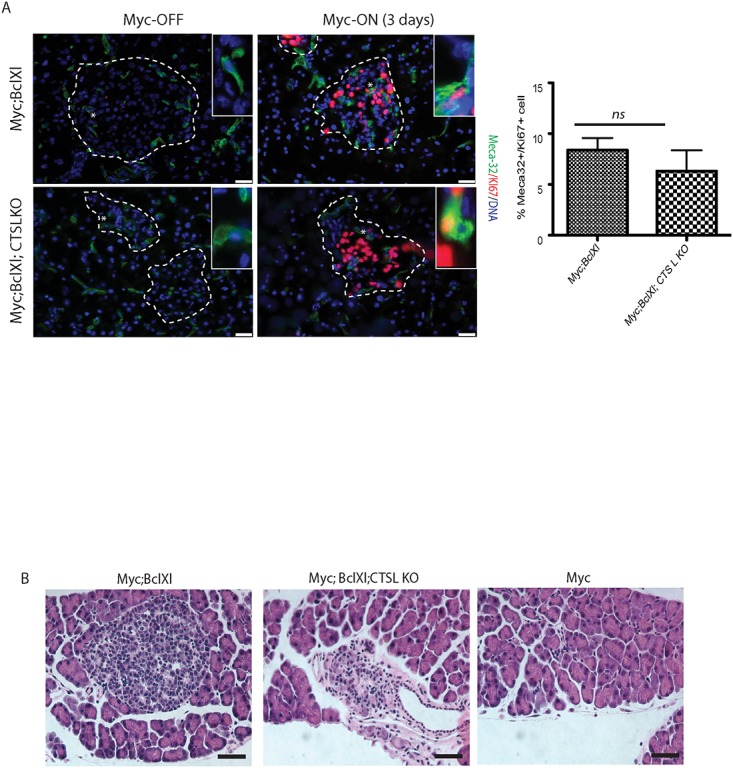
Motivated by the recent implication of cysteine protease cathepsin L as a potential target for anti-cancer drug development, we used a conditional MycERTAM;Bcl-xL model of pancreatic neuroendocrine tumorigenesis (PNET) to assess the role of cathepsin L in Myc-induced tumor progression. By employing a cysteine cathepsin activity probe in vivo and in vitro, we first established that cathepsin activity increases during the initial stages of MycERTAM;Bcl-xL tumor development. Among the cathepsin family members investigated, only cathepsin L was predominately produced by beta-tumor cells in neoplastic pancreata and, consistent with this, cathepsin L mRNA expression was rapidly upregulated following Myc activation in the beta cell compartment. By contrast, cathepsins B, S and C were highly enriched in tumor-infiltrating leukocytes. Genetic deletion of cathepsin L had no discernible effect on the initiation of neoplastic growth or concordant angiogenesis. However, the tumors that developed in the cathepsin L-deficient background were markedly reduced in size relative to their typical wild-type counterparts, indicative of a role for cathepsin L in enabling expansive tumor growth. Thus, genetic blockade of cathepsin L activity is inferred to retard Myc-driven tumor growth, encouraging the potential utility of pharmacological inhibitors of cysteine cathepsins in treating late stage tumors.
受半胱氨酸蛋白酶组织蛋白酶L作为抗癌药物开发潜在靶点这一最新发现的启发,我们使用了一种条件性MycERTAM;Bcl-xL胰腺神经内分泌肿瘤发生(PNET)模型,以评估组织蛋白酶L在Myc诱导的肿瘤进展中的作用。通过在体内和体外使用半胱氨酸组织蛋白酶活性探针,我们首先确定在MycERTAM;Bcl-xL肿瘤发展的初始阶段组织蛋白酶活性会增加。在所研究的组织蛋白酶家族成员中,只有组织蛋白酶L主要由肿瘤胰腺中的β肿瘤细胞产生,与此一致的是,在β细胞区室中Myc激活后,组织蛋白酶L的mRNA表达迅速上调。相比之下,组织蛋白酶B、S和C在肿瘤浸润白细胞中高度富集。组织蛋白酶L的基因缺失对肿瘤生长的起始或相应的血管生成没有明显影响。然而,在组织蛋白酶L缺陷背景下形成的肿瘤相对于典型的野生型对应肿瘤,大小明显减小,这表明组织蛋白酶L在促进肿瘤扩张性生长中起作用。因此,推断组织蛋白酶L活性的基因阻断可延缓Myc驱动的肿瘤生长,这为半胱氨酸组织蛋白酶的药理抑制剂在治疗晚期肿瘤中的潜在应用提供了依据。