Hucklenbroich Joerg, Klein Rebecca, Neumaier Bernd, Graf Rudolf, Fink Gereon Rudolf, Schroeter Michael, Rueger Maria Adele
Cognitive Neuroscience, Institute of Neuroscience and Medicine (INM-3), Research Centre Juelich, Leo-Brandt-Straße 52425, Jülich, Germany.
Department of Neurology, University Hospital of Cologne, Cologne, Germany.
Stem Cell Res Ther. 2014 Sep 26;5(4):100. doi: 10.1186/scrt500.
Aromatic (ar-) turmerone is a major bioactive compound of the herb Curcuma longa. It has been suggested that ar-turmerone inhibits microglia activation, a property that may be useful in treating neurodegenerative disease. Furthermore, the effects of ar-turmerone on neural stem cells (NSCs) remain to be investigated.
We exposed primary fetal rat NSCs to various concentrations of ar-turmerone. Thereafter, cell proliferation and differentiation potential were assessed. In vivo, naïve rats were treated with a single intracerebroventricular (i.c.v.) injection of ar-turmerone. Proliferative activity of endogenous NSCs was assessed in vivo, by using noninvasive positron emission tomography (PET) imaging and the tracer [(18)F]-fluoro-L-thymidine ([(18)F]FLT), as well as ex vivo.
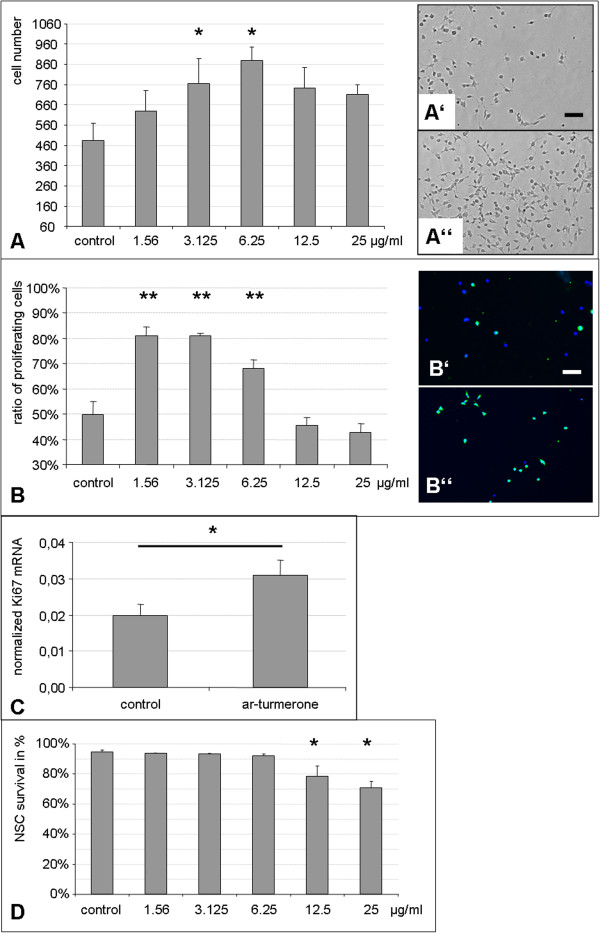
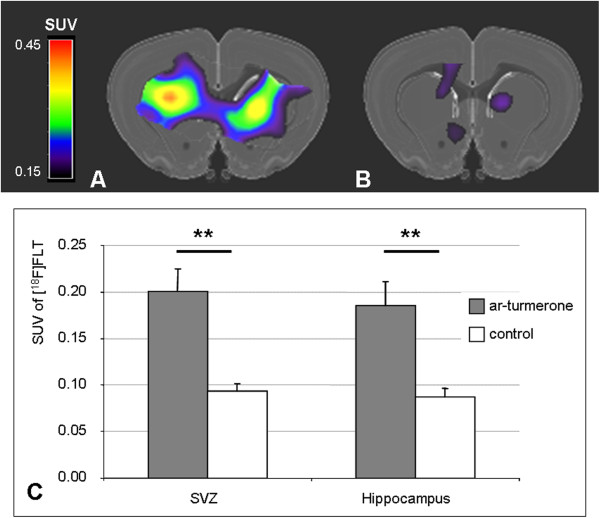
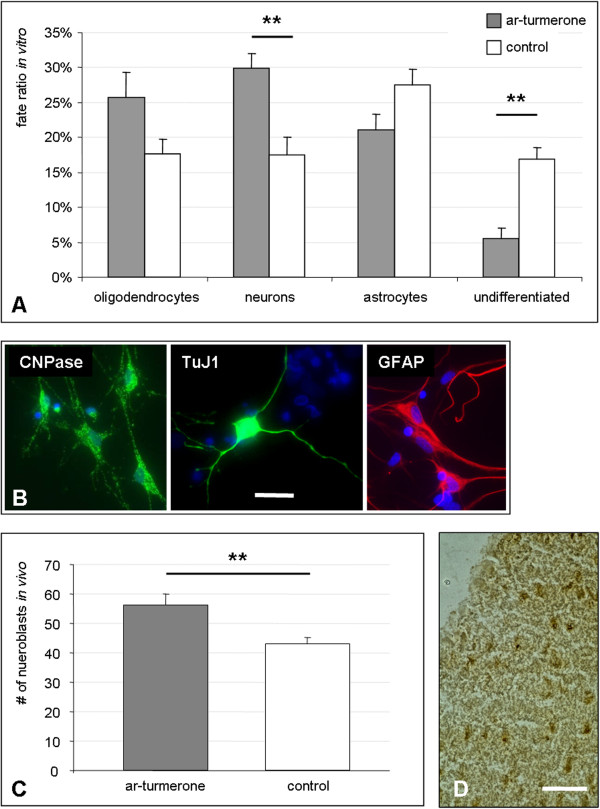
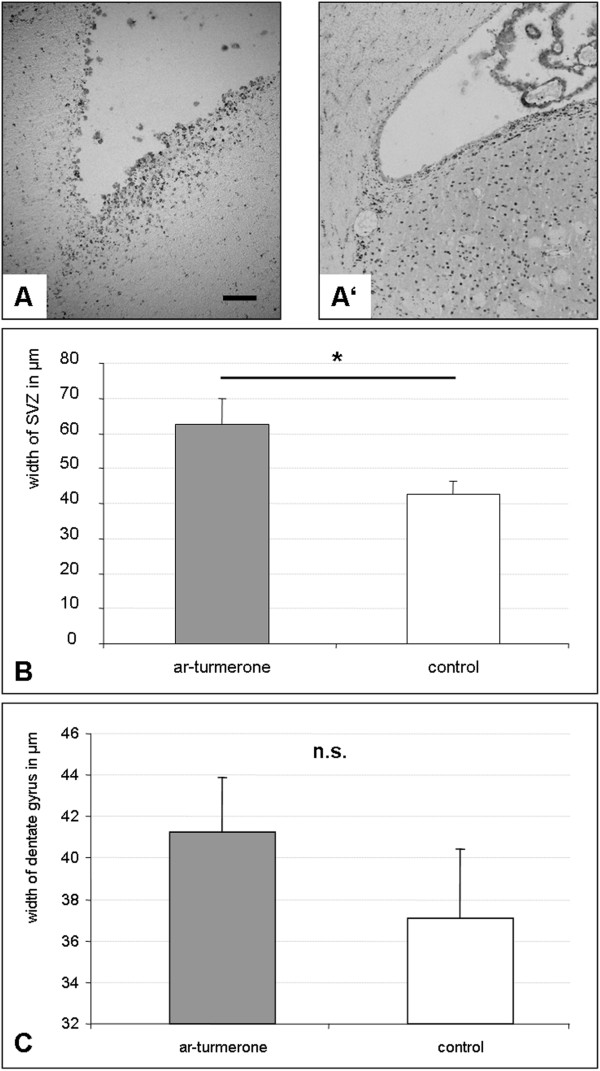
In vitro, ar-turmerone increased dose-dependently the number of cultured NSCs, because of an increase in NSC proliferation (P < 0.01). Proliferation data were supported by qPCR-data for Ki-67 mRNA. In vitro as well as in vivo, ar-turmerone promoted neuronal differentiation of NSCs. In vivo, after i.c.v. injection of ar-turmerone, proliferating NSCs were mobilized from the subventricular zone (SVZ) and the hippocampus of adult rats, as demonstrated by both [(18)F]FLT-PET and histology (P < 0.05).
Both in vitro and in vivo data suggest that ar-turmerone induces NSC proliferation. Ar-turmerone thus constitutes a promising candidate to support regeneration in neurologic disease.
芳香型姜黄酮是姜黄属植物姜黄中的一种主要生物活性化合物。有人提出,芳香型姜黄酮可抑制小胶质细胞活化,这一特性可能对治疗神经退行性疾病有用。此外,芳香型姜黄酮对神经干细胞(NSCs)的影响仍有待研究。
我们将原代胎鼠神经干细胞暴露于不同浓度的芳香型姜黄酮中。此后,评估细胞增殖和分化潜能。在体内,对未处理的大鼠进行单次脑室内注射芳香型姜黄酮。通过使用无创正电子发射断层扫描(PET)成像和示踪剂[(18)F] - 氟 - L - 胸腺嘧啶([(18)F] FLT)以及离体实验,评估内源性神经干细胞的增殖活性。
在体外,由于神经干细胞增殖增加(P < 0.01),芳香型姜黄酮剂量依赖性地增加了培养的神经干细胞数量。增殖数据得到Ki - 67 mRNA的qPCR数据支持。在体外和体内,芳香型姜黄酮均促进神经干细胞向神经元分化。在体内,脑室内注射芳香型姜黄酮后,增殖的神经干细胞从成年大鼠的脑室下区(SVZ)和海马体中被动员起来,这通过[(18)F] FLT - PET和组织学均得到证实(P < 0.05)。
体外和体内数据均表明,芳香型姜黄酮可诱导神经干细胞增殖。因此,芳香型姜黄酮是支持神经疾病再生的一个有前景的候选物。