Rayaisse Jean-Baptiste, Salou Ernest, Courtin Fabrice, Yoni Wilfrid, Barry Issiaka, Dofini Fabien, Kagbadouno Moise, Camara Mamadou, Torr Stephen J, Solano Philippe
Centre International de Recherche - Développement sur l'Elevage en zone Subhumide (CIRDES), Bobo-Dioulasso, Burkina Faso.
Institut de Recherche pour le Développement, UMR 177 IRD-CIRAD INTERTRYP, CIRDES, Bobo-Dioulasso, Burkina Faso.
Parasit Vectors. 2015 Apr 18;8:236. doi: 10.1186/s13071-015-0851-0.
Human African Trypanosomiasis (HAT) is an important neglected tropical disease caused by Trypanosoma spp. parasites transmitted by species of tsetse fly (Glossina spp). The most important vectors of HAT are riverine tsetse and these can be controlled by attracting them to stationary baits such as insecticide-impregnated traps or targets deployed along the banks of rivers. However, the geographical nature of some riverine habitats, particularly mangroves but also extensive lake and river networks, makes deployment of baits difficult and limits their efficacy. It is known that tsetse are attracted by the movement of their hosts. Our hypothesis was that mounting a target on canoes typically used in Africa ('pirogues') would produce an effective means of attracting-and-killing riverine tsetse in extensive wetland habitats.
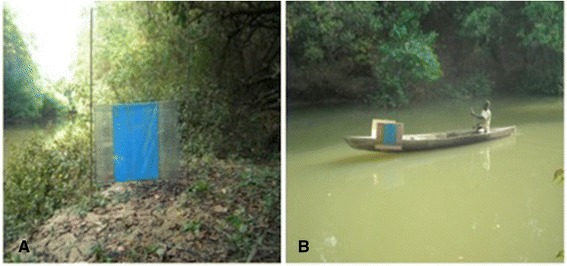
In Folonzo, southern Burkina Faso, studies were made of the numbers of tsetse attracted to a target (75 × 50 cm) of blue cloth and netting mounted on a pirogue moving along a river, versus the same target placed on the riverbank. The targets were covered with a sticky film which caught tsetse as they contacted the target.
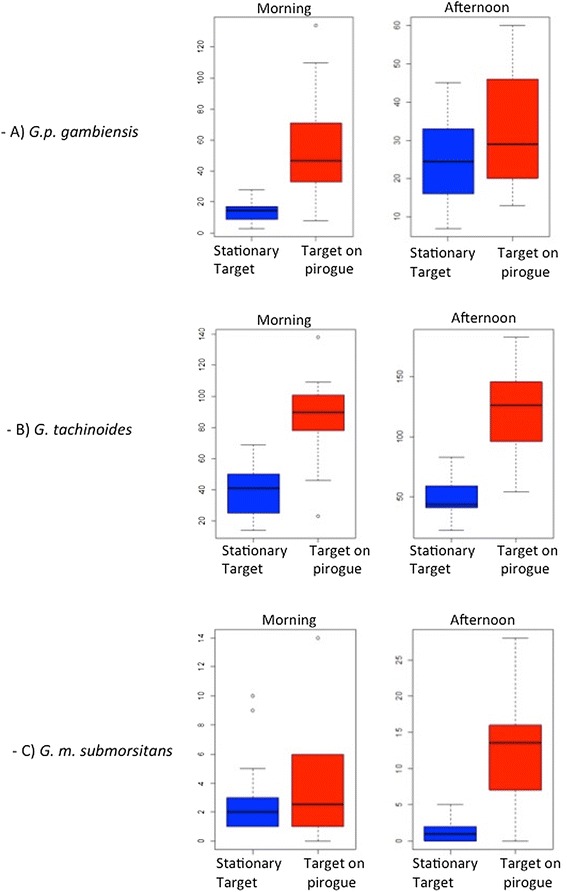
The pirogue-mounted target caught twice as many G. tachinoides and G. p. gambiensis, and 8 times more G. morsitans submorsitans than the stationary one (P < 0.001).
Pirogues are common vehicle for navigating the rivers, lakes and swamps of West Africa. The demonstration that tsetse can be attracted to targets mounted on such boats suggests that pirogues might provide a cost-effective and convenient platform for deploying targets to control tsetse in the mangrove systems of West Africa where HAT persists. Further studies to assess the impact of pirogue-mounted targets on tsetse populations in HAT foci and the protective value of targets for pirogue passengers are recommended.
人类非洲锥虫病(HAT)是一种由采采蝇(舌蝇属)传播的布氏锥虫属寄生虫引起的重要被忽视热带病。HAT最重要的传播媒介是河流型采采蝇,可通过将它们吸引到固定诱饵(如沿河岸设置的浸有杀虫剂的诱捕器或目标物)来进行控制。然而,一些河流栖息地的地理特性,特别是红树林,还有广阔的湖泊和河网,使得诱饵的部署困难并限制了其效果。已知采采蝇会被其宿主的移动所吸引。我们的假设是,在非洲常用的独木舟(“pirogues”)上安装目标物将产生一种在广阔湿地栖息地吸引并杀死河流型采采蝇的有效方法。
在布基纳法索南部的福隆佐,对安装在沿河流移动的独木舟上的蓝色布料和网制成的目标物(75×50厘米)吸引的采采蝇数量与放置在河岸上的相同目标物吸引的采采蝇数量进行了研究。目标物覆盖有粘性薄膜,采采蝇接触目标物时会被粘住。
安装在独木舟上的目标物捕获的嗜人采采蝇和冈比亚采采蝇指名亚种数量是固定目标物的两倍,而莫氏采采蝇亚组捕获的数量是其8倍(P<0.001)。
独木舟是在西非的河流、湖泊和沼泽中航行的常用工具。采采蝇可被安装在这类船只上的目标物吸引这一证明表明,独木舟可能为在HAT持续存在的西非红树林系统中部署目标物以控制采采蝇提供一个经济高效且便捷的平台。建议进一步开展研究,以评估安装在独木舟上的目标物对HAT疫源地采采蝇种群的影响以及目标物对独木舟乘客的保护价值。