Wahlster Philip, Goetghebeur Mireille, Schaller Sandra, Kriza Christine, Kolominsky-Rabas Peter
Interdisciplinary Centre for Health Technology Assessment (HTA) and Public Health (IZPH), Friedrich-Alexander-University Erlangen-Nürnberg (FAU), National Cluster of Excellence, Medical Technologies - Medical Valley EMN, Schwabachanlage 6, 91054, Erlangen, Bavaria, Germany.
School of Public Health, Universiy of Montreal & LASER Analytica, 1405 TransCanada Highway, Suite 310, Montréal, QC, H9P 2 V9, Canada.
Health Res Policy Syst. 2015 Apr 28;13:24. doi: 10.1186/s12961-015-0011-1.
Health technology assessment and healthcare decision-making are based on multiple criteria and evidence, and heterogeneous opinions of participating stakeholders. Multi-criteria decision analysis (MCDA) offers a potential framework to systematize this process and take different perspectives into account. The objectives of this study were to explore perspectives and preferences across German stakeholders when appraising healthcare interventions, using multi-criteria assessment of a heart pulmonary sensor as a case study.
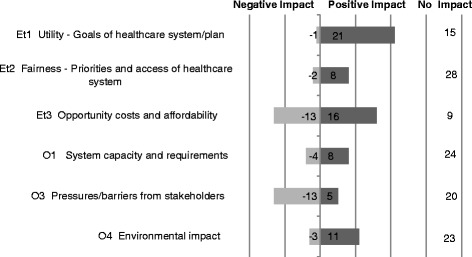
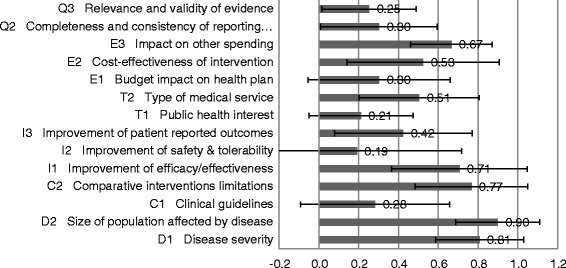
An online survey of 100 German healthcare stakeholders was conducted using a comprehensive MCDA framework (EVIDEM V2.2). Participants were asked to provide i) relative weights for each criterion of the framework; ii) performance scores for a health pulmonary sensor, based on available data synthesized for each criterion; and iii) qualitative feedback on the consideration of contextual criteria. Normalized weights and scores were combined using a linear model to calculate a value estimate across different stakeholders. Differences across types of stakeholders were explored.
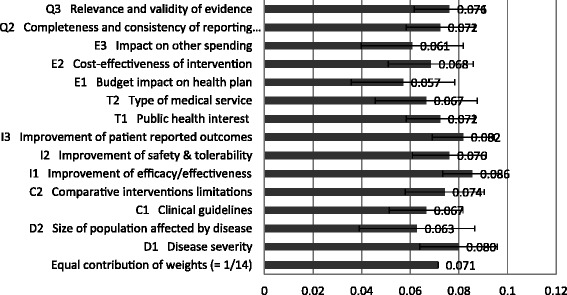
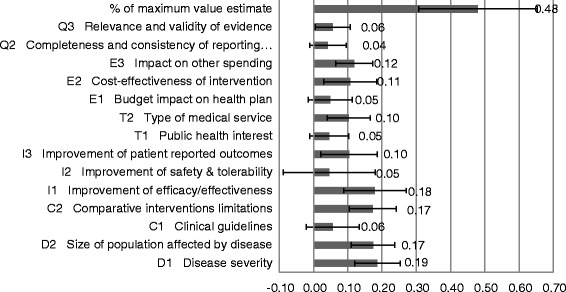
The survey was completed by 54 participants. The most important criteria were efficacy, patient reported outcomes, disease severity, safety, and quality of evidence (relative weight >0.075 each). Compared to all participants, policymakers gave more weight to budget impact and quality of evidence. The quantitative appraisal of a pulmonary heart sensor revealed differences in scoring performance of this intervention at the criteria level between stakeholder groups. The highest value estimate of the sensor reached 0.68 (on a scale of 0 to 1, 1 representing maximum value) for industry representatives and the lowest value of 0.40 was reported for policymakers, compared to 0.48 for all participants. Participants indicated that most qualitative criteria should be considered and their impact on the quantitative appraisal was captured transparently.
The study identified important variations in perspectives across German stakeholders when appraising a healthcare intervention and revealed that MCDA can demonstrate the value of a specified technology for all participating stakeholders. Better understanding of these differences at the criteria level, in particular between policymakers and industry representatives, is important to focus innovation aligned with patient health and healthcare system values and constraints.
卫生技术评估和医疗保健决策基于多种标准和证据,以及参与利益相关者的不同意见。多标准决策分析(MCDA)提供了一个潜在的框架,可将这一过程系统化并考虑不同的观点。本研究的目的是通过将心肺传感器的多标准评估作为案例研究,探讨德国利益相关者在评估医疗保健干预措施时的观点和偏好。
使用全面的MCDA框架(EVIDEM V2.2)对100名德国医疗保健利益相关者进行了在线调查。要求参与者提供:i)框架各标准的相对权重;ii)根据为每个标准综合的现有数据,给出心肺传感器的性能得分;iii)关于上下文标准考虑的定性反馈。使用线性模型组合归一化权重和得分,以计算不同利益相关者的价值估计。探讨了不同类型利益相关者之间的差异。
54名参与者完成了调查。最重要的标准是疗效、患者报告的结果、疾病严重程度、安全性和证据质量(每个标准的相对权重>0.075)。与所有参与者相比,政策制定者更重视预算影响和证据质量。对心肺传感器的定量评估显示,利益相关者群体之间在该干预措施的标准层面得分表现存在差异。行业代表对该传感器的最高价值估计达到0.68(范围为0至1,1代表最大值),政策制定者报告的最低值为0.40,而所有参与者的平均值为0.48。参与者表示,大多数定性标准应予以考虑,并且其对定量评估的影响得到了透明呈现。
该研究确定了德国利益相关者在评估医疗保健干预措施时观点的重要差异,并表明MCDA可以为所有参与的利益相关者展示特定技术的价值。在标准层面更好地理解这些差异,特别是政策制定者和行业代表之间的差异,对于使创新与患者健康以及医疗保健系统的价值观和限制保持一致非常重要。