Liao Jiang-Lin, Zhou Hui-Wen, Peng Qi, Zhong Ping-An, Zhang Hong-Yu, He Chao, Huang Ying-Jin
Key Laboratory of Crop Physiology, Ecology and Genetic Breeding (Jiangxi Agricultural University), Ministry of Education, Jiangxi Province, 330045, China.
Key Laboratory of Agriculture responding to Climate Change (Jiangxi Agricultural University), Nanchang City, Jiangxi Province, 330045, China.
BMC Genomics. 2015 Jan 23;16(1):18. doi: 10.1186/s12864-015-1222-0.
Rice yield and quality are adversely affected by high temperatures, especially at night; high nighttime temperatures are more harmful to grain weight than high daytime temperatures. Unfortunately, global temperatures are consistently increasing at an alarming rate and the minimum nighttime temperature has increased three times as much as the corresponding maximum daytime temperature over the past few decades.
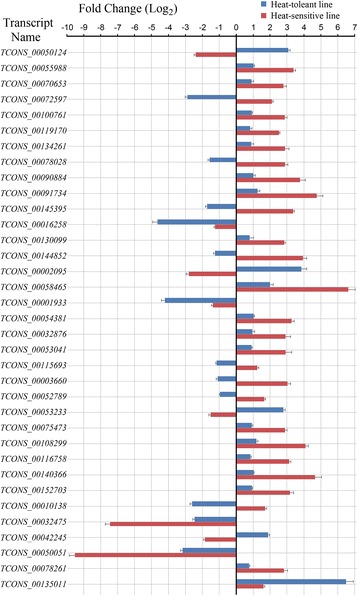
We analyzed the transcriptome profiles for rice grain from heat-tolerant and -sensitive lines in response to high night temperatures at the early milky stage using the Illumina Sequencing method. The analysis results for the sequencing data indicated that 35 transcripts showed different expressions between heat-tolerant and -sensitive rice, and RT-qPCR analyses confirmed the expression patterns of selected transcripts. Functional analysis of the differentially expressed transcripts indicated that 21 genes have functional annotation and their functions are mainly involved in oxidation-reduction (6 genes), metabolic (7 genes), transport (4 genes), transcript regulation (2 genes), defense response (1 gene) and photosynthetic (1 gene) processes. Based on the functional annotation of the differentially expressed genes, the possible process that regulates these differentially expressed transcripts in rice grain responding to high night temperature stress at the early milky stage was further analyzed. This analysis indicated that high night temperature stress disrupts electron transport in the mitochondria, which leads to changes in the concentration of hydrogen ions in the mitochondrial and cellular matrix and influences the activity of enzymes involved in TCA and its secondary metabolism in plant cells.
Using Illumina sequencing technology, the differences between the transcriptomes of heat-tolerant and -sensitive rice lines in response to high night temperature stress at the early milky stage was described here for the first time. The candidate transcripts may provide genetic resources that may be useful in the improvement of heat-tolerant characters of rice. The model proposed here is based on differences in expression and transcription between two rice lines. In addition, the model may support future studies on the molecular mechanisms underlying plant responses to high night temperatures.
水稻产量和品质受到高温的不利影响,尤其是夜间高温;夜间高温对粒重的危害比对白天高温更大。不幸的是,全球气温正以惊人的速度持续上升,在过去几十年中,夜间最低温度的升高幅度是相应白天最高温度升高幅度的三倍。
我们使用Illumina测序方法分析了耐热和热敏品系水稻籽粒在乳熟初期对夜间高温的转录组图谱。测序数据分析结果表明,35个转录本在耐热和热敏水稻之间表现出不同的表达,RT-qPCR分析证实了所选转录本的表达模式。对差异表达转录本的功能分析表明,21个基因具有功能注释,其功能主要涉及氧化还原(6个基因)、代谢(7个基因)、转运(4个基因)、转录调控(2个基因)、防御反应(1个基因)和光合(1个基因)过程。基于差异表达基因的功能注释,进一步分析了水稻籽粒在乳熟初期响应夜间高温胁迫时调控这些差异表达转录本的可能过程。该分析表明,夜间高温胁迫会破坏线粒体中的电子传递,导致线粒体和细胞基质中氢离子浓度发生变化,并影响植物细胞中参与三羧酸循环及其次生代谢的酶的活性。
本文首次使用Illumina测序技术描述了耐热和热敏水稻品系转录组在乳熟初期对夜间高温胁迫的差异。候选转录本可能为改善水稻耐热性状提供有用的遗传资源。这里提出的模型基于两个水稻品系在表达和转录上的差异。此外,该模型可能支持未来关于植物对夜间高温响应的分子机制的研究。