Hapunda Given, Abubakar Amina, van de Vijver Fons, Pouwer Frans
Department of Psychology, University of Zambia, P.O Box 32379, Lusaka, Zambia.
Department of Culture Studies, Tilburg University, Tilburg, The Netherlands.
BMC Endocr Disord. 2015 Apr 18;15:20. doi: 10.1186/s12902-015-0013-6.
Psychosocial problems are common in patients with diabetes. However, data on psychosocial issues affecting patients with diabetes in Zambia are scarce. The present study explored sources of stress, stress coping strategies, stigma and perceived quality of life and care as experienced by adolescents living with Type 1 Diabetes in Zambia.
Semi-structured interviews were carried out. Three groups of participants involving adolescents with Type 1 Diabetes (n = 10), caregivers (n = 8) and health practitioners (n = 4) were interviewed. Transcripts were analyzed using a thematic approach.
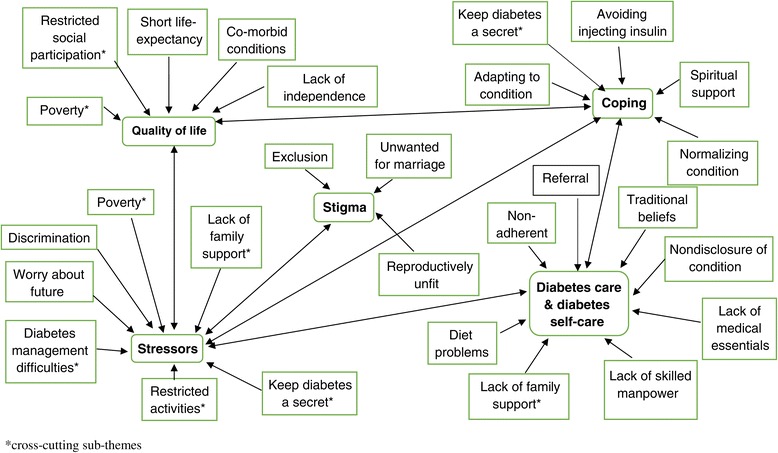
Stress was commonly reported by adolescents mainly stemming from social, psychological and physical sources. To deal with stress, adolescents often employed different coping strategies such as adapting, accepting and avoiding among others. Both internal factors (those relating to the patients themselves) and external factors (those related to the context of the patients') influenced the patients' quality of health care. In addition, low quality of life was an issue among adolescents and their families. Poor diet, low socioeconomic status and lack of medicine were factors affecting quality of health care.
Stress was an issue affecting adolescents; the coping strategies employed were sometimes maladaptive such as avoiding injecting themselves to escape stress. Several aspects of quality of life were suboptimal in both adolescents and their families, such as stigmatization, short life expectancy, low socioeconomic status and poor social participation. Findings show that there is an urgent need for a strong response from all stakeholders (governments, patients, organizations and companies) to improve diabetes care and living conditions for young people with type 1 diabetes living in Zambia.
心理社会问题在糖尿病患者中很常见。然而,关于影响赞比亚糖尿病患者心理社会问题的数据却很稀少。本研究探讨了赞比亚1型糖尿病青少年患者所经历的压力源、压力应对策略、耻辱感以及生活质量和护理质量的感知情况。
进行了半结构化访谈。对三组参与者进行了访谈,包括1型糖尿病青少年(n = 10)、照顾者(n = 8)和医疗从业者(n = 4)。使用主题分析法对访谈记录进行了分析。
青少年普遍报告存在压力,主要源于社会、心理和身体方面的因素。为应对压力,青少年经常采用不同的应对策略,如适应、接受和回避等。内部因素(与患者自身有关的因素)和外部因素(与患者所处环境有关的因素)都影响了患者的医疗质量。此外,青少年及其家庭的生活质量较低。不良饮食、低社会经济地位和药品短缺是影响医疗质量的因素。
压力是影响青少年的一个问题;所采用的应对策略有时是适应不良的,比如为逃避压力而避免自我注射。青少年及其家庭生活质量的几个方面都不尽如人意,如耻辱感、预期寿命短、社会经济地位低和社会参与度差。研究结果表明,所有利益相关者(政府、患者、组织和公司)迫切需要做出有力回应,以改善赞比亚1型糖尿病青少年患者的糖尿病护理和生活条件。