Pedersen Susanne K, Baker Rohan T, McEvoy Aidan, Murray David H, Thomas Melissa, Molloy Peter L, Mitchell Sue, Lockett Trevor, Young Graeme P, LaPointe Lawrence C
Clinical Genomics Proprietary Limited, Sydney, Australia.
Food & Nutrition Flagship, Commonwealth Scientific and Industrial Research Organisation, Sydney, Australia.
PLoS One. 2015 Apr 30;10(4):e0125041. doi: 10.1371/journal.pone.0125041. eCollection 2015.
Specific genes are methylated with high frequency in colorectal neoplasia, and may leak into blood. Detection of multiple methylated DNA biomarkers in blood may improve assay sensitivity for colorectal cancer (CRC) relative to a single marker. We undertook a case-control study evaluating the presence of two methylation DNA markers, BCAT1 and IKZF1, in circulation to determine if they were complementary for detection of CRC.
Methylation-specific PCR assays were developed to measure the level of methylated BCAT1 and IKZF1 in DNA extracted from plasma obtained from colonoscopy-confirmed 144 healthy controls and 74 CRC cases.
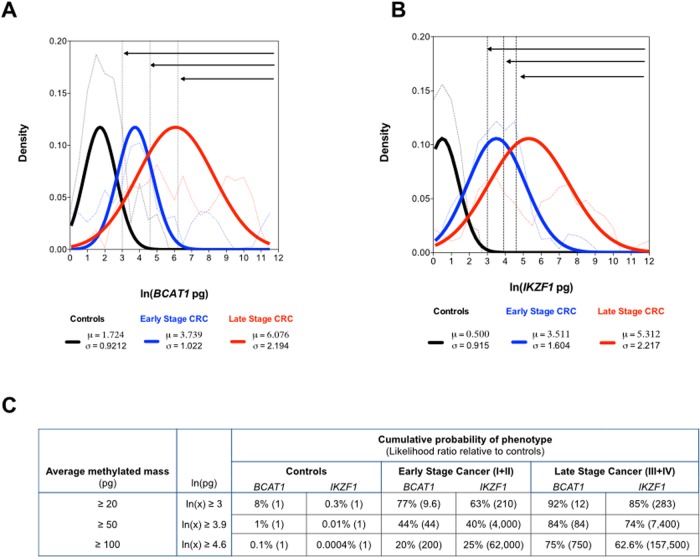
DNA yields ranged from 2 to 730 ng/mL plasma (mean 18.6ng/mL; 95% CI 11-26 ng/mL) and did not correlate with gender, age or CRC status. Methylated BCAT1 and IKZF1 DNA were detected in respectively 48 (65%) and 50 (68%) of the 74 cancers. In contrast, only 5 (4%) and 7 (5%) controls were positive for BCAT1 and IKZF1 DNA methylation, respectively. A two-gene classifier model ("either or" rule) improved segregation of CRC from controls, with 57 of 74 cancers (77%) compared to only 11 of 144 (7.6%) controls being positive for BCAT1 and/or IKZF1 DNA methylation. Increasing levels of methylated DNA were observed as CRC stage progressed.
Detection of methylated BCAT1 and/or IKZF1 DNA in plasma may have clinical application as a novel blood test for CRC. Combining the results from the two methylation-specific PCR assays improved CRC detection with minimal change in specificity. Further validation of this two-gene blood test with a view to application in screening is now indicated.
特定基因在结直肠肿瘤中高频甲基化,并可能释放入血。相对于单一标志物,检测血液中多种甲基化DNA生物标志物可能提高结直肠癌(CRC)检测的灵敏度。我们开展了一项病例对照研究,评估循环中两种甲基化DNA标志物BCAT1和IKZF1的存在情况,以确定它们对CRC检测是否具有互补性。
开发了甲基化特异性PCR检测方法,以测量从结肠镜检查确诊的144名健康对照者和74例CRC患者的血浆中提取的DNA中甲基化BCAT1和IKZF1的水平。
血浆DNA产量范围为2至730 ng/mL(平均18.6 ng/mL;95%CI 11 - 26 ng/mL),与性别、年龄或CRC状态无关。在74例癌症患者中,分别有48例(65%)和50例(68%)检测到甲基化BCAT1和IKZF1 DNA。相比之下,分别只有5例(4%)和7例(5%)对照者的BCAT1和IKZF1 DNA甲基化呈阳性。双基因分类模型(“二者其一”规则)改善了CRC与对照者的区分,74例癌症中有57例(77%)与144例对照者中仅11例(7.6%)的BCAT1和/或IKZF1 DNA甲基化呈阳性。随着CRC分期进展,观察到甲基化DNA水平升高。
检测血浆中甲基化BCAT1和/或IKZF1 DNA可能作为一种新型的CRC血液检测方法具有临床应用价值。结合两种甲基化特异性PCR检测结果可在特异性变化最小的情况下提高CRC检测率。现在需要对这种双基因血液检测进行进一步验证,以期应用于筛查。