Goto Atsushi, Noda Mitsuhiko, Matsushita Yumi, Goto Maki, Kato Masayuki, Isogawa Akihiro, Takahashi Yoshihiko, Kurotani Kayo, Oba Shino, Nanri Akiko, Mizoue Tetsuya, Yamagishi Kazumasa, Yatsuya Hiroshi, Saito Isao, Kokubo Yoshihiro, Sawada Norie, Inoue Manami, Iso Hiroyasu, Kadowaki Takashi, Tsugane Shoichiro
From the Departments of Diabetes Research, Diabetes Research Center, National Center for Global Health and Medicine, Tokyo, Japan (AG, MN, MG, MK); Department of Public Health, Tokyo Women's Medical University, Tokyo, Japan (AG); Departments of Clinical Research (YM) and Epidemiology and Prevention (KK, AN, TM), National Center for Global Health and Medicine, Tokyo, Japan; Department of Internal Medicine, Mitsui Memorial Hospital, Tokyo, Japan (AI); Division of Diabetes and Metabolism, Iwate Medical University School of Medicine, Iwate, Japan (YT); Department of Health Promotion, National Institute of Public Health, Saitama, Japan (SO); Department of Public Health Medicine, Faculty of Medicine, University of Tsukuba, Ibaraki, Japan (KY); Department of Public Health, Fujita Health University, Aichi, Japan (HY); Department of Basic Nursing and Health Science, Ehime University Graduate School of Medicine, Ehime, Japan (IS); Department of Preventive Cardiology, National Cerebral and Cardiovascular Center, Osaka, Japan (YK); Epidemiology and Prevention Group, Research Center for Cancer Prevention and Screening, National Cancer Center, Tokyo, Japan (NS, ST); AXA Department of Health and Human Security (MI) and Diabetes and Metabolic Diseases (TK), Graduate School of Medicine, The University of Tokyo, Tokyo, Japan; Public Health, Department of Social and Environmental Medicine, Osaka University Graduate School of Medicine, Osaka, Japan (HI).
Medicine (Baltimore). 2015 May;94(17):e785. doi: 10.1097/MD.0000000000000785.
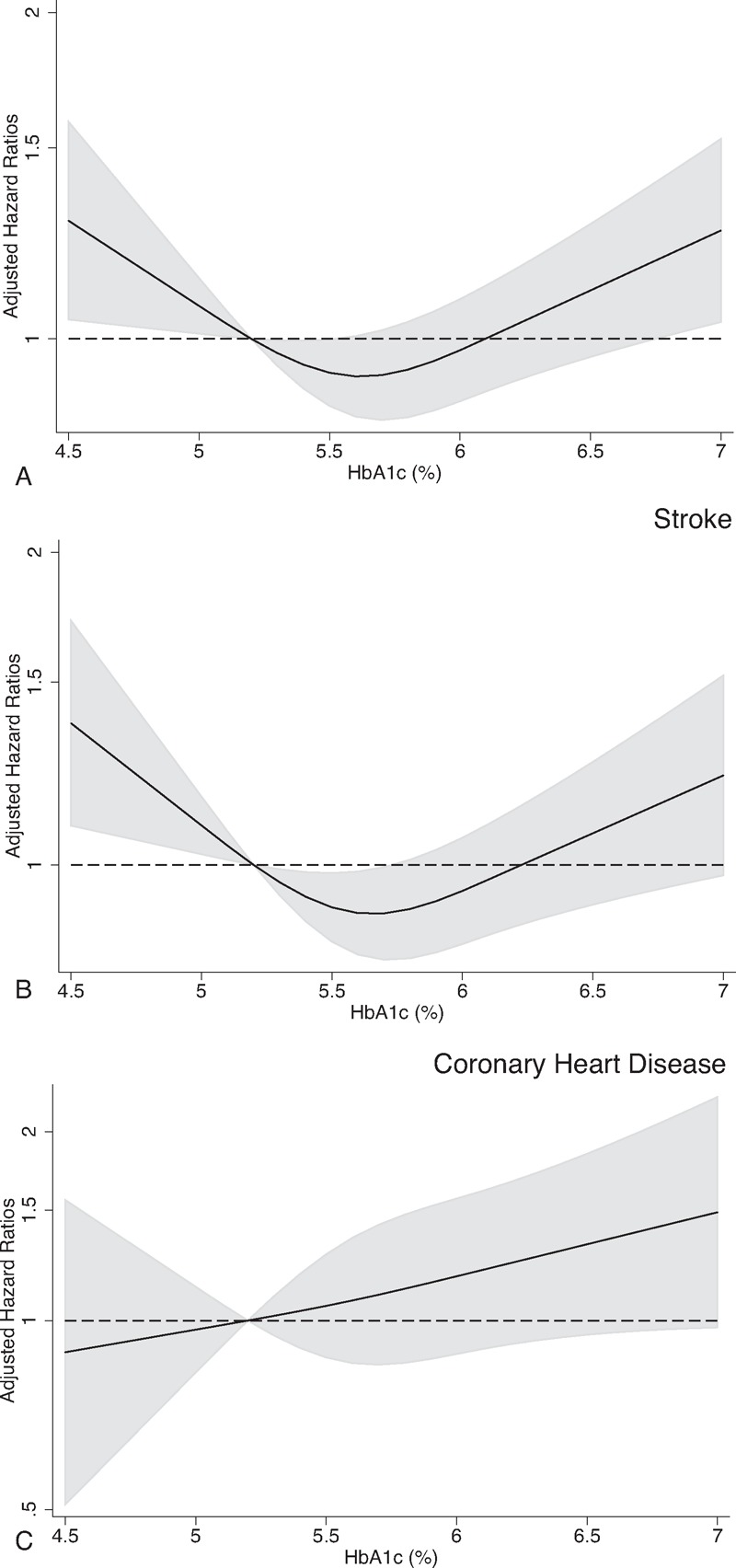
High hemoglobin A1c (HbA1c) levels are strongly associated with an increased risk of cardiovascular disease (CVD) in people with and without diabetes. However, information regarding the relationship between low HbA1c levels and the risk of CVD among people without known diabetes is limited. The aim of this large-scale, prospective, population-based cohort study was to clarify the association between HbA1c levels and CVD risk among people without known diabetes.We followed-up 10,980 men and 18,079 women (46-80 years old and free of CVD and cancer at baseline) in the Japan Public Health Center-based Prospective Study. Using Cox models, we estimated the hazard ratios for CVD risk with adjustments for age, sex, geographic areas, body mass index, smoking status, sports and physical exercise, alcohol intake, systolic blood pressure, non-high-density lipoprotein cholesterol, and high-density lipoprotein cholesterol.During the median follow-up of 9.4 years, 935 CVD events (770 strokes and 165 coronary heart diseases) occurred. We observed a nonlinear association between HbA1c levels and CVD risk in participants without known diabetes. Compared with HbA1c levels of 5.0 to 5.4% (31-36 mmol/mol), the hazard ratios for CVD in participants without known diabetes were 1.50 (95% confidence interval: 1.15-1.95), 1.01 (0.85-1.20), 1.04 (0.82-1.32), and 1.77 (1.32-2.38) for HbA1c levels of <5.0% (<31 mmol/mol), 5.5 to 5.9% (37-41 mmol/mol), 6.0 to 6.4% (42-47 mmol/mol), and ≥6.5% (≥48 mmol/mol), respectively (P value for nonlinear trend: <0.001). In addition, the hazard ratio for CVD was 1.81 (1.43-2.29) in patients with known diabetes compared with participants with HbA1c levels of 5.0 to 5.4% and without known diabetes. This nonlinear relation persisted after excluding people with kidney dysfunction, liver dysfunction, anemia, body mass index <18.5 kg/m, or early events within 3 years of follow-up (P value for nonlinear trend: <0.01 for all tests).In conclusion, both low and high levels of HbA1c were associated with a higher risk of CVD in a Japanese general population without known diabetes.
高糖化血红蛋白(HbA1c)水平与糖尿病患者及非糖尿病患者心血管疾病(CVD)风险增加密切相关。然而,关于HbA1c水平低与未患糖尿病者CVD风险之间关系的信息有限。这项大规模、前瞻性、基于人群的队列研究旨在阐明未患糖尿病者HbA1c水平与CVD风险之间的关联。我们在日本公共卫生中心前瞻性研究中对10980名男性和18079名女性(年龄46 - 80岁,基线时无CVD和癌症)进行了随访。使用Cox模型,我们在对年龄、性别、地理区域、体重指数、吸烟状况、体育锻炼、饮酒量、收缩压、非高密度脂蛋白胆固醇和高密度脂蛋白胆固醇进行调整后,估计了CVD风险的风险比。在9.4年的中位随访期内,发生了935例CVD事件(770例中风和165例冠心病)。我们在未患糖尿病的参与者中观察到HbA1c水平与CVD风险之间存在非线性关联。与HbA1c水平为5.0%至5.4%(31 - 36 mmol/mol)相比,未患糖尿病的参与者中,HbA1c水平<5.0%(<31 mmol/mol)、5.5%至5.9%(37 - 41 mmol/mol)、6.0%至6.4%(42 - 47 mmol/mol)和≥6.5%(≥48 mmol/mol)时CVD的风险比分别为1.50(95%置信区间:1.15 - 1.95)、1.01(0.85 - 1.20)、1.04(0.82 - 1.32)和1.77(1.32 - 2.38)(非线性趋势P值:<0.001)。此外,与HbA1c水平为5.0%至5.4%且未患糖尿病的参与者相比,已知糖尿病患者CVD的风险比为1.81(1.43 -