Wang Ziqian, Wang Yanhong, Zhu Rongrong, Tian Xinping, Xu Dong, Wang Qian, Wu Chanyuan, Zhang Shangzhu, Zhao Jiuliang, Zhao Yan, Li Mengtao, Zeng Xiaofeng
From the Department of Rheumatology (ZW, RZ, XT, DX, QW, CW, SZ, JZ, YZ, ML, XZ), Peking Union Medical College Hospital, Peking Union Medical College & Chinese Academy of Medical Science, Key Laboratory of Rheumatology and Clinical Immunology, Ministry of Education, ; and Department of Epidemiology and Bio-statistics (YW), Institute of Basic Medical Sciences, China Academy of Medical Sciences & Peking Union Medical College, Beijing, China.
Medicine (Baltimore). 2015 May;94(17):e794. doi: 10.1097/MD.0000000000000794.
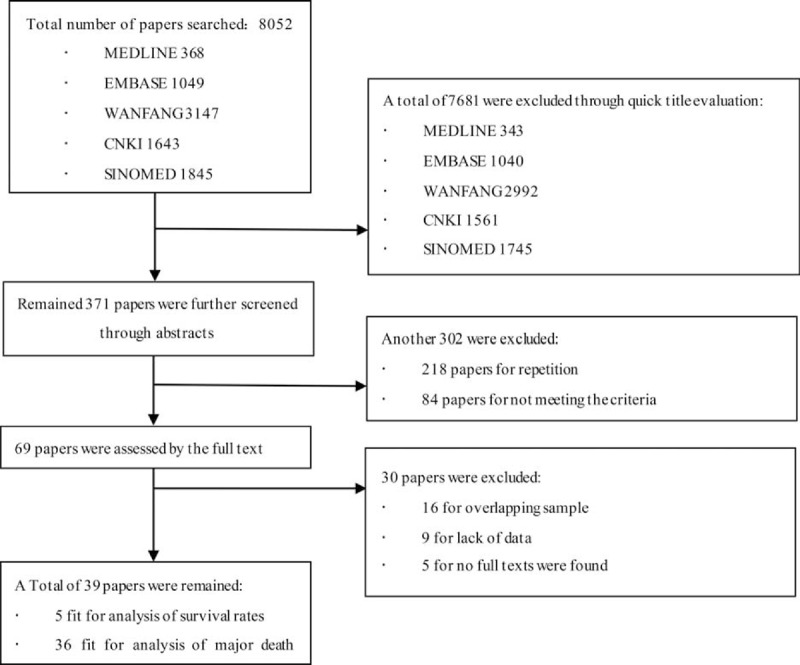
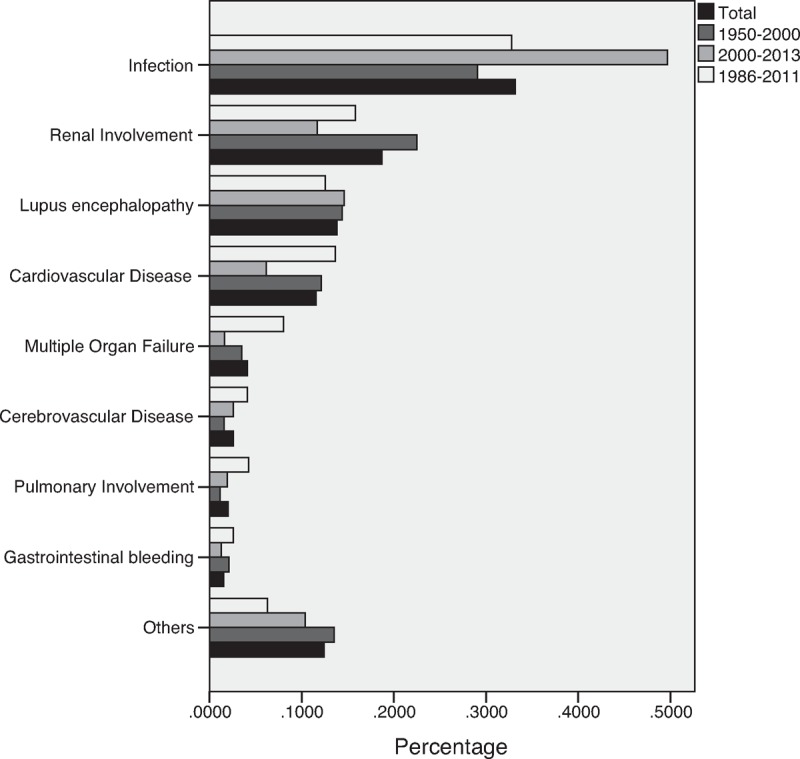
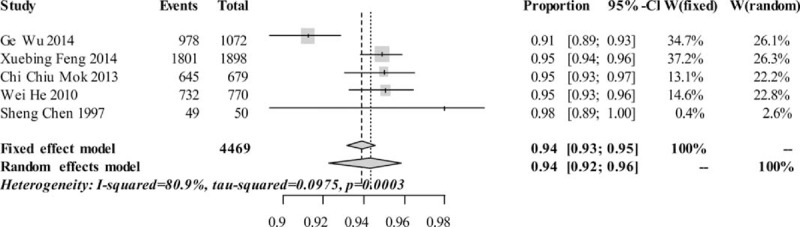
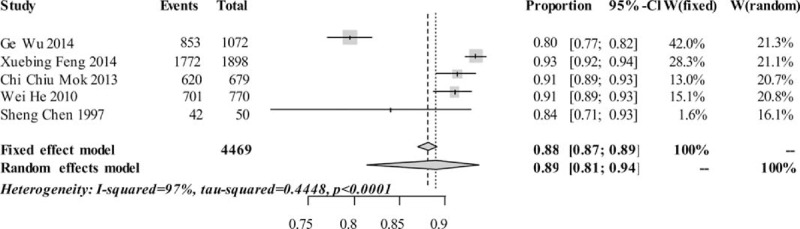
Systemic lupus erythematosus (SLE) is a chronic autoimmune disease with an increased risk of death compared to general population. Although previous studies showed improvement in survival of SLE, the long-term prognosis has not been elaborated in China.This study aims to integrate the observational studies estimating current long-term survival of Chinese SLE patients and analyze the death-cause situation of SLE in China.The study is a systemic review of English and non-English articles using MEDLINE, EMBASE, CNKI, WANFANG, and SINOMED databases. Additional studies were found by consultation with clinical experts, browse of references in selected papers, and search of related textbooks. Our major search terms were SLE, follow-up, prognosis, survival, mortality, and China.We included cohort studies for survival analysis, and both cohort studies and case series for death-cause analysis in China.The extraction of the articles were done by 2 authors independently using predesigned charts, including characteristics of study, clinical data, analyzing data, and study quality indicators.All pooled analyses were conducted both for random-effects model and fixed-effects model. Funnel plots and Egger regression tests were applied to check potential publication bias. Heterogeneity was tested by sensitivity analysis. We identified 5 studies for survival analysis comprising 4469 Chinese patients with SLE (380 observed deaths). Thirty-six studies were suitable for death-cause analysis with 2179 observed deaths (derived from more than 20,000 Chinese patients with SLE). The overall pooled survival rates for SLE in China were 94% for 5-year survival rate and 89% for 10-year survival rate after disease onset from the year 1995 to 2013, which were similar with previous publications in Asia-Pacific area. The proportions of different causes of death showed infection (33.2%), renal involvement (18.7%), lupus encephalopathy (13.8%), and cardiovascular disease (11.5%) as the top 4 causes.The overall survival rates for Chinese patients with SLE resembled previous publications in Asia-Pacific area. But the death causes of SLE in China were of some differences indicating relatively higher proportion of infection and lupus encephalopathy and lower cardiovascular disease. Ethnicity and more aggressive treatment might have contributed to the difference in death composition.
系统性红斑狼疮(SLE)是一种慢性自身免疫性疾病,与普通人群相比死亡风险增加。尽管先前的研究显示SLE患者的生存率有所改善,但中国尚未对其长期预后进行阐述。本研究旨在综合估计中国SLE患者当前长期生存率的观察性研究,并分析中国SLE的死因情况。该研究是对使用MEDLINE、EMBASE、CNKI、万方和中国生物医学文献数据库的英文和非英文文章进行的系统评价。通过咨询临床专家、浏览所选论文的参考文献以及搜索相关教科书发现了其他研究。我们的主要检索词为SLE、随访、预后、生存、死亡率和中国。我们纳入了用于生存分析的队列研究,以及用于中国死因分析的队列研究和病例系列。文章的提取由2位作者独立使用预先设计的图表进行,包括研究特征、临床数据、分析数据和研究质量指标。所有汇总分析均采用随机效应模型和固定效应模型进行。应用漏斗图和Egger回归检验来检查潜在的发表偏倚。通过敏感性分析检验异质性。我们确定了5项用于生存分析的研究,包括4469例中国SLE患者(380例观察到的死亡病例)。36项研究适合进行死因分析,有2179例观察到的死亡病例(来自20000多名中国SLE患者)。1995年至2013年发病后,中国SLE患者的总体汇总生存率为5年生存率94%,10年生存率89%,与亚太地区先前的出版物相似。不同死因的比例显示感染(33.2%)、肾脏受累(18.7%)、狼疮脑病(13.8%)和心血管疾病(11.5%)是前4大死因。中国SLE患者的总体生存率与亚太地区先前的出版物相似。但中国SLE的死因存在一些差异,表明感染和狼疮脑病的比例相对较高,心血管疾病的比例较低。种族和更积极的治疗可能导致了死亡构成的差异。