Polhemus David J, Li Zhen, Pattillo Christopher B, Gojon Gabriel, Gojon Gabriel, Giordano Tony, Krum Henry
Cardiovascular Center of Excellence, LSU Health Sciences Center, New Orleans, LA, USA.
Department of Molecular and Cellular Physiology, LSU Health Sciences Center, Shreveport, LA, USA.
Cardiovasc Ther. 2015 Aug;33(4):216-26. doi: 10.1111/1755-5922.12128.
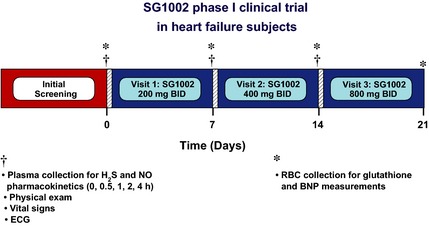
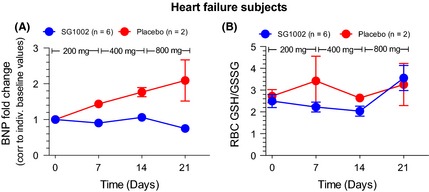
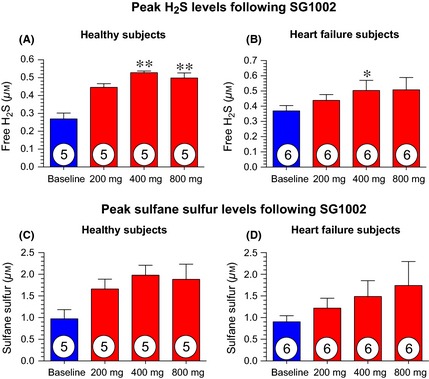
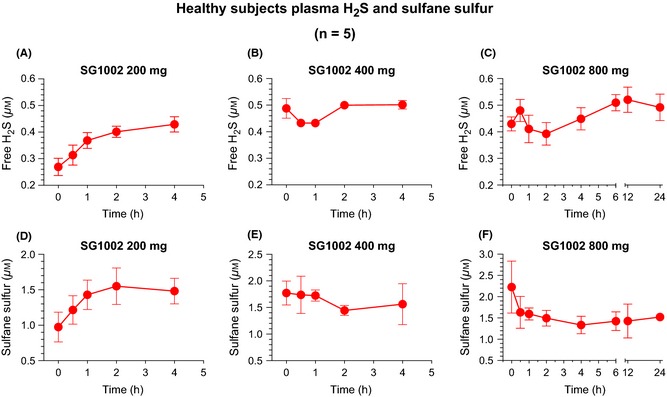
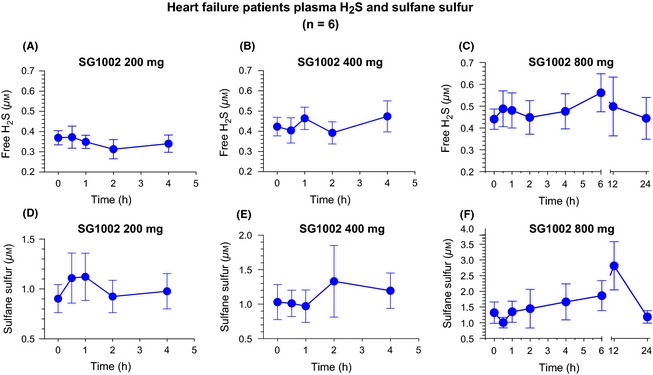
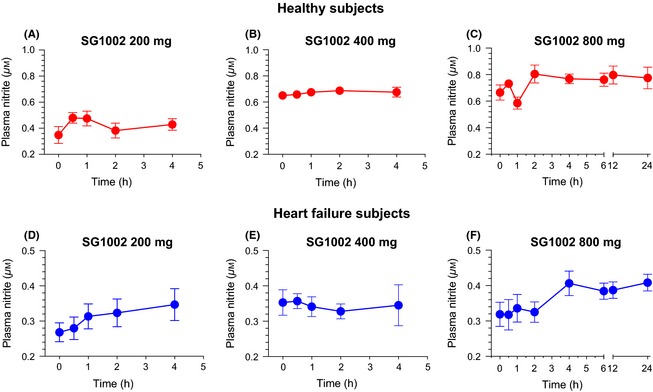
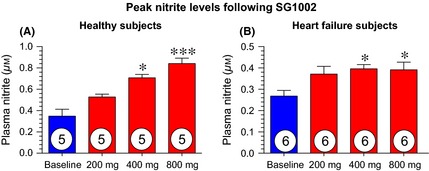
Recent studies demonstrate robust molecular cross talk and signaling between hydrogen sulfide (H2 S) and nitric oxide (NO). Heart failure (HF) patients are deficient in both H2 S and NO, two molecules that are critical for cardiovascular homeostasis. A phase I clinical trial of a novel H2 S prodrug (SG1002) was designed to assess safety and changes in H2 S and NO bioavailability in healthy and HF subjects. Healthy subjects (n = 7) and heart failure patients (n = 8) received oral SG1002 treatment in escalating dosages of 200, 400, and 800 mg twice daily for 7 days for each dose. Safety and tolerability were assessed by physical examination, vital signs, and ECG analysis. Plasma samples were collected during a 24-h period each week for H2 S and NO analysis. BNP and glutathione levels were analyzed as markers of cardiac health and redox status. Administration of SG1002 resulted in increased H2 S levels in healthy subjects. We also observed increased H2 S levels in HF subjects following 400 mg SG1002. Nitrite, a metabolite of NO, was increased in both healthy and HF patients receiving 400 mg and 800 mg SG1002. HF subjects treated with SG1002 displayed stable drug levels over the course of the trial. SG1002 was safe and well tolerated at all doses in both healthy and HF subjects. These data suggest that SG1002 increases blood H2 S levels and circulating NO bioavailability. The finding that SG1002 attenuates increases in BNP in HF patients suggests that this novel agent warrants further study in a larger clinical study.
最近的研究表明,硫化氢(H2S)和一氧化氮(NO)之间存在强大的分子相互作用和信号传导。心力衰竭(HF)患者体内的H2S和NO均不足,这两种分子对心血管稳态至关重要。一项关于新型H2S前药(SG1002)的I期临床试验旨在评估健康受试者和HF受试者中H2S和NO生物利用度的安全性及变化。健康受试者(n = 7)和心力衰竭患者(n = 8)接受口服SG1002治疗,剂量递增,分别为每日两次200、400和800 mg,每个剂量持续7天。通过体格检查、生命体征和心电图分析评估安全性和耐受性。每周在24小时内采集血浆样本进行H2S和NO分析。分析BNP和谷胱甘肽水平作为心脏健康和氧化还原状态的标志物。给予SG1002可使健康受试者体内的H2S水平升高。我们还观察到,HF受试者在服用400 mg SG1002后H2S水平升高。在接受400 mg和800 mg SG1002治疗的健康受试者和HF患者中,NO的代谢产物亚硝酸盐均增加。在试验过程中,接受SG1002治疗的HF受试者的药物水平保持稳定。SG1002在健康受试者和HF受试者的所有剂量下均安全且耐受性良好。这些数据表明,SG1002可提高血液中的H2S水平和循环中的NO生物利用度。SG1002可减轻HF患者BNP升高的这一发现表明,这种新型药物值得在更大规模的临床研究中进一步研究。