Rozera Carmela, Cappellini Giancarlo Antonini, D'Agostino Giuseppina, Santodonato Laura, Castiello Luciano, Urbani Francesca, Macchia Iole, Aricò Eleonora, Casorelli Ida, Sestili Paola, Montefiore Enrica, Monque Domenica, Carlei Davide, Napolitano Mariarosaria, Rizza Paola, Moschella Federica, Buccione Carla, Belli Roberto, Proietti Enrico, Pavan Antonio, Marchetti Paolo, Belardelli Filippo, Capone Imerio
Department of Hematology, Oncology and Molecular Medicine, Istituto Superiore di Sanità, viale Regina Elena 299, Rome, 00161, Italy.
IV Dermatology Oncology Unit, Istituto Dermopatico dell'Immacolata, Istituto di Ricovero e Cura a Carattere Scientifico (IDI-IRCCS), via Monti Creta 104, Rome, 00167, Italy.
J Transl Med. 2015 May 2;13:139. doi: 10.1186/s12967-015-0473-5.
Advanced melanoma patients have an extremely poor long term prognosis and are in strong need of new therapies. The recently developed targeted therapies have resulted in a marked antitumor effect, but most responses are partial and some degree of toxicity remain the major concerns. Dendritic cells play a key role in the activation of the immune system and have been typically used as ex vivo antigen-loaded cell drugs for cancer immunotherapy. Another approach consists in intratumoral injection of unloaded DCs that can exploit the uptake of a wider array of tumor-specific and individual unique antigens. However, intratumoral immunization requires DCs endowed at the same time with properties typically belonging to both immature and mature DCs (i.e. antigen uptake and T cell priming). DCs generated in presence of interferon-alpha (IFN-DCs), due to their features of partially mature DCs, capable of efficiently up-taking, processing and cross-presenting antigens to T cells, could successfully carry out this task. Combining intratumoral immunization with tumor-destructing therapies can induce antigen release in situ, facilitating the injected DCs in triggering an antitumor immune response.
We tested in a phase I clinical study in advanced melanoma a chemo-immunotherapy approach based on unloaded IFN-DCs injected intratumorally one day after administration of dacarbazine. Primary endpoint of the study was treatment safety and tolerability. Secondary endpoints were immune and clinical responses of patients.
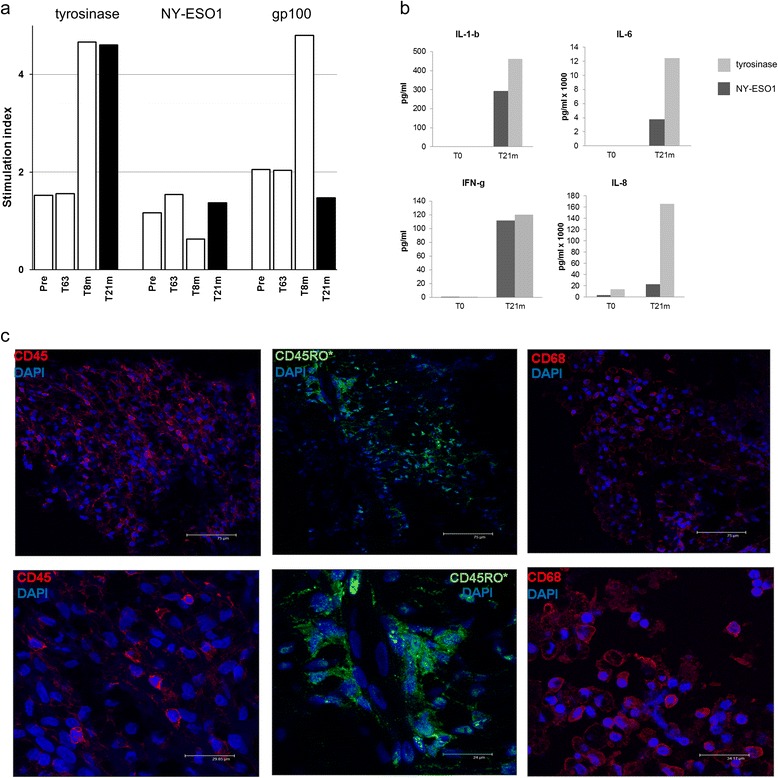
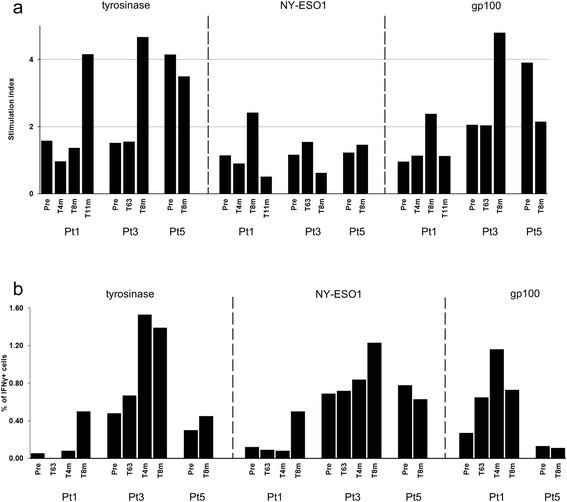
Six patients were enrolled, and only three completed the treatment. The chemo-immunotherapy was well tolerated with no major side effects. Three patients showed temporary disease stabilization and two of them showed induction of T cells specific for tyrosinase, NY-ESO-1 and gp100. Of interest, one patient showing a remarkable long-term disease stabilization kept showing presence of tyrosinase specific T cells in PBMC and high infiltration of memory T cells in the tumor lesion at 21 months.
We tested a chemo-immunotherapeutic approach based on IFN-DCs injected intratumorally one day after DTIC in advanced melanoma. The treatment was well tolerated, and clinical and immunological responses, including development of vitiligo, were observed, therefore warranting additional clinical studies aimed at evaluating efficacy of this approach.
Trial Registration Number not publicly available due to EudraCT regulations: https://www.clinicaltrialsregister.eu/doc/EU_CTR_FAQ.pdf.
晚期黑色素瘤患者的长期预后极差,急需新的治疗方法。最近开发的靶向治疗已产生显著的抗肿瘤效果,但大多数反应是部分缓解,且一定程度的毒性仍是主要问题。树突状细胞在免疫系统激活中起关键作用,通常被用作体外负载抗原的细胞药物用于癌症免疫治疗。另一种方法是瘤内注射未负载的树突状细胞,其可摄取更广泛的肿瘤特异性和个体独特抗原。然而,瘤内免疫需要树突状细胞同时具备通常属于未成熟和成熟树突状细胞的特性(即抗原摄取和T细胞启动)。在α-干扰素(IFN-DCs)存在下产生的树突状细胞,由于其部分成熟树突状细胞的特性,能够有效地摄取、处理抗原并将其交叉呈递给T细胞,可成功完成此项任务。将瘤内免疫与肿瘤破坏疗法相结合可原位诱导抗原释放,促进注射的树突状细胞触发抗肿瘤免疫反应。
我们在一项针对晚期黑色素瘤的I期临床研究中测试了一种化学免疫疗法,该方法基于在达卡巴嗪给药一天后瘤内注射未负载的IFN-DCs。该研究的主要终点是治疗安全性和耐受性。次要终点是患者的免疫和临床反应。
招募了6名患者,只有3名完成了治疗。化学免疫疗法耐受性良好,无重大副作用。3名患者出现疾病暂时稳定,其中2名患者的酪氨酸酶、NY-ESO-1和gp100特异性T细胞被诱导产生。有趣的是,一名表现出显著长期疾病稳定的患者在21个月时外周血单核细胞中仍存在酪氨酸酶特异性T细胞,且肿瘤病灶中有大量记忆T细胞浸润。
我们在晚期黑色素瘤中测试了一种基于在达卡巴嗪给药一天后瘤内注射IFN-DCs的化学免疫疗法。该治疗耐受性良好,观察到了临床和免疫反应,包括白癜风的出现,因此有必要进行更多临床研究以评估该方法的疗效。
由于欧盟临床试验数据库(EudraCT)规定,试验注册号未公开:https://www.clinicaltrialsregister.eu/doc/EU_CTR_FAQ.pdf。