Lapenta Caterina, Gabriele Lucia, Santini Stefano Maria
Department of Oncology and Molecular Medicine, Istituto Superiore di Sanità, Viale Regina Elena 299, 00161 Rome, Italy.
Vaccines (Basel). 2020 Oct 19;8(4):617. doi: 10.3390/vaccines8040617.
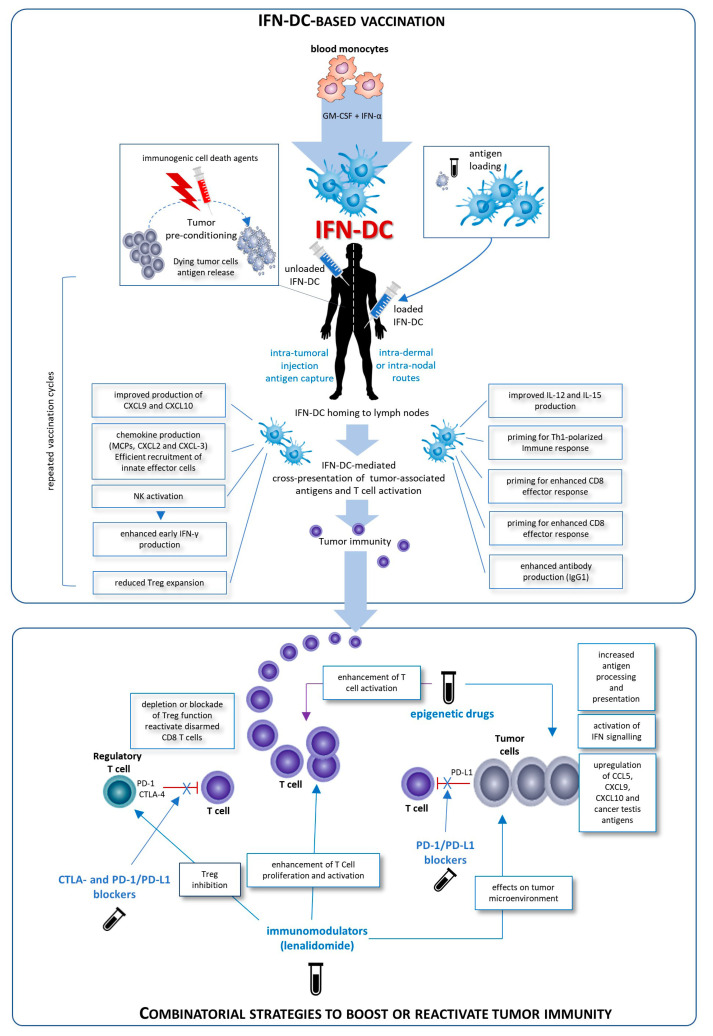
The past decade has seen tremendous developments in novel cancer therapies through targeting immune-checkpoint molecules. However, since increasing the presentation of tumor antigens remains one of the major issues for eliciting a strong antitumor immune response, dendritic cells (DC) still hold a great potential for the development of cancer immunotherapy. A considerable body of evidence clearly demonstrates the importance of the interactions of type I IFN with the immune system for the generation of a durable antitumor response through its effects on DC. Actually, highly active DC can be rapidly generated from blood monocytes in vitro in the presence of IFN-α (IFN-DC), suitable for therapeutic vaccination of cancer patients. Here we review how type I IFN can promote the ex vivo differentiation of human DC and orientate DC functions towards the priming and expansion of protective antitumor immune responses. New epigenetic elements of control on activation of the type I IFN signal will be highlighted. We also review a few clinical trials exploiting IFN-DC in cancer vaccination and discuss how IFN-DC could be exploited for the design of effective strategies of cancer immunotherapy as a monotherapy or in combination with immune-checkpoint inhibitors or immunomodulatory drugs.
在过去十年中,通过靶向免疫检查点分子,新型癌症疗法取得了巨大进展。然而,由于增加肿瘤抗原的呈递仍然是引发强烈抗肿瘤免疫反应的主要问题之一,树突状细胞(DC)在癌症免疫治疗的发展中仍具有巨大潜力。大量证据清楚地表明,I型干扰素与免疫系统的相互作用对于通过其对DC的作用产生持久的抗肿瘤反应至关重要。实际上,在IFN-α存在的情况下,可在体外从血液单核细胞快速生成高活性DC(IFN-DC),适用于癌症患者的治疗性疫苗接种。在此,我们综述I型干扰素如何促进人DC的体外分化,并使DC功能朝着启动和扩展保护性抗肿瘤免疫反应的方向发展。将重点介绍I型干扰素信号激活的新表观遗传调控元件。我们还综述了一些在癌症疫苗接种中利用IFN-DC的临床试验,并讨论了如何将IFN-DC作为单一疗法或与免疫检查点抑制剂或免疫调节药物联合用于设计有效的癌症免疫治疗策略。