Federal University of Minas Gerais UFMG, Rua Padre Rolim 769, sala 802. Bairro São Lucas, Belo Horizonte, Minas Gerais Brazil.
Department of Internal Medicine, UFMG, Belo Horizonte, Minas Gerais Brazil.
Diabetol Metab Syndr. 2014 Dec 1;6:131. doi: 10.1186/1758-5996-6-131. eCollection 2014.
To assess the presence of insulin resistance (IR) in patients with type 1 diabetes (T1DM) according to the estimated glucose disposal rate formula (eGDR) and the insulin sensitivity score (ISS) and to estimate the correlation between these two measures and identify the clinical and laboratory markers related to IR.
Cross-sectional study of adults with T1DM (n = 135). The results of the formulas that estimate IR were separated into quartiles and correlated with demographic data, clinical characteristics and laboratory parameters. We analyzed the total and regional adiposity by dual-energy X-ray absorptiometry and skin fold thickness measurements.
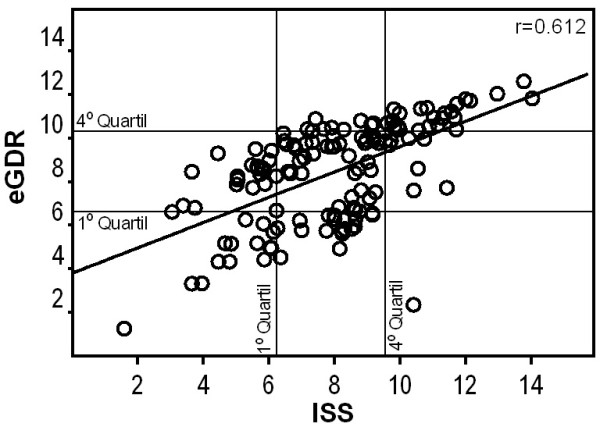
Two thirds of the patients were overweight or obese. A moderate correlation was found between eGDR and ISS (r = 0.612). The results of both formulas were positively correlated with BMI (r = -0.373 eGDR and r = -0.721 ISS), thoracic-abdominal fat (r = -0.484 eGDR and r = -0.758 ISS), waist/height ratio (r = -0.537 eGDR and r = -0.779 ISS), subscapular skinfold (mm) (r = -0.356 eGDR and r = -0.569 ISS), total dose insulin IU/lean mass (kg) (r = -0.279 eGDR and r = -0.398 ISS), age (years) (r = -0.495 eGDR and r = -0.190 ISS) and diabetes duration (years) (r = -0.428 eGDR and r = -0.187 ISS). A moderate agreement (Kappa 0.226) was observed between the 1st quartile of results determined by the formulas in 10.4% of the patients, but the 4th quartile presented a strong correlation (Kappa 0.679). The individuals with IR that were classified in the 1st quartile by the ISS formula had a higher chance of presenting with acanthosis nigricans (OR = 5.58, 95% CI =1.46-21.3).
The correlations found in this study indicate the possibility of using clinical and laboratory data to estimate IR in patients with TDM1. The detection of IR in T1DM patients may allow early intervention and possibly impact on future diabetes complications.
根据估计的葡萄糖清除率公式(eGDR)和胰岛素敏感性评分(ISS)评估 1 型糖尿病(T1DM)患者的胰岛素抵抗(IR)的存在,并评估这两种方法之间的相关性,以及确定与 IR 相关的临床和实验室标志物。
这是一项对 135 名成人 T1DM 患者的横断面研究。将估计 IR 的公式的结果分为四分位数,并与人口统计学数据、临床特征和实验室参数相关联。我们通过双能 X 射线吸收法和皮褶厚度测量来分析总脂肪和局部脂肪。
三分之二的患者超重或肥胖。eGDR 和 ISS 之间存在中度相关性(r=0.612)。两种公式的结果均与 BMI(r=-0.373eGDR 和 r=-0.721ISS)、胸腹部脂肪(r=-0.484eGDR 和 r=-0.758ISS)、腰围/身高比(r=-0.537eGDR 和 r=-0.779ISS)、肩胛下皮褶厚度(mm)(r=-0.356eGDR 和 r=-0.569ISS)、单位质量瘦体重胰岛素剂量(IU/kg)(r=-0.279eGDR 和 r=-0.398ISS)、年龄(岁)(r=-0.495eGDR 和 r=-0.190ISS)和糖尿病病程(年)(r=-0.428eGDR 和 r=-0.187ISS)呈正相关。在 10.4%的患者中,两种公式第 1 四分位数的结果之间观察到中度一致性(Kappa 0.226),但第 4 四分位数呈强相关性(Kappa 0.679)。根据 ISS 公式分类为第 1 四分位数的 IR 患者,出现黑棘皮病的可能性更高(OR=5.58,95%CI=1.46-21.3)。
本研究发现的相关性表明,使用临床和实验室数据可以估计 TDM1 患者的 IR。在 T1DM 患者中检测 IR 可能允许早期干预,并可能影响未来的糖尿病并发症。