Rhoades Galena K, Stanley Scott M, Markman Howard J, Allen Elizabeth S
Department of Psychology, University of Denver.
Department of Psychology, University of Colorado Denver.
J Fam Psychol. 2015 Jun;29(3):500-6. doi: 10.1037/fam0000081. Epub 2015 May 4.
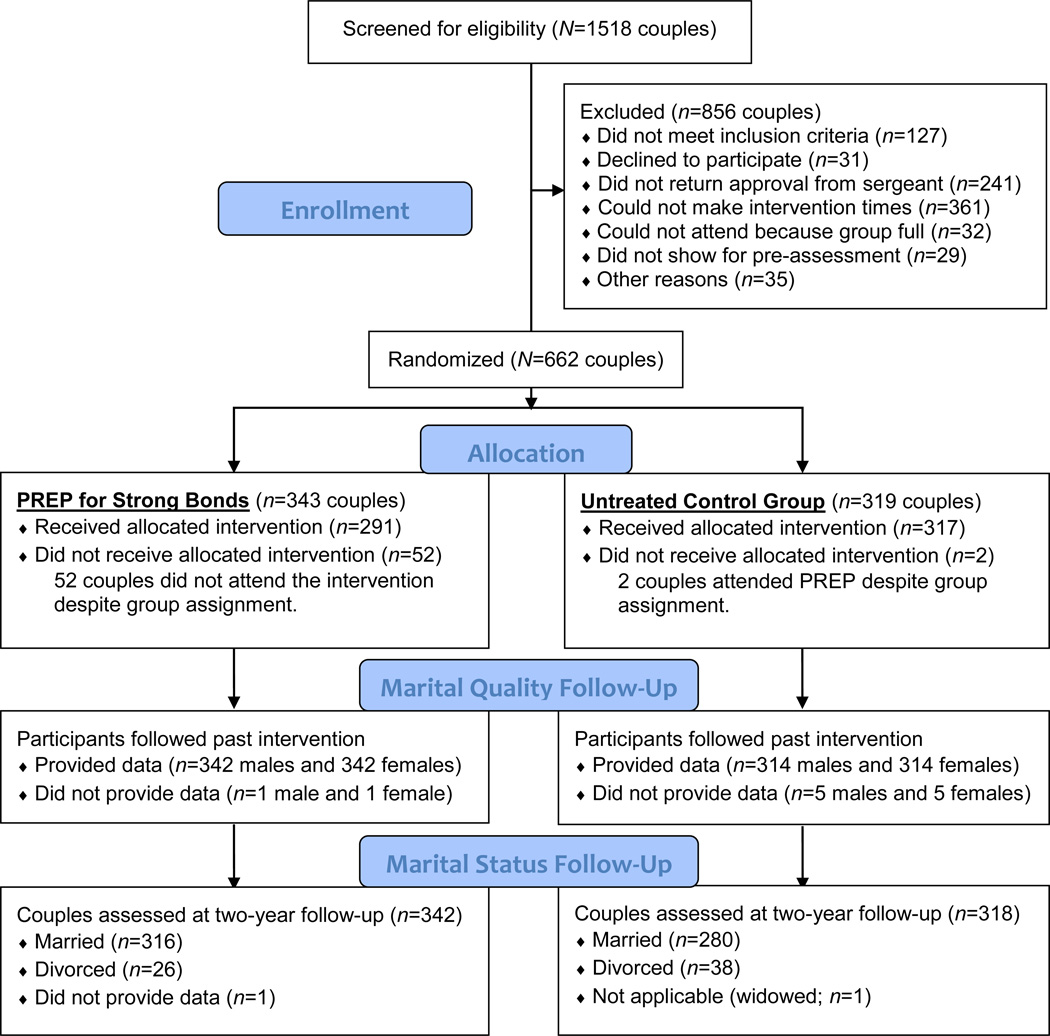
This study tested whether relationship education (i.e., the Prevention and Relationship Education Program; PREP) can mitigate the risk of having cohabited before making a mutual commitment to marry (i.e., "precommitment cohabitation") for marital distress and divorce. Using data from a study of PREP for married couples in the U.S. Army (N = 662 couples), we found that there was a significant association between precommitment cohabitation and lower marital satisfaction and dedication before random assignment to intervention. After intervention, this precommitment cohabitation effect was only apparent in the control group. Specifically, significant interactions between intervention condition and cohabitation history indicated that for the control group, but not the PREP group, precommitment cohabitation was associated with lower dedication as well as declines in marital satisfaction and increases in negative communication over time. Furthermore, those with precommitment cohabitation were more likely to divorce by the 2-year follow-up only in the control group; there were no differences in divorce based on premarital cohabitation history in the PREP group. These findings are discussed in light of current research on cohabitation and relationship education; potential implications are also considered.
本研究检验了关系教育(即预防与关系教育项目;PREP)是否能够降低在做出相互结婚承诺之前同居(即“婚前承诺同居”)对婚姻困扰和离婚的风险。利用来自美国陆军已婚夫妇PREP研究的数据(N = 662对夫妇),我们发现,在随机分配到干预组之前,婚前承诺同居与较低的婚姻满意度和婚姻投入之间存在显著关联。干预后,这种婚前承诺同居效应仅在对照组中明显。具体而言,干预条件与同居历史之间的显著交互作用表明,对于对照组而非PREP组,婚前承诺同居与较低的婚姻投入以及随着时间推移婚姻满意度下降和负面沟通增加有关。此外,只有在对照组中,有婚前承诺同居经历的人在2年随访时更有可能离婚;PREP组中基于婚前同居历史的离婚情况没有差异。根据当前关于同居和关系教育的研究对这些发现进行了讨论;还考虑了潜在的影响。