Liu Yu, Zhou Rong, Yuan Xun, Han Na, Zhou Si, Xu Hanxiao, Guo Mingzhou, Yu Shiying, Zhang Cuntai, Yin Tiejun, Wu Kongming
Department of Geriatrics, Tongji Hospital of Tongji Medical College, Huazhong University of Science and Technology, Wuhan, P.R. China.
Department of Oncology, Tongji Hospital of Tongji Medical College, Huazhong University of Science and Technology, Wuhan, P.R. China.
Oncotarget. 2015 Apr 20;6(11):8621-34. doi: 10.18632/oncotarget.3281.
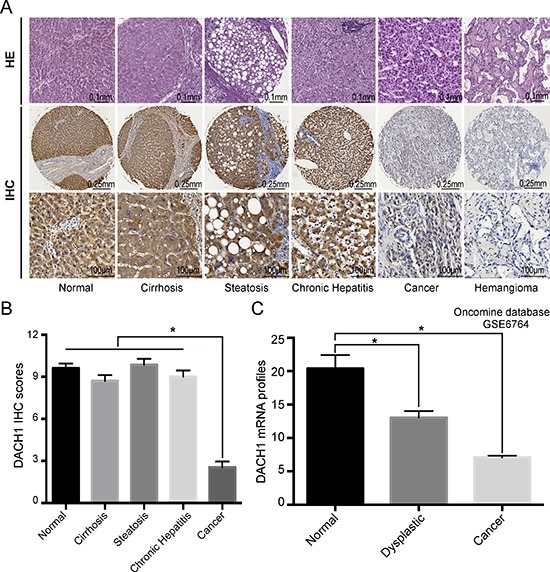
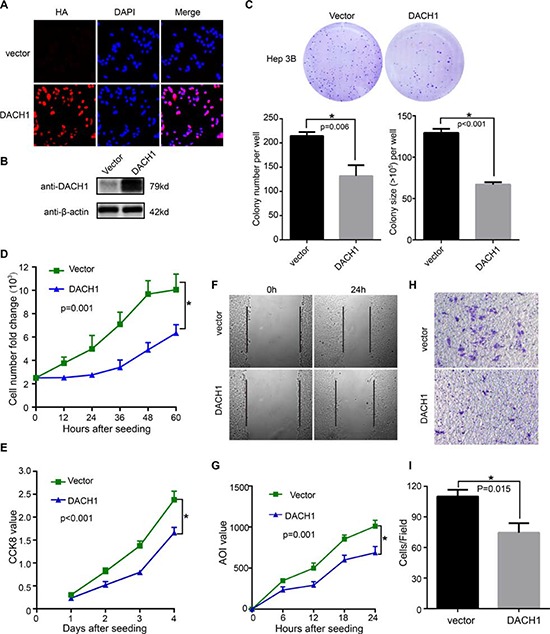
The cell fate determination factor Dachshund (DACH1) functions as a novel suppressor in the progression of various neoplasms. Previous study has suggested that hypermethylation of promoter region was responsible for the reduction of DACH1 expression in hepatocellular carcinoma (HCC), and associated with the progression of HCC, but the clinical significance and the exact molecular mechanisms of DACH1 in the progression of HCC remain unclear. In this study, we employed public microarray data analysis and tissue microarrays (TMAs) technologies and showed that DACH1 expression was reduced in HCC even at early stage and associated with the tumor progression. Notably, Kaplan-Meier analysis further indicated DACH1 could be an independent prognostic factor for the overall survival of HCC. Further, mechanistic studies revealed that overexpression of DACH1 inhibited the growth and migration of HCC cell line, which were dependent in part on the inactivation of Wnt pathway via phosphorylation of GSK3β to suppress β-catenin. In agreement, the abundance of DACH1 was inversely correlated with several Wnt target genes. Collectively, our study indicated β-catenin is a novel target of DACH1 in HCC.
细胞命运决定因子腊肠犬基因(DACH1)在多种肿瘤进展过程中作为一种新型抑制因子发挥作用。先前的研究表明,启动子区域的高甲基化是导致肝细胞癌(HCC)中DACH1表达降低的原因,且与HCC的进展相关,但DACH1在HCC进展中的临床意义及确切分子机制仍不清楚。在本研究中,我们采用公共微阵列数据分析和组织芯片(TMAs)技术,结果显示即使在HCC早期阶段,DACH1表达也会降低,且与肿瘤进展相关。值得注意的是,Kaplan-Meier分析进一步表明,DACH1可能是HCC总体生存的独立预后因素。此外,机制研究表明,DACH1的过表达抑制了HCC细胞系的生长和迁移,这部分依赖于通过GSK3β磷酸化使Wnt通路失活来抑制β-连环蛋白。与此一致的是,DACH1丰度与多个Wnt靶基因呈负相关。总体而言,我们的研究表明β-连环蛋白是DACH1在HCC中的一个新靶点。