Boleij Annemarie, Tops Bastiaan B J, Rombout Paul D M, Dequeker Elizabeth M, Ligtenberg Marjolijn J L, van Krieken J Han
Department of Pathology, Radboud University Medical Center, Nijmegen, The Netherlands.
Department of Human Genetics, Radboud University Medical Center, Nijmegen, The Netherlands.
Oncotarget. 2015 Jun 20;6(17):15681-9. doi: 10.18632/oncotarget.3804.
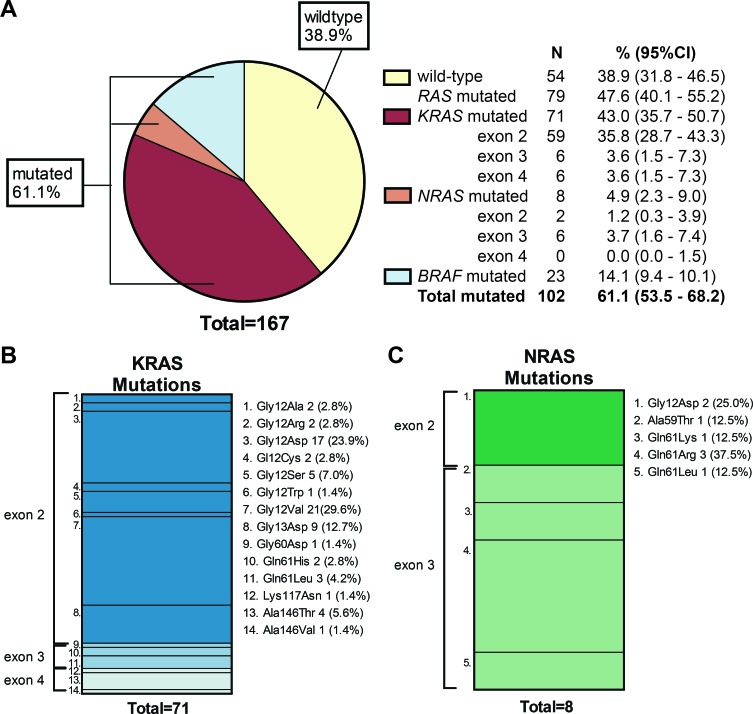
In 2013 the European Medicine Agency (EMA) restricted the indication for anti-EGFR targeted therapy to metastatic colorectal cancer (mCRC) with a wild-type RAS gene, increasing the need for reliable RAS mutation testing. We evaluated the completeness and reproducibility of RAS-testing in the Netherlands. From 17 laboratories, tumor DNA of the first 10 CRC cases tested in 2014 in routine clinical practice was re-tested by a reference laboratory using a custom next generation sequencing panel. In total, 171 CRC cases were re-evaluated for hotspot mutations in KRAS, NRAS and BRAF. Most laboratories had introduced complete RAS-testing (65%) and BRAF-testing (71%) by January 2014. The most employed method for all hotspot regions was Sanger sequencing (range 35.7 - 49.2%). The reference laboratory detected all mutations that had been found in the participating laboratories (n = 92), plus 10 additional mutations. This concerned three RAS and seven BRAF mutations that were missed due to incomplete testing of the participating laboratory. Overall, the concordance of tests performed by both the reference and participating laboratory was 100% (163/163; κ-static 1.0) for RAS and 100% (144/144; κ-static 1.0) for BRAF. Our study shows that RAS and BRAF mutations can be reproducibly assessed using a variety of testing methods.
2013年,欧洲药品管理局(EMA)将抗表皮生长因子受体(EGFR)靶向治疗的适应症限制为具有野生型RAS基因的转移性结直肠癌(mCRC),这增加了对可靠的RAS突变检测的需求。我们评估了荷兰RAS检测的完整性和可重复性。从17个实验室收集了2014年在常规临床实践中检测的前10例结直肠癌病例的肿瘤DNA,由一家参考实验室使用定制的下一代测序平台进行重新检测。总共对171例结直肠癌病例的KRAS、NRAS和BRAF热点突变进行了重新评估。到2014年1月,大多数实验室已引入完整的RAS检测(65%)和BRAF检测(71%)。所有热点区域最常用的方法是桑格测序(范围为35.7 - 49.2%)。参考实验室检测到了参与实验室中发现的所有突变(n = 92),另外还检测到10个突变。这涉及3个RAS突变和7个BRAF突变,这些突变因参与实验室检测不完整而被遗漏。总体而言,参考实验室和参与实验室进行的检测在RAS方面的一致性为100%(163/163;κ统计量1.0),在BRAF方面的一致性为100%(144/144;κ统计量1.0)。我们的研究表明,使用多种检测方法可以可重复地评估RAS和BRAF突变。