Moreira Wilfried, Ngan Grace J Y, Low Jian Liang, Poulsen Anders, Chia Brian C S, Ang Melgious J Y, Yap Amelia, Fulwood Justina, Lakshmanan Umayal, Lim Jolander, Khoo Audrey Y T, Flotow Horst, Hill Jeffrey, Raju Ravikiran M, Rubin Eric J, Dick Thomas
Department of Microbiology, Yong Loo Lin School of Medicine, National University Health System, National University of Singapore, Singapore.
Experimental Therapeutics Center, Agency for Science, Technology and Research (A*STAR), Singapore.
mBio. 2015 May 5;6(3):e00253-15. doi: 10.1128/mBio.00253-15.
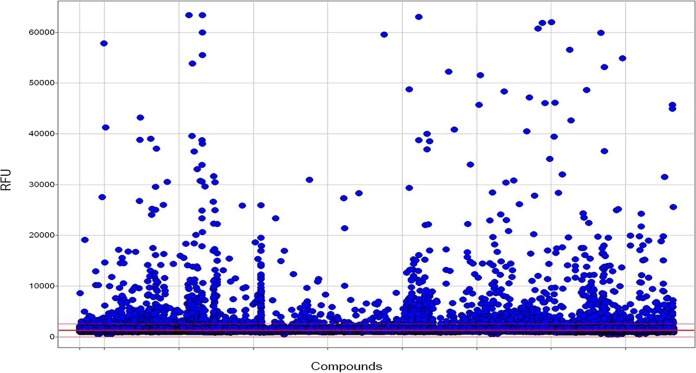
A novel type of antibacterial screening method, a target mechanism-based whole-cell screening method, was developed to combine the advantages of target mechanism- and whole-cell-based approaches. A mycobacterial reporter strain with a synthetic phenotype for caseinolytic protease (ClpP1P2) activity was engineered, allowing the detection of inhibitors of this enzyme inside intact bacilli. A high-throughput screening method identified bortezomib, a human 26S proteasome drug, as a potent inhibitor of ClpP1P2 activity and bacterial growth. A battery of secondary assays was employed to demonstrate that bortezomib indeed exerts its antimicrobial activity via inhibition of ClpP1P2: Down- or upmodulation of the intracellular protease level resulted in hyper- or hyposensitivity of the bacteria, the drug showed specific potentiation of translation error-inducing aminoglycosides, ClpP1P2-specific substrate WhiB1 accumulated upon exposure, and growth inhibition potencies of bortezomib derivatives correlated with ClpP1P2 inhibition potencies. Furthermore, molecular modeling showed that the drug can bind to the catalytic sites of ClpP1P2. This work demonstrates the feasibility of target mechanism-based whole-cell screening, provides chemical validation of ClpP1P2 as a target, and identifies a drug in clinical use as a new lead compound for tuberculosis therapy.
During the last decade, antibacterial drug discovery relied on biochemical assays, rather than whole-cell approaches, to identify molecules that interact with purified target proteins derived by genomics. This approach failed to deliver antibacterial compounds with whole-cell activity, either because of cell permeability issues that medicinal chemistry cannot easily fix or because genomic data of essentiality insufficiently predicted the vulnerability of the target identified. As a consequence, the field largely moved back to a whole-cell approach whose main limitation is its black-box nature, i.e., that it requires trial-and-error chemistry because the cellular target is unknown. We developed a novel type of antibacterial screening method, target mechanism-based whole-cell screening, to combine the advantages of both approaches. We engineered a mycobacterial reporter strain with a synthetic phenotype allowing us to identify inhibitors of the caseinolytic protease (ClpP1P2) inside the cell. This approach identified bortezomib, an anticancer drug, as a specific inhibitor of ClpP1P2. We further confirmed the specific "on-target" activity of bortezomib by independent approaches including, but not limited to, genetic manipulation of the target level (over- and underexpressing strains) and by establishing a dynamic structure-activity relationship between ClpP1P2 and growth inhibition. Identifying an "on-target" compound is critical to optimize the efficacy of the compound without compromising its specificity. This work demonstrates the feasibility of target mechanism-based whole-cell screening methods, validates ClpP1P2 as a druggable target, and delivers a lead compound for tuberculosis therapy.
开发了一种新型抗菌筛选方法,即基于靶点机制的全细胞筛选方法,以结合基于靶点机制和全细胞方法的优点。构建了一种具有酪蛋白水解蛋白酶(ClpP1P2)活性合成表型的分枝杆菌报告菌株,可检测完整杆菌内该酶的抑制剂。一种高通量筛选方法确定硼替佐米(一种人类26S蛋白酶体药物)是ClpP1P2活性和细菌生长的有效抑制剂。采用一系列二次试验来证明硼替佐米确实通过抑制ClpP1P2发挥其抗菌活性:细胞内蛋白酶水平的下调或上调导致细菌的超敏或低敏,该药物显示出诱导翻译错误的氨基糖苷类药物的特异性增强作用,暴露后ClpP1P2特异性底物WhiB1积累,硼替佐米衍生物的生长抑制效力与ClpP1P2抑制效力相关。此外,分子建模表明该药物可与ClpP1P2的催化位点结合。这项工作证明了基于靶点机制的全细胞筛选的可行性,为ClpP1P2作为靶点提供了化学验证,并确定了一种临床使用的药物作为结核病治疗的新先导化合物。
在过去十年中,抗菌药物发现依赖于生化试验而非全细胞方法来识别与通过基因组学获得的纯化靶蛋白相互作用的分子。这种方法未能提供具有全细胞活性的抗菌化合物,要么是因为药物化学难以解决的细胞通透性问题,要么是因为必需性的基因组数据未能充分预测所鉴定靶点的脆弱性。因此,该领域在很大程度上又回到了全细胞方法,其主要局限性在于其黑箱性质,即由于细胞靶点未知,需要反复试验的化学方法。我们开发了一种新型抗菌筛选方法,即基于靶点机制的全细胞筛选,以结合两种方法的优点。我们构建了一种具有合成表型的分枝杆菌报告菌株,使我们能够识别细胞内酪蛋白水解蛋白酶(ClpP1P2)的抑制剂。这种方法确定抗癌药物硼替佐米是ClpP1P2的特异性抑制剂。我们通过包括但不限于对靶点水平进行基因操作(过表达和低表达菌株)以及建立ClpP1P2与生长抑制之间的动态构效关系等独立方法,进一步证实了硼替佐米的特异性“靶向”活性。识别“靶向”化合物对于在不影响其特异性的情况下优化化合物的疗效至关重要。这项工作证明了基于靶点机制的全细胞筛选方法的可行性,验证了ClpP1P2作为可成药靶点,并提供了一种结核病治疗的先导化合物。