Barbieri Elena, Agostini Deborah, Polidori Emanuela, Potenza Lucia, Guescini Michele, Lucertini Francesco, Annibalini Giosuè, Stocchi Laura, De Santi Mauro, Stocchi Vilberto
Department of Biomolecular Sciences, Division of Exercise and Health Sciences, University of Urbino Carlo Bo, Via A. Saffi 2, 61029 Urbino, Italy.
Department of Biomedicine and Prevention, University of Tor Vergata, Via Montpellier 1, 00133 Rome, Italy.
Oxid Med Cell Longev. 2015;2015:917085. doi: 10.1155/2015/917085. Epub 2015 Apr 5.
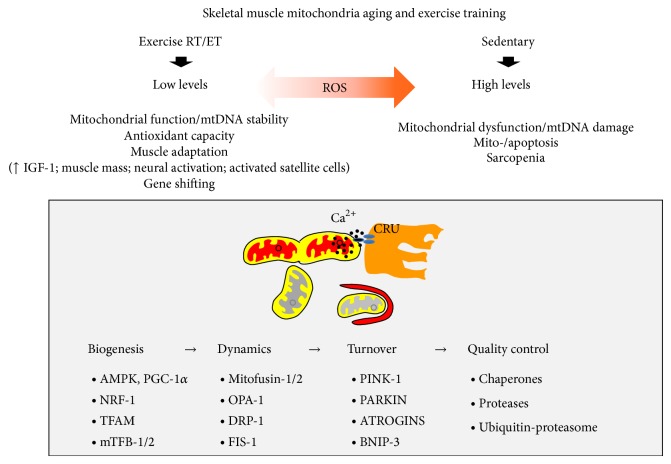
Decline in human muscle mass and strength (sarcopenia) is one of the principal hallmarks of the aging process. Regular physical exercise and training programs are certain powerful stimuli to attenuate the physiological skeletal muscle alterations occurring during aging and contribute to promote health and well-being. Although the series of events that led to these muscle adaptations are poorly understood, the mechanisms that regulate these processes involve the "quality" of skeletal muscle mitochondria. Aerobic/endurance exercise helps to maintain and improve cardiovascular fitness and respiratory function, whereas strength/resistance-exercise programs increase muscle strength, power development, and function. Due to the different effect of both exercises in improving mitochondrial content and quality, in terms of biogenesis, dynamics, turnover, and genotype, combined physical activity programs should be individually prescribed to maximize the antiaging effects of exercise.
人类肌肉质量和力量的下降(肌肉减少症)是衰老过程的主要标志之一。定期进行体育锻炼和训练计划是减轻衰老过程中发生的生理性骨骼肌改变并有助于促进健康和幸福的有力刺激因素。尽管导致这些肌肉适应的一系列事件尚不清楚,但调节这些过程的机制涉及骨骼肌线粒体的“质量”。有氧/耐力运动有助于维持和改善心血管健康和呼吸功能,而力量/抗阻运动计划则可增加肌肉力量、力量发展和功能。由于这两种运动在改善线粒体含量和质量方面(在生物发生、动力学、更新和基因型方面)具有不同的效果,因此应根据个人情况制定综合体育活动计划,以最大限度地发挥运动的抗衰老作用。