Antonova Elena, Chadwick Paul, Kumari Veena
Department of Psychology, Institute of Psychiatry, Psychology and Neuroscience, King's College London, London, United Kingdom.
Department of Psychology, Institute of Psychiatry, Psychology and Neuroscience, King's College London, London, United Kingdom; National Institute of Health Research (NIHR) Biomedical Research Centre for Mental Health, South London and Maudsley National Health Services Trust, London, United Kingdom.
PLoS One. 2015 May 6;10(5):e0123512. doi: 10.1371/journal.pone.0123512. eCollection 2015.
Mindfulness as a mode of sustained and receptive attention promotes openness to each incoming stimulus, even if repetitive and/or aversive. Mindful attention has been shown to attenuate sensory habituation in expert meditators; however, others were not able to replicate this effect. The present study used acoustic startle reflex to investigate the effect of mindfulness practice intensity on sensory habituation.
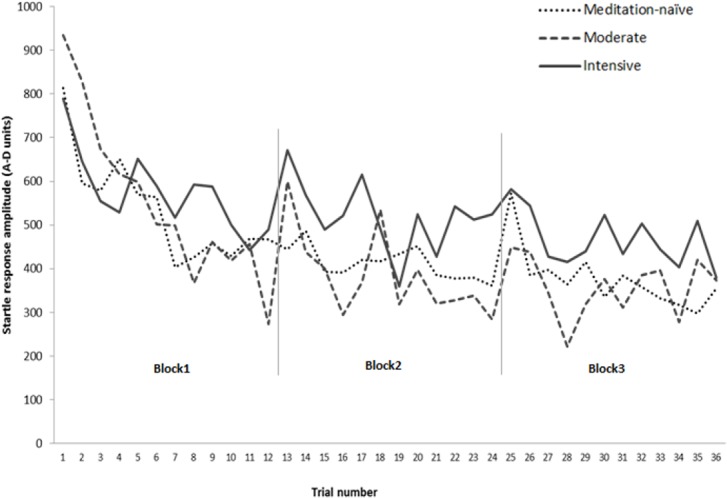
Auditory Startle Response (ASR) to 36 startling probes (12 trials x 3 block with 40 ms inter-block intervals), was measured using electromyography (EMG) in three groups of participants (N = 12/group): meditation-naïve, moderate practice, and intensive practice.
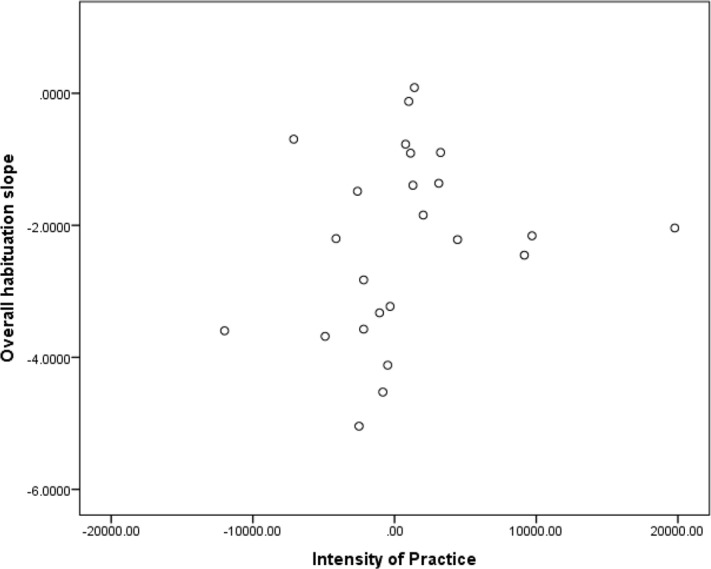
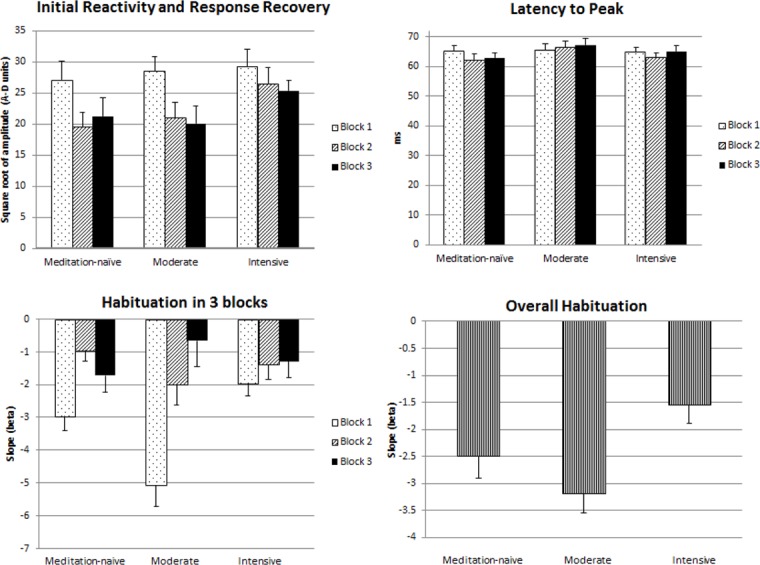
Intensive practice group showed attenuated startle habituation as evidenced by significantly less habituation over the entire experiment relative to the meditation-naïve and moderate practice groups. Furthermore, there was a significant linear effect showing between-block habituation in meditation-naïve and moderate practice groups, but not in the intensive practice group. However, the Block x Group interaction between the intensive practice and the meditation-naive groups was not significant. Moderate practice group was not significantly different from the meditation-naïve in the overall measure of habituation, but showed significantly stronger habituation than both meditation-naïve and intensive practice groups in Block 1. Greater practice intensity was significantly correlated with slower overall habituation and habituation rate in Blocks 2 and 3 in the intensive, but not in the moderate, practice group.
The study provides tentative evidence that intensive mindfulness practice attenuates acoustic startle habituation as measured by EMG, but the effect is modest.Moderate practice, on the other hand, appears to enhance habituation, suggesting the effect of mindfulness practice on startle habituation might be non-linear [corrected] . Better understanding of the effect of mindful attention on startle habituation may shed new light on sensory information processing capacity of the human brain and its potential for de-automatisation of hard-wired processes.
正念作为一种持续且专注的注意力模式,能促进对每个传入刺激的开放性,即便该刺激具有重复性和/或令人厌恶。已有研究表明,正念注意力可减弱专业冥想者的感觉习惯化;然而,其他研究未能重复这一效果。本研究采用听觉惊吓反射来探究正念练习强度对感觉习惯化的影响。
通过肌电图(EMG)测量三组参与者(每组N = 12)对36次惊吓探测音(12次试验×3个组块,组块间隔40毫秒)的听觉惊吓反应(ASR):未接触过冥想者、适度练习者和高强度练习者。
高强度练习组表现出惊吓习惯化减弱,这体现在相对于未接触过冥想者和适度练习组,在整个实验过程中习惯化显著减少。此外,存在显著的线性效应,表明未接触过冥想者和适度练习组在组块间有习惯化现象,而高强度练习组没有。然而,高强度练习组与未接触过冥想者组之间的组块×组间交互作用不显著。适度练习组在习惯化的总体测量上与未接触过冥想者组无显著差异,但在第1个组块中比未接触过冥想者组和高强度练习组表现出更强的习惯化。在高强度练习组而非适度练习组中,更大的练习强度与第2和第3个组块中总体习惯化和习惯化速率的减慢显著相关。
该研究提供了初步证据,表明高强度正念练习可减弱肌电图测量的听觉惊吓习惯化,但效果不明显。另一方面,适度练习似乎增强了习惯化,这表明正念练习对惊吓习惯化的影响可能是非线性的[已修正]。更好地理解正念注意力对惊吓习惯化的影响可能会为人类大脑的感觉信息处理能力及其对固有过程去自动化的潜力带来新的启示。